In Greenfield this spring, an entity long thought extinct has made an impressive return. In a collaboration between a local financial institution and a local architecture firm, a handsome bank building was built that enhances the neighborhood in which it stands.
Walk down any main street of any sizeable downtown in the Pioneer Valley and chances are that among the most impressive and imposing edifices will be those of banks from a century or more ago. Many were built in the Beaux Arts style—stone pillars, arches, cornices, often heavily adorned with classic sculpture. Some later ones included Deco design flares. Inside were opulent spaces full of light, spaces that inspired trust. Business transactions done in them felt somehow elevated above the crassness of the cold, hard cash involved.
For the most part, though, through a hundred years of booms and busts, the vaults in these banks have long since been emptied. Some stand derelict; many been co-opted by art galleries, jewelry stores, or other businesses whose owners appreciated and sought to capitalize on the architectural grandeur of yesteryear.
While many of our local banks regularly invest financially in their communities, and whereas most have proved reliable stewards of our wealth during these difficult financial times, it has been a long time since any bank—local or not—has attempted to build anything in our Valley that aspires to be a physical manifestation of its philosophy and devotion to the neighborhood it does business in.
Or, to put it more bluntly, most bank buildings built in the last 50 years or more seem cheap and ugly compared to what came before. Instead of inspiring confidence and awe, they are as bland and homogenized as the rest of strip-mall America has become.
Instead of works of art, the buildings are often adorned with Disney-like reproductions of “olde New England:” a faux-copper weathervane or a cupola stuck on top of asphalt shingles and vinyl siding. In some cases, pillars are erected in front of a new bank, seemingly trying to camouflage what is otherwise a mundane construction.
In part, this architectural regression has been due to a change in banking habits. Instead of having one central office everyone made their way to, today’s banks pride themselves on convenience and being ubiquitous. They require drive-through access. Like monolithic tombstones on a plot of mowed grass no one will ever walk on, automatic teller machines have popped up everywhere.
And as more and more customers bring their banking online, the less and less likely it has seemed that any bank would attempt to reverse this bleak trend.
Then, early last year, Greenfield Savings Bank decided to invest in replacing and improving its drive-through banking building, located on Federal Street in the parking lot behind its Main Street headquarters.
*
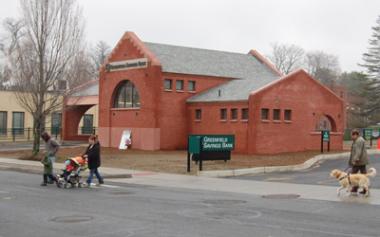
Approached from Main Street, the building looks something like a bulldog—small, compact and burly. You’re presented a simple fa?ade of red brick with a grey peaked roof, but instead of a door in the center and two windows flanking it, there are three square windows high in the wall and to the right of them an arch cut into the wall. The shapes are simple and unadorned except for pronounced sills, and though the windows seem small for the wall, the arch is an ample half-circle.
As you drive toward the front of the building, facing Federal Street, these geometric and asymmetrical themes are repeated, but in the center of the main building the arched window is tall and magnificent. It’s too high to see inside to where the tellers are working, but it fills their space with light and outside it reflects the sky.
On the far side of the main building, a low, peaked roof extends out over the car port and is capped by another brick wall, this time with an even larger semicircular arch.
The building has balance without being starkly symmetrical and dignity without being ostentatious. Though it’s a private building (customers do their business from their cars, but aren’t invited into where the tellers work), it feels welcoming. While there isn’t much adornment, the brickwork patterns are complex and satisfyingly detailed.
Best of all, though, even as the building appears in many ways to be modern and the design cutting-edge, the drive-through bank fits on the street as if it had been there long before there were cars. It belongs. It feels quintessentially of New England without any fake cupola or weathervane mounted on top saying it is.
The dramatic arches are reminiscent of those found in the work of H.H. Richardson, the Victorian-era Boston-based architect who designed such landmarks as Trinity Church in Boston and the New York State Capital in Albany. Even while he was alive, Richardson’s style was emulated in public buildings throughout New England (Amherst Town Hall and the former Northampton train station are examples of buildings done in a similar style, though not by him), and seeing these old techniques employed again is both familiar and edifying.
*
Greenfield Savings Bank’s new drive-through is the work of Austin Design Inc., an architecture firm based in Colrain, and an army of locally-based engineering firms, contractors, designers and tradesmen. Though Austin Design, owned by Bill Austin, often works on residential projects that emphasize sustainable design, the firm has worked on several local commercial projects, most notably the Northampton Brewery.
Austin Design’s offices are in a renovated two-room school house, which they share with landscape architecture firm Joan S. Rockwell & Associates (Rockwell also worked on the bank project). In addition to being colleagues, Bill and Joan are married. In an interview last week, they and architect Chris Farley—who was the lead designer for the drive-through—discussed how they became involved in the project, the challenges it presented, and how they were able to complete it in such a handsome fashion.
“In the summer of 2009, Greenfield Savings Bank president Rebecca Caplice contacted four local architecture firms who use them as their bank,” Bill Austin explained. “She said that they love doing business with companies that do business with them, and it had been a longstanding goal of the bank to address what they saw as the shortcomings of the parking lot and the drive-through building they had behind their main offices. They offered each of us a stipend of $4,000 to make proposals for the site, and ours won.”
Denise Coyne, the bank’s executive vice-president in charge of operations, was the architects’ chief contact through the project. In a telephone interview last week, she explained that they’d been having structural problems with the previous drive-through (a 60s-modern mess with flat roofs), and they wanted to reconfigure the parking lot “so that it wasn’t just a sea of asphalt.”
The previous parking lot, Rockwell explained, was confusing and dangerous. While there was one main entrance into the lot and drive-through, there were four ways for cars to exit back onto Federal Street and into moving traffic. None of them aligned with Ames Street, the one road across the street.
Further, the lot itself was confusing to navigate, but, because of its central location to downtown, pedestrians were crisscrossing it all day between the shops and restaurants on one side and the library and post office on the other.
The successful bid needed not only to deliver a building that met the bank’s goals, but to unknot this terrible tangle, making a parking lot somehow friendly to car and foot traffic.
“There were plenty of challenges involved with what you can see from the street,” Rockwell said, “but a lot of the complexity of the job was what was happening under the ground, reconfiguring utility lines and drainage.”
To add further complication, Farley said, a condemned multi-story building adjacent to the site needed to come down, and, even more daunting, the parking lot and drive-through needed to remain open and functional throughout the construction.
*
“Greenfield Savings Bank had been clear that they were looking for something more traditional, rather than modern,” Austin said. “Our drive-up was to be next to the Bank of Western Mass, which has sort of a Deco brick building, and further up the street is the Greenfield Co-op Bank, which is more colonial. So we were trying to find a style that stood out but also complemented the other buildings on the street.”
“Given that downtown Greenfield’s been going through a dramatic revitalization lately, brought about by people like Ed Wierzbowski and Jordi Herold,” Rockwell said, “we all felt the bar had been raised. Something run-of-the-mill wouldn’t do.”
“The one thing that was really important to me and to Chris, the project architect, was that we didn’t want any piece of the building to feel tacked on,” Austin said. “Most drive-ups have a big awning that’s a steel and tin shed with a couple steel pipe legs to hold it up. We wanted every element to be integrated into the whole, and nothing to appear short-cut for budgetary reasons or the lack of understanding that a building such as this—which is a very modern concept, a drive-through bank—can still have complete architectural integrity.”
Austin and Farley each presented early concepts to the bank—one that was more classical and another that appeared northern European style. Neither looked much like the final design.
“They weren’t scared to tell us what they think,” Farley said. “While they liked elements of each design, they weren’t crazy about either of them, and they worked very closely with us to find a look that we could all be happy with.”
Pinned to the wall above his desk for inspiration, Farley had pictures of H.H. Richardson’s 1886 Emmanuel Episcopal Church in Pittsburgh, and the 1908 National Farmer’s Bank in Owatonna, Minn. by Louis Sullivan.
“The bank knew what they wanted,” Austin said, “but if they didn’t understand something, or it was outside their areas of expertise, they trusted us. Also they worked closely with their customers, helping to explain the redesign and fielding complaints and questions.”
The contractor, Mowry & Schmidt, Inc. of Greenfield, planned the nine different phases of development that would allow construction to occur simultaneously with bank business. But even with a detailed plan, the redesign caused some confusion for regular bank customers.
“We were always having to change the traffic lanes, and at first some customers weren’t convinced the changes were for the better,” Farley said. “But the bank always relayed their customers’ concerns, and the design was regularly adapted and updated to address the feedback.”
In addition to being attractively designed, the 1,200-square-foot building was also constructed to be environmentally friendly.
“All the walls are insulated concrete forms,” Farley said, explaining how the interlocking bricks are known for their durability and insulating properties. “We’ve got a very well insulated attic and an air-to-air heat pump.”
“The air pump provides fresh air, heating and cooling all in one system,” Austin said. “And it’s very efficient. It’s quite a bit simpler than a ground source heat system—less cost, less disturbance to the site.
“With sustainability, of course, we’re talking about the energy that goes into the materials and the actual construction of the building, as well as what most people think—the energy that the building actually uses. Durability and long life are key to sustainable design, and in this case, [the building’s solid construction] served double-duty, representing the solidity of the bank and banking in general.”
*
Though the building is operational, some finishing touches are still required, and much of the landscaping will be finished this spring. When complete, the site will have more green space than before, including several large planting areas. Rockwell is particularly excited to be re-introducing American elms to the site.
Still, even in its not-quite-finished state, the new drive-through serves as a monument to what is possible when community concerns are put front and center in a project such as this.
As Farley explained, “To their enormous credit, Greenfield Savings Bank spent a lot of time, effort and money to redesign the site and building, and while they get an increased level of efficiency and safety on the site, they aren’t getting any more drive-up lanes and they still only have one ATM. So, to a large degree, it was an effort they went through to improve the environment for the city, their customers and their employees, which is remarkable. Who knows: maybe down the road they’ll get a return on their investment. But I don’t think that’s why they did it.”