
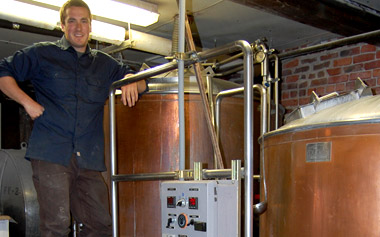
Taking over as head brewer for a local brewery with a passionately loyal and ever-thirsty community of beer drinkers can be a daunting task.
Though he appears to have mastered the job, Chris Sellers, the brewer for the People’s Pint, admitted in an Advocate interview last week that he learned some things the hard way.
“After I’d been in charge for a while,” Sellers said, “I tried taking some of our regular varieties and making them available only seasonally—taking them off the regular rotation.” He laughed and his eyes went wide remembering the reaction. “Oooh boy,” he said, holding up his hands. “I know now never to let the old standbys run out.”
Though the Pint has brewed over 70 varieties since opening, the regular lineup includes Natural Blonde Ale, Provider Pale Ale, Farmer Brown, Pied pIpa, Oatmeal Stout, and the recently added Double IPA. [See “The People in the Pint” for a review of that fine beverage and the pub in which it’s served.] In addition to making certain the pub across town from the brewery doesn’t ever run dry, the People’s Pint ships beers across the Valley and state to restaurants, bars and pubs. The best package stores in the Bay State offer it bottled.
Slaking this crowd’s thirst is a full-time job for Sellers, who works from dawn to dusk in his brewery, hidden away in the basement of an old mill building it shares with a number of other businesses a few blocks from the Pint.
“A lot of my job is juggling,” Sellers said. “Keeping the brewing equipment working, responding to demand, ordering supplies, filling orders.” He doesn’t have as much opportunity as he might like to experiment, and aside from some true seasonal varieties, he estimates he only gets to make about one new variety a year.
When the People’s Pint first opened, co-owner Dan Young did the brewing in the pub’s none-too-big kitchen from equipment he’d cobbled together. As their production increased, the brewers outgrew the restaurant. Around the same time the brewers found the vacant basement space, another western Massachusetts brewery’s untimely demise put their lightly-used, top-notch, stainless steel equipment on the auctioneer’s block.
“Because they’d set everything up and got it working, when we bought it and installed it here, we were up and running in relatively short order,” Sellers said. He’s clearly proud of the equipment and is grateful for the ability to have so much control over the temperatures, timing and measurements. Still, the precise, trusty brewing gear is mostly devoted to fulfilling expectations, and Sellers likes to find ways to exceed them, to push boundaries, to take his fancy equipment out for a test ride.
Most recently, such experimentation resulted in the Double IPA. As good as that is, for the previous brew he created some real magic: a local beer that was made from completely local ingredients.
*
“The real breakthrough came when someone local was able to offer malted barley,” Sellers said. “Unless the grain is malted, it’s no good to brewers.”
He’d taken me up stairs to the first floor storage room that holds malt and grains. Sweet smelling sacks were stacked on the wooden floors in the only space in the brewery that had windows. Most of the labels indicated they were from either England or Wisconsin.
“It used to be, before Prohibition, that there were a lot of farms growing grains for brewing in the Northeast. New York was full of farms growing hops; they were one of the biggest exporters,” the brewer explained. Not only do hops add a distinctive flavor, they help prevent spoilage. Hops are believed to have first been commercially harvested in Massachusetts in 1791, and the now thriving West Coast hops industry was started when Vermont hops growers relocated to Washington State.
When Prohibition made purchasing alcohol require a doctor’s prescription, Northeastern farmers looked to other crops, and when buying beer became legal again, brewers had to look across the country or across the seas for their ingredients.
In recent years, though, that began to change, slowly at first.
“For a few years, Gene L’Etoile of Four Star farms up in Northfield kept urging me to try using his hops, and I was kind of on the fence,” Sellers said. “But then out of the blue, in 2008, prices for hops spiked. They went ballistic, in part due to a blight in England. All of a sudden our distributors were calling, saying they could sell us what they had in reserves, but they didn’t know when more was coming. Prices were going from three or four dollars a pound to 20 or 30 dollars.”
Sellers eventually was able to sign a contract that stabilized his price and guaranteed supply. But he started considering Gene from Four Star’s offer more seriously, and he even began testing different hop varieties. Still, hops are only one of the types of grain required for beer.
“Around that time, too, this couple who had just moved to the area—Christian and Andrea Stanley—came by from Hadley, asking me figuratively if I were able to buy locally produced malted barley, what would my requirements be,” Sellers said, but again, he was a skeptical at first. “Still, we talked for a while, they took notes and seemed to go away happy.”
Like hops being grown in the Northeast, malt houses—once a regular feature of agricultural areas across New England—hadn’t been seen for many decades. Malting is the process of germinating a grain, steeping it in water, draining it, and repeating the process over a period of days. This makes the grain sprout, and in doing so, it produces enzymes that begin the process of converting the starch into sugar. Once the grain has been primed and ready for brewing through this malting process, it’s packaged, ready to be revived and fully activated when the brewer starts a new batch.
“Before I knew it, Christian and Andrea had come back. They had a business with a name, Valley Malt, and they had some barley they’d malted,” Sellers said. “It wasn’t perfect, but it was close, and I realized I could work with it.”
One of the key challenges he faced in turning local ingredients into beer was that his state-of-the-art brewing equipment was used with standard, state-of-the-art ingredients. The malted grain he usually buys in bulk all has a large, uniform kernel size, for instance, and the local grain was smaller than his grain mills were set to grind. Since he was using the same equipment for their standard line of People’s Pint brews, he couldn’t afford to recalibrate the equipment for a one-off with irregularly sized ingredients.
“I realized, though, I could compensate by increasing amounts of ingredients and adjusting the process accordingly,” Sellers said. “It was trial and error, but I really liked the challenge. It seemed the gods of local food were with me.”
Whereas wine-makers are often as intimately involved with the agricultural side of their product as the brewing, Sellers pointed out that beer brewers often are working almost exclusively at combining materials others have produced. One of the things he enjoyed most about the process of making a local beer was how it started forcing him to include a broad range of new concerns into his thinking. How much it was raining and what the nitrogen levels in the ground were suddenly became significant.
The final beer was a mild ale with a copper color, similar to their Provider Ale. Like most of the beers Chris Sellers brews, it was gentlemanly and refined. Humble and not demanding attention, but with plenty of depth and flavor ready for the savoring. It’s perfect for enjoying at your leisure and in succession.
Though it’s no longer on the chalkboard behind the bar at the Pint, Sellers assures me he’s excited to start treating Valley Malt as a sort of “brewery CSA” and hopes others will, too. He’s already put in his order for his this year’s shares.”