
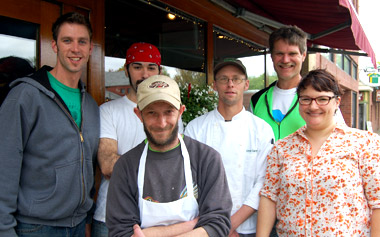
The chef at the People’s Pint says the reason he whips the butter every day and squirts it into small, reusable crocks individually for each customer is because his boss, the Pint’s founder and owner, Alden Booth “bristles at the word ‘convenience.'”
Booth, sitting next to his chef, laughed and added nuance to Chris Carpenter’s observation.
“What I really hate is when people say we’ve got to do something ‘because that’s how they do things somewhere else,'” he said. “For me, that’s actually a reason not to do it.”
Alden Booth knows what he wants, how he wants it, and doesn’t cut corners to achieve his goal, no matter what it costs him in cash or convenience. Having it his way and doing it the “hard” way—like insisting his kitchen staff do what it takes to avoid using individual plastic packets of butter that are difficult, if not impossible, to recycle—has served him, his community, and his pub’s loyal following well for more than a millennium. In restaurant time.
More precisely, next January 1, The People’s Pint on Federal Street in downtown Greenfield will have been in business 15 human years.
Since its first days, Booth and his partner Dan Young have devoted themselves to running a business that takes its commitment to being a good neighbor seriously and literally. In addition to offering a friendly environment in which to devour delicious beer and adventurous dishes made from local, fresh ingredients, the People’s Pint does as much business locally as possible. Further, they make as small an ecological impact as possible, feeding scraps to livestock, and not using any plastic (no straws!) or paper products.
Booth has explained (and defended) some of his pub’s decisions countless times—such as why they don’t accept credit or debit cards—and in an interview with the Advocate last week, we discussed those topics and more. But he gave priority to more important decisions first. As soon as we sat down in a booth, his lanky, bicyclist-fit body filling one side of the table, he knew what he wanted to drink.
When asked by Beth Frasier, the restaurant’s manager, what he wanted, he scanned the chalkboard on the wall and from beneath his wooly, gray mustache a broad smile appeared. “Double IPA,” he said with something very like glee.
The People’s Pint has long had an Indian Pale Ale among its array of tried-and-true standards—Pied pIPA. In a vastly competitive field, its version is distinguished for backing off on making a full-on hops assault, and looking for balance. In their new, potent Double IPA, served to us up in goblets, as far as balance goes, the monster “hops” has his end of the see-saw buried in the dirt and isn’t prepared to relent to the other flavors any time soon. They’re there, but the hops have got the spotlight. It’s got more alcohol than its more gentlemanly cousin, but Double IPA’s finish is sharp, without leaving a ghost of booze on your breath.
After we clinked glasses and each took a sip, we agreed on its quality. After taking an admiring second sip, Booth put down his glass and said with pride, “We’re going to start bottling it.”
Booth’s one-time partner, Dan Young, moved away several years ago, following his wife to a new job in northern Michigan; he’s now making artisan hard ciders there. In his stead, back at the Pint, Chris Sellers has taken over as head brewer, and he’s proven that he can maintain the quality of their trademark beers, but also venture forth into uncharted territories, and both customers and Booth seem happy with the results.
“He’s quite a find for us,” Booth said of Sellers, taking another sip. [See accompanying profile of the Pint’s brewer and his recent Local Beer]. “He’s so serious about what he does. It’s a science, craft and art for him. I love it.”
*
Alden Booth’s appreciation and love for his staff appears genuine and the sentiment is reciprocated. As we sat down for our interview, manager Frasier and chef Carpenter pulled up chairs and joined in. They spoke enthusiastically, almost as disciples, emphatic that what they did was more than a job—they were proving a point, living an ideal, and enjoying themselves to boot.
Before they elaborated, though, they were also emphatic that we not talk without food on the table. Booth said I needed to try one of Carpenter’s sausages, Frasier insisted.
“He makes seven or eight varieties,” Booth explained, “and he smokes his own bacon.” Turning to the chef, he asked, “What have you got today?”
“It’s a sort of Boudin Blanc,” the chef explained, “a white sausage made from pork, spices and cream. It’s the one sausage I don’t put in the smoker. I poach it.”
I found it to be mild, but still full of delicate flavor. Booth gave me the last bite.
I’d been eating there for well over a decade, and I’d returned several times in recent months, trying to get a sense of their culinary range. Within the limits of basic bar food made from mostly local produce, Carpenter has found plenty of room to be creative and offer surprises. I’ve always left satisfied and often surprised, and realized lately that they’ve come a long way from their turkey burgers and quesadillas.
A pulled pork sandwich that originated from just over the Vermont border went down easy with one of the their 100 percent Valley-made beer. On an earlier visit with my family, we had gotten good and greasy with barbecue sauce, gobbling up his chicken wings. The Thai noodles with chicken have always been a reliable favorite.
While I’ve been satisfying my carnivore appetites there for over a decade, I asked Carpenter about the impression I had that at some point they’d been exclusively vegetarian.
“It’s one of the common myths about the Pint,” Carpenter said.
“Before we opened in ’97, there had been a vegetarian place before us,” Booth said. “We wanted to sell local produce, and when we opened, there weren’t a lot of opportunities for local beef. We didn’t want to become just another brew pub that sold steaks and burgers with our craft beer. We used free-range chicken, and humanely treated ground turkey.” They also have never had a Fryolator, and if tomatoes aren’t in season, you might be out of luck if you want one on your sandwich.
Having found local grass-fed beef in Shelburne, they now sell beef burgers, and a newly established relationship with the Vermont farm that raises pigs has given Carpenter new ways to express his culinary arts. In addition to the sausages and the bacon, he recently held a beer dinner that featured a 160-pound pig that he roasted. He used every part from snout to tail.
Central to the Pint’s mission, though, has been offering simple, in-season, mostly local, flavorful foods at affordable prices. Some evenings and weekends, they host local musicians.
Sound commonplace? It wasn’t back in 1997, but by embracing the model of a sustainably-run restaurant that buys primarily local produce, and finding a community that embraces it, the People’s Pint has become a sort of role model.
“We don’t want to preach to anyone,” Booth said. “We try to motivate by example.” They’ve often been duplicated, but seldom matched for their devotion to trying new things.
“I remember in the late ’90s, we had Swiss chard and collards,” Booth said. “We had these quesadillas with garlic and collard greens, and people would come to me and say, ‘What the hell are you doing?’ But now everyone knows what those things are. People were receptive, and this idea that Greenfield was totally conservative and we couldn’t [challenge their sense of cuisine] was just totally wrong.”
“To be honest, I don’t think cooking with fresh produce is all that newsworthy. It’s important, sure, but it’s old hat,” Carpenter said. “Everyone’s doing it. I’m more proud of the stuff behind the scenes. Because Alden insists on us using as few resources as possible, keeping our waste stream small, a lot of thought goes into our meals that goes far beyond what we put on the table. Whenever we make adjustments to the menu, I’m considering what goes into an ingredient and how far it needs to come before we have to use it, and I’m also thinking of what kind of waste it will create and whether its something we can easily recycle.”
*
“The other myth is that we’re a bar,” chef Carpenter said. “I overheard someone recently saying they wouldn’t come here with their kids, because they didn’t think children should be in bars. I was astonished.
“We’re very much a pub. Everyone’s welcome.”
It’s a favorite meeting place for formal and impromptu groups, and lingering is encouraged, especially over a beverage. And, as is pointed out to me, in addition to a selection of fine beers crafted down the street in its brewery, the People’s Pint also sells custom sodas. But I already knew this.
All are delicious, but the standout is their magnificent ginger ale.
Their wonderfully sharp, frothy glass of carbonated ginger goodness has, on occasion, tipped the balance for me in favor of the Pint when deciding on a dining destination. It tastes like a strong elixir ought to: powerful, stimulating and refreshing. I’m told they have one customer who comes in regularly, orders a glass at the bar, drinks it down and is on her way.
I take a more casual approach. As an appetizer, I like to order two glasses—one packed with ice as is customary and the other without. Though they call it an ale, its bite and distinct lack of sugary sweetness makes it taste far more like a ginger beer. It’s cloudy and, bursting with refreshing, prickly fizzyness, it takes a while to pour but goes down all too easily. Ordering two at once, I don’t have to wait to get my second infusion, and I just add ice from the empty glass to the full one. (I know, genius!) To top things off, and to accentuate the spiciness, I sometimes also order a plate of pepperoncinis.
Unlike their beer, though, the ginger ale is sold only on premises. Though it’s worth traveling for, Alden Booth would prefer if you made the trip on bicycle. His commitment to the community he does business in actually goes so far as not encouraging long-distance customers. Just as chef Carpenter hopes to find ingredients from within a close a range as possible, Booth goes out of his way to attract patrons who can leave their cars at home.
“I get calls from publications outside Massachusetts all the time who want us to advertise,” manager Frasier said, “and they always are surprised when I turn them down.”
“Right from the start, we wanted to serve the customer base right here, in and around Greenfield,” Booth said. “I know this might sound strange, but it doesn’t seem right encouraging people to drive 50 miles to drink beer. Shouldn’t every place have somewhere local that serves fresh food and beer that they can call their own?
“Our challenge has always been to be big enough to support ourselves, but not so big that we depend on 91 or traffic from Northampton, Amherst and beyond to survive,” he said.
But, Frasier points out, her boss is as fundamentally opposed to traveling far in a car for good food as he is active in promoting other modes of self-propelled transportation.
“We started opening for lunch this winter, and when we were getting these knee-high blizzards,” Frasier said, “I’d call Alden to see if it was okay to close for the day. He’d always say, though, ‘What if someone comes in from Montague or Deerfield on cross-country skis? How are they going to feel if we’re not open?’ So we stayed open for the skiers. We didn’t get many, but we got some.”
While Beth Frasier manages a routinely upbeat and welcoming pub, not all of their customers are grateful winter adventurers happy to find a warm meal and fresh beer to greet them.
“Some people get really ticked off about the credit card thing,” she admits. “More than once we’ve had people tell us they’d never return because of it.”
But as the friendly note cards she’s printed up for people’s tables explain, “Yes, we realize it’s the 21st century. Actually, we believe this is advanced thinking. We don’t have to charge you more for food so we can cover charges for credit.”
Booth is less politic. “Why should any faceless, greedy corporation from a thousand miles away that doesn’t give a damn about what we’re doing here—why should they make a dime off me or my customers?”
He smiles and acknowledges there’s a certain hypocrisy in his stance—it’s been made possible by the ATM across the street—but he continues the policy because most people seem to embrace it. Leaving the People’s Pint, customers typically have full bellies and a pleasant buzz, but they haven’t left a digital paper trail or a pile of trash to fill a landfill with. It’s a good feeling.
As if to underscore the point, as we got up to leave, another table containing local community college students and one of the employees also got up.
“The tall guy’s Kenny,” Frasier explained. “He works here, and on Mondays it’s his job to bring the scraps to the farm for the animals. He’s really gotten into it, and he’s been getting some of his fellow students at Greenfield Community College involved in doing it on a bigger scale.”
“Knowing our food waste is feeding a goat that’s producing milk for a cheese we serve,” Booth added, “it’s so satisfying knowing how…”
He seemed to be searching of the word. “Efficient?”
“No. It’s more about being a part of the ecology. Being part of a closed, sustainable loop,” he said. “Sustainability doesn’t mean growth, necessarily, and it’s not like you’re either sustainable or you’re not. It’s a constant process of always trying to be aware of what you’re buying, what’s out there, and questioning what you’re doing. You can’t ever be completely sustainable—not unless, maybe, you’re living in a cave in the woods—you just do your best.”
Though Booth is wary of growth for growth’s sake, he conceded that his own businesses have been blossoming.
“We’ve opened up for lunch on the weekdays lately, and there’s our restaurant in Gill, the Gill Tavern, that’s been open a few years,” he said, but insists these efforts have been more about filling a community need than trying to build an empire.
“Prices were going up, we have a big staff, and we were already paying heat and so forth, so it seemed like a good idea for the People’s Pint to be open for business more often,” he explained.
“It started out as an April Fool’s joke,” Frasier said. “We put out menus saying breakfast would be served all day, and people seemed to think it was a good idea, rather than funny.”
And the Tavern?
“I live in Gill, and the tavern is where the old country store used to be; my wife, Alissa Greenough, and I bought it when the former owners Phil and Lucy retired. We tried to keep it open as a store for a couple years, but that didn’t work. I don’t know anything about running a store, but I do know restaurants. It’s right at the crossroads, and we wanted to keep it as some kind of place the community could use to gather over some good food and drink.”
Though the Pint has also started trying their hand at catering weddings (“People are really getting into the idea of no-waste weddings”), Booth said he and Greenough mostly have their hands full serving their current customers at their two locations. Most thoughts of growth these days center on tending their large garden that supplements the Pint’s larder.
“I’ve got tons of rosemary,” Booth told Carpenter as we were saying our goodbyes. “Can you use that?”
“Sure. I’ll put it in the potatoes,” Carpenter said.
“It might look nice on the tables, too,” Frasier added. “Would be good to get the smell of spring in here.”