
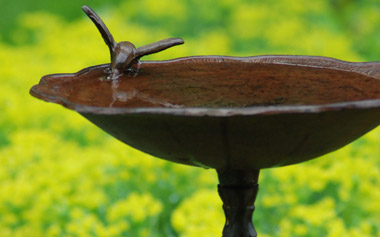
The great landscape designer Fredrick Law Olmsted referred to it as “furniture”: the broad category of man-made objects—sculptures, benches, bridges and fountains—that appear in otherwise “natural” park settings.
Though surely not so lofty a source as Olmsted, today’s steady parade of cable television shows aimed at DIY home and garden buffs frequently uses a similar metaphor, speaking of garden or “backyard landscapes” (frequently with pools and barbeques, decks and pergolas, but scarcely more than a potted plant and a welcome mat-sized lawn) as “outdoor rooms.”
And outdoor rooms are often furnished.
To my surprise, I like a certain amount of furniture in my backyard, and not just the kind I can sit on. We’ve acummulated quite a lot of it over the last 20 years, and no matter how much time I spend prowling around our gardens, I continually stumble into some little artifact or another that somebody in the family added without telling the rest of us.
While I consider myself a woodsy sort who prefers the world unadulterated, I also like the quiet company of man-made objects in the gardens. Some objects are purely ornamental, while others are useful as well as decorative, like an old watering can or galvanized pail. Inanimate but ever-changing, marked by weather and oxidation, these silent sentinels stand watch over the gardens throughout the days and years.
*
When we started scratching around the dirt more than two decades ago, my wife and I had big dreams of growing lots and lots of pretty plants in big healthy gardens. Such dreams are far more general, of course, than the actual work it takes to get anywhere close to realizing them. Gardening is a slow, deliberate and often taxing enterprise, with something always needing doing and everything taking time.
Some plants need endless coaxing, endless mollycoddling. Some plants grow, quite literally, like weeds. Vital as they may be, they’re far from work-free. It takes constant vigilance to keep them contained, invasive little buggers that they are. Thankfully, some plants thrive on neglect and stay where they’re put, but when you find one, chances are you have too much sun or not enough sun to grow it—or any one of scores of variables that come into play when trying to cultivate a particular plant.
But it took almost no effort to throw the rusting old bicycle wheel between the dog hobble and the Delaware White azalea several years ago, nor has it required even a single moment’s maintenance over the years. Is that why I appreciate it, that decaying relic, machined symmetry juxtaposed against random order of leaves and petals?
Like my wife and I, our gardens are no longer upstarts, and as they mature, they show evidence of greater dimension and depth—or so we like to think. Like nooks and crannies of our home’s interior, our gardens seem to have become repositories of keepsakes. In our case, none has any particular economic or historical value, but each means something special to us.
“Where did this come from?” I’ll ask my wife as we’re out weeding, referring to some objet d’art or another. I’ll know the answer, but I love hearing the story again, recalling travels past.
Sometimes the garden objects come from places we go specifically for gardening stuff, places like Hadley Garden Center in Hadley, Sixteen Acres Garden Center in Springfield, or, closer to home, Bay State Perennial or Lasalle Florist in Whately. Some of my wife’s favorites come from Annie’s Garden and Gift Store in Amherst, the Cedar Chest in Northampton or any number of similar stores that specialize in limited-production ceramics and statuary for outdoor use.
Some are just old objects we pulled out of the attic or bought in junk shops, items that, if we didn’t have a garden to hide them in, we’d surely throw away.
*
For me, there is always a tension at play in a backyard—or a great city park: how “natural” do you want it to be? How carefully weeded and edged will you keep the garden? How much lawn paraphernalia are you going to sprinkle around?
Of course, though very beautiful, the great public landscapes Olmsted created, including the Emerald Necklace park system in Boston and dozens of other public places in Massachusetts, as well as New York’s Central Park, are not wild places. Filled with the cultivations of plants found in nature, they are places tamed sufficiently to allow for a closer, more intimate outdoor experience than most people—even by Olmsted’s time and certainly today—would likely allow themselves to have in true wilderness.
The same is true of most backyards in America, I suspect. Whether the setting is urban, suburban, rural or any shade in between, all homes seem to need some kind of outdoor sanctuary, a transition from a controlled, protective environment into a volatile, unpredictable one fraught with dangers.
The furnishings in our gardens, like those inside, make the gardens uniquely ours, and function as architectural elements that add structure and shape to a garden, accenting the organic changes taking place in the garden, as well as changes of light and of season, but also as totems of our civilized nature, bits of home that make our outdoor sanctuaries feel safe.