Summer is a time of infinite possibilities, of taking winter’s cabin-fever-induced dreams out into the air to see how they feel against the backdrop of reality.
For the last bunch of years, Springfield musician Mark Mulcahy has teamed up with New York cartoonist Ben Katchor to create and disseminate their own self-contained dream worlds to the general public.
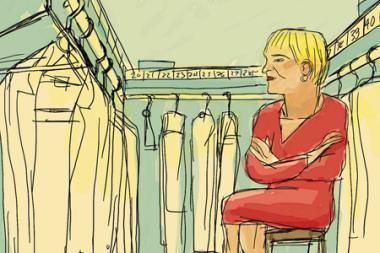
Mulcahy and Katchor’s latest creation, A Checkroom Romance, is an avant garde opera about a man who runs a coat check in his apartment, and whose world is inhabited by lovesick podiatrists, paraphilic playboys and sundry other interesting characters running around New York City.
Checkroom makes its area debut at Amherst’s Yiddish Book Center June 6 at 2 p.m. in a performance that features the services of some of the area’s finest musical talents: singer Flora Reed (Winterpills), multi-instrumentalists Ken Mauri (Spouse, Young@Heart Chorus) and Dave Trenholm (King Radio, Young@Heart Chorus), and sound technician extraordinaire Dan Richardson.
The artists’ collaborative journey began at one of Mulcahy’s gigs at The Fez in New York City. Mulcahy can’t be sure if it was a solo gig or if he was playing with his criminally underrated band Miracle Legion. Either way, Katchor (Julius Knipl, Real Estate Photographer and The Jew of New York), an accomplished visual artist and MacArthur fellow, was in attendance and subsequently introduced to the performer through a mutual pal.
The two became fast friends, and when Katchor was commissioned to create something for New York experimental arts organization The Kitchen, he called on Mulcahy to provide the music.
The result was the off-the-wall The Slug Bearers of Kayrol Island. Performances of that piece set a working template for future creations by presenting otherworldly Katchor-created images and animations projected over and above a live band, helmed by Mulcahy, playing his original compositions to Katchor’s libretto.
“That opened a lot of doors,” says Mulcahy. Sure enough, the opera made it to MASS MoCA and other prestigious stages as part of a 12-show run.
Next came a request from a little museum in Philadelphia, The Rosenbach, a testament to the lives and work of the Rosenbach brothers, particularly Abe Rosenbach, thought to be one of the preeminent rare-book dealers of the 20th century.
The proprietors wanted something to commemorate the place, and when Katchor suggested an opera, the benefactors “recalibrated” and came up with significantly more dough. The resultant work, The Rosenbach Company, was a great success, both critically and amongst the crowds lucky enough to get a view of these fleeting performances at interesting and nontraditional venues like the New York Public Library and Amherst’s Yiddish Book Center.
The trick of these collaborations is that, for now at least, they are just that: fleeting, surreal moments of time conjured by two artists at the top of their respective crafts working in complete symmetry. Words, images, and sounds gathering at one point of space and time, lasting no more than a few instants.
Mulcahy hints that the duo’s latest creation, A Checkroom Romance, might just be their best yet. The musical tragicomedy features a man so obsessed with the architecture and culture of checkrooms that he runs one out of his cramped New York apartment. Zaniness inevitably ensues.
Checkroom was formed like many of their past collaborations. “It all starts with a [comic] strip,” says Mulcahy. “This one was an eight-panel strip about a guy with a coat check in his apartment. [Katchor] will come up with a story that really enlarges that, brings in a lot more characters and a plot. He writes all that up into scenes and then he sends that straight dialogue to me and I write a song for each scene.
“The thing that Ben always says in interviews is that he has great faith in me to turn human speech to music. And I can actually do that. I’m sure plenty of people can, but I can take this conversation or this thing from a scene and then just make a song of it. I just look at [Ben’s words] as lyrics.”
Mulcahy says their workflow is facilitated by the fact that he has traditionally written lyrics first, which he then proceeds to “shoehorn” in and out of the music. When working with Katchor, he tries not to predetermine a character’s motivations or a scene’s ultimate machinations.
“It’s best to just write without anything else in your mind,” he says. “If you think about who it’s for, or what it is, or how will we do this or what’s this supposed to be about—I’d rather write something that turns out wrong than try to write something to an idea, an order. Like, this guy is supposed to be this way, or this should be fast—I’d rather do it wrong and then do it again.”
Mulcahy contends that he would get stuck doing it the other way. He describes Katchor as a director, letting him know if something feels wrong.
“I used to argue about it,” he says. “But I’m sure that I’m wrong now. I have no doubt in my mind if he tells me it’s the wrong direction. He has a great grip on his world and I’ve learned to trust his instincts.
“He’s a great guy to work with. It makes it a happy marriage. We never fight—well, maybe a little bit.”
*
Mulcahy and Katchor, despite their considerable successes, are hoping to take their partnership to the next level, but are still in search of their ultimate place in the creative world. They learned just how difficult that prospect might be when an independent theater company liked Rosenbach so much that they hired actors and staged the thing themselves. After this off-Broadway experience and taste of “the theater world,” Mulcahy and Katchor determined it wasn’t for them.
“We don’t really fit in anywhere,” Mulcahy says. “If you take the extremes of the Vineyard Theater, which is kind of off-Broadway, and then The Kitchen, which is a total experimental place, we’re not in either of those places. We’re trying to figure out our place—that middle ground.
“We have our benefactors—the New York Public Library has just commissioned us to write another one, so we’re onto something good, but there’s a lot of other places we could be playing.”
Has finding that sweet spot proven especially elusive because of the uniqueness of their product?
“To me it’s not that unique,” says Mulcahy. “It’s pop opera—pop music set to cartoons, so it’s not anything that should be over anyone’s head or highbrow or anything, but I think it’s different. If we do it enough, we’ll have invented our own place. That, I think, is the plan.”
*
A Checkroom Romance is sure to be an interesting kickoff to the summer entertainment calendar: a deluge of information and songs and images. Mulcahy describes it as a “Pink Floyd-ish thing,” with live players performing music under projected pictures. He says it might be a bit overwhelming, particularly for those expecting traditional theater.
As for the thematic content, it follows a similar pattern for Mucahy/Katchor collaborations, falling squarely into a subgenre they have carved out themselves.
“It’s noirish—it’s ‘egghead noir,’ I guess is the best way to put it,” laughs Mulcahy. “I guess all of our stuff is. It’s complicated, but it’s really about how good meets evil—Benny would shoot me for putting it that way. The good people meet the bad people, and then somebody gets hurt. An innocent man gets involved with the wrong crowd.”
As he puts it, anytime you try and describe their pieces in simple terms, those terms never quite cover it all. There’s a simple synopsis—and then there’s there rest of it.
Mulcahy promises an added edge to the impending Amherst performance: “This is the beginning of the process for this one, which is exciting—as much as I hate the concept of workshop, it is, in a way. In the past we’ve had a few weeks to rehearse and work things out—with this one we just wrote it and started performing it, really. If you see it in a year, it will probably be somewhat different.”
*
Mulcahy calls the Valley a great base of operations and a great place to perform, thanks to its preponderance of talent.
“It’s great to be around here, because all these guys—Flora, Ken—they’re so talented and can pull all this off. It makes it so much easier. Dave Trenholm—forget about Dave Trenholm, he’s an amazing musician—in this one he’s like sitting there, surrounded by instruments, like in a music store, and he’s just picking up instruments and playing away. They’re great, and local, and we can rehearse and go anywhere.”
Mulcahy describes his team as a completely self-contained unit, which makes them a unique case. He says the players’ backgrounds in the world of rock, performing gigs in other bands, are key.
“There’s the process of writing it, and then the process of doing it,” he explains. “Getting together with Dave and Ken, and in this case Flora—just getting together and singing it, there’s a lot of harmonies and varied instrumentation, a lot of which Dave handles, but Ken as well. It works and it’s a great collaboration.”
*
Not content with one project, both guys have plenty of other irons currently in the fire.
Mulcahy has a new record he’s hoping to finish within the next few months, and a bunch of other projects he’s raring to jump into. Katchor is currently working on a book.
They are also trying to figure out how to turn one of their operas—most likely Checkroom—into a movie, replete with acting, animation, and plenty of music: a way to cement and preserve it in perpetuity. But Mulcahy concedes that it won’t be the same as being there live.
And they already have another opera lined up, this one about a guy who works down below in the New York Public Library stacks. He leaves work and heads out into Times Square where things go horribly awry—or something like that.
“I’d like to write and record one every year, perform it,” Mulcahy says. “That would be great.”
A Checkroom Romance plays at Amherst’s National Yiddish Book Center June 6 at 2 p.m. For more information, please visit www.yiddishbookcenter.org.