
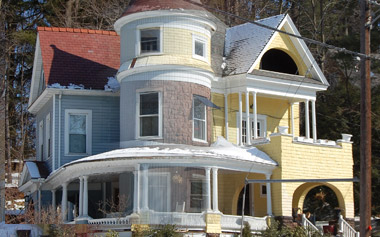
Some of America’s oldest buildings are in New England.
Along with split-ranches and capes, most towns have colonial homes, Industrial Age train stations, Victorian mansions and turn-of-last-century granite banks. Fortune has treated them all differently. Some neighborhoods are slavish about maintaining the historical integrity of their appearance and spare no expense, while in other cases the inability to pay for improvements keeps the appearance of buildings intact. Most buildings, though, are an amalgam of repairs and additions that are as distinct as the decades in which they were made.
Preservation is often not the primary objective when a contractor is called in by a homeowner looking for a new deck or when the board of a public library calls, interested in adding a new wing. These clients would, of course, like the work to be seamless and sympathetic to the style of the original building, but often the size of their budget doesn’t match the scale of their vision. Sometimes the seams show.
Like Darwin noting the variations between birds on the different islands of the Galapagos, those who explore the neighborhoods of most Northeastern towns find joy in seeing how the homes, libraries, town halls and other public buildings have adapted to their times and surroundings. The older the building, the more likely it is to be a patchwork of construction methods, materials and tastes, each era having its own identifiers. Looking closely, it’s often possible to distinguish the strata of modifications: the funhouse distortion of a really old window in the original portion of the eighteenth-century house, the addition in back with Victorian gingerbread in the gables, and the added garage with bulging bubble skylights dating it as being constructed in the era of bellbottom jeans and sideburns.
Pleun Bouricius and her husband Tee O’Sullivan, of Measure Twice Renewal, are often faced with the challenge of modernizing old buildings, some of which have been modernized many times before. Based in Plainfield, the team distinguishes between what they do and renovation and restoration. Rather than trying to preserve a building or return it to a prior state, they work to update a building.
“We are not purists,” she said. “We do a lot of work on post and beam houses, and we don’t always try to restore them using the old techniques, because it’s prohibitively expensive. The old beams were often hemlock, sometimes chestnut. In Plainfield, there’s lot’s of chestnut; beautiful, old, hard stuff. If you try to put current hemlock or oak, it’s not as hard, it’s not old growth, and it can rot more easily. So we’re not purists, but we try to make it work, using honest methods.”
O’Sullivan has over thirty-five years’ experience working on buildings, and his specialty is dealing with water issues—”Problems people have where one corner of the house has rotted out, or stairs are falling off, or a porch is sagging,” Bouricius explained. They have been business partners since 2002. While she has a Ph.D. from Harvard in the history of American civilization and has taught at the university, she was born and grew up in the Netherlands. When it comes to construction issues, rather than striving for historical accuracy, her approach is Dutch: practical and timely.
“Renewal,” she says, “can sometimes involve renovation and restoration, but the goal is to fix [a construction problem], to make something solid, and make it look like it was always thus. It’s not about just renewing the building, but also renewing an owner’s relationship to the building.”
Taking a drive through the Pioneer Valley on a house-spotting safari and asked to comment on building renewal projects that appeared in downtowns and along dirt roads, Bouricius did not show a particular affinity for expensive, pristine preservation projects. Instead she admired construction solutions that were faithful to the building’s whole history (the original structure, including subsequent additions), but also married affordable, modern solutions that would require a minimum of ongoing maintenance.
While she appreciated much about a project that expanded an Arts and Crafts-style single-family home in Northampton into a multi-family residence, she pointed out that the complicated roofline made up of many nearly flat surfaces increased the likelihood that ice dams or other water problems would crop up. She also suggested that while the ornamentation was attractive now, it would be the first place where problems like rot or chipping paint might occur.
A few houses down from this house, which won a local preservation award, was a house that may well have been built around the same time as the award winner, but it hadn’t had the same kind of attention lavished on it. Still, at sometime in the past, it had been expanded into a multi-family residence, too, and while it was possibly not as glamorous as its neighbor, Bouricius suggested it might not cause as much stress for its owners down the road.
“I feel like we live in a society where ‘maintenance’ is a dirty word,” she said. Sometimes clients are more focused on the ideal they want constructed than living with the addition and having to pay for its upkeep.
The new addition to the Meekins Library in Williamsburg she pointed to as an example of an historic building that was successful in finding a modern, affordable solution to its challenges. The town had outgrown the original granite and marble building with stained glass windows. Though they wanted to keep the distinguished anchor for the downtown, its austere entrance wasn’t handicapped-accessible, and there wasn’t any parking. Rather than matching the materials and workmanship of the original, the new building keeps the proportions and shapes of the roof and windows, but foregoes the granite and stained glass for concrete and plate glass windows. The original entrance is left untouched, and a new, brighter and more friendly face has been constructed at the back.
Driving north through Whately and up to Greenfield, Bouricius discussed contractors’ relationships to their clients and how essential it was for both parties to find people with whom they can work over a long period of time. “Our first question to a new client is, ‘What happened to the last carpenter?'” she said.
Housing inspectors legally can only look at a house’s surfaces, and while they might comment on what they suspect is a problem with the underlying structure, they often don’t know. Contractors dig in, though, and as a result, “We are often bearers of bad news.” If the contractor finds something has rotted, removing it can be like doing a root canal on a patient that’s up and walking around.
She also advised that “changes in a project are expensive—in dollars, but also in goodwill between contractor and client. Changes are also unavoidable.” She recommends that clients anticipate that both the cost and length of the project will inevitably be more than anyone guessed.
Arriving in Greenfield and driving by mansions in the hills, she spotted another two homes that, when built, had probably been very similar in appearance, but over the years, additions and modifications had taken them in very different directions. One was preserved and seemed to resemble what it might have once been; the other was covered in vinyl and dozens of layers of additions.
Neither house suited Bouricius’ sense of aesthetics, which favors proportion over adornment, but looking at the buildings, she said she was reminded of Greek statuary. Now we admire the chiseled stone and white marble of those ancient works of art, but of course, when presented to the Greeks, the statues were painted with bright, garish colors. Whatever garnish has been added to a building, the artistry that will last and be the greatest resource to those that dwell inside is what’s underneath the surface.