
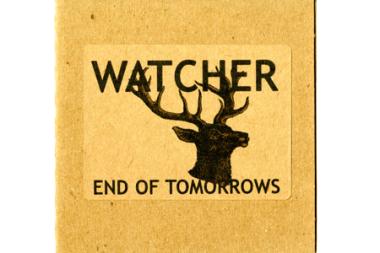
Watcher
End of Tomorrows
(Mohawk Cat)
Watcher’s musical aesthetic seems to fall somewhere between the mellowness of the Velvet Underground and the ’90s rock of indie bands like The Strokes or Franz Ferdinand (by way of ’60s Doors psychedelia). End of Tomorrows is a six-song EP that’s well produced by Jose Ayerve (Spouse), and features chunky guitars, spooky ethereal keyboards and a wonderfully recorded bass guitar sound. Drum parts are creative, if a little wiggly and not always rock solid, while the vocals (male and female) are melodic and occasionally raspily powerful a la Peter Wolf (when they’re at their best). The EP starts off a little shakily, but both the songs and the musicianship seem to steadily improve as the CD progresses, until you arrive at “Summer Mahi” and “999,” the last two songs, which are the best (and maybe the simplest) on the album. —Tom Sturm
Flying Lotus
Cosmogramma
(Warp)
After his breakthrough Los Angeles, producer Steve Ellison (Flying Lotus) swings for the fences with this follow-up. Cosmogramma stitches avant garde jazz, hip-hop, and electronica into a crazy-quilt of dizzying beats, dubbed-out samples, and kaleidoscopic textures. Guest stars such as Radiohead’s Thom Yorke and saxophonist Ravi Coltrane are folded into album’s continuous, suite-like flow. There are multiple references to the visionary cosmic jazz of Ellison’s aunt, Alice Coltrane, including the prominent use of strings and harp.
While Ellison’s ambition and technical reach is impressive, Cosmogramma doesn’t scale the same heights of lucid astral traveling. The album suffers from a surfeit of good ideas, and Ellison can’t resist piling synth squiggles, processed breakbeats, and twitchy insect rhythms atop already busy tracks. expect Flying Lotus to really hit his stride once he employs more restraint. —Jeff Jackson
Danger Mouse & Sparklehorse
Dark Night of the Soul
(Capitol)
Bring two renowned hipsters together, throw in co-songwriters including David Lynch and well-known rockers, and you get something stratospherically hip. At least in theory. Both Danger Mouse and Sparklehorse’s Mark Linkous have crafted extraordinary material, but their co-effort is an album weighted with heavy expectation, torqued up by legal battles that hindered its release and the tragedy of Linkous’ suicide. For every turn toward oddly canted and well-crafted tunefulness, there are counter-acting missteps. The titles sound like bad band names (“Just War,” “Insane Lullaby,” “Grim Augury”) and the often clinically crafted sounds support lyrics that tend toward ill-fitting silliness—”Every time I’m with you/ I am drunk and you are too.” Then again, collaborations with Iggy Pop, Suzanne Vega and the late Vic Chesnutt are taut, coherent high points. An important, if scattershot, album. —James Heflin