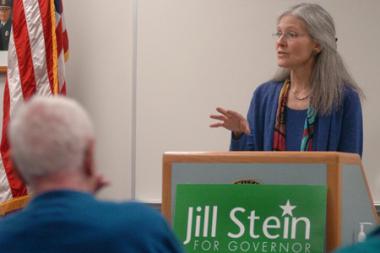
Jill Stein was running more than an hour late for a recent campaign event in Florence. But that did little to dampen the spirits of the 50 or so Green-Rainbow Party supporters who chatted over glasses of lemonade as they waited patiently for their gubernatorial candidate to arrive at the community room at the Rocky Hill Cohousing development.
Any impatience about where the candidate wasn’t at this particular moment, it seemed, was overshadowed by delight about where she will be in the coming months: at a series of gubernatorial candidate debates hosted by a consortium of Boston-area media outlets.
Stein had been excluded from earlier debates, on the argument that she, and her party, were too “marginal” to warrant a voice in the conversation. That kind of shaky circular logic—that voters aren’t interested in hearing from candidates whom the large media gatekeepers have already ensured they don’t hear from—is, of course, a self-fulfilling prophecy; what better way to render a candidate marginal than for those very gatekeepers to marginalize her?
It’s nothing new; third-party candidates typically can’t get the time of day from the mainstream media in our stagnant two-party system (with certain exceptions, like the gazillionaire populist Ross Perot). In this year’s gubernatorial race, however, that practice has been shaken up, thanks to the decision by state treasurer Tim Cahill, a long-time Democrat, to go Independent for the race rather than face a bitter party primary against incumbent Gov. Deval Patrick. In apparent deference to his big-party roots and big-time state position, organizers of the first major debate, hosted by a Boston radio station back in June, allowed Cahill to take part—a move that made the decision to exclude Stein appear even more arbitrary, not to mention embarrassingly undemocratic.
But now, it appears, the big Boston media have had a change of heart. In the days before Stein’s Florence event, the media consortium that controls the highest-profile debates conceded that Stein can, indeed, participate—an indication, Green-Rainbow supporters say, that their candidate’s message is resonating with voters dissatisfied with the political status quo. And, they predict, voters will continue to be bowled over by Stein, now that they will actually have a chance to hear what she has to say.
*
The Greens attribute the debate organizers’ about-face to Stein’s performance at an Aug. 16 debate on the controversial Cape Wind project, hosted by the non-partisan think tank MassINC.
At that debate, Stein was joined by Cahill and Republican Charlie Baker in criticizing the insider nature of the wind farm deal promoted by Patrick. While the Green-Rainbow Party supports wind power in theory—indeed, sustainable development and renewable energy are cornerstones of the party’s platform—Stein has grave concerns about the Cape Wind project, which she has taken to calling “Big Wind” in wry homage to that most egregious of examples of taxpayer-funded mismanagement and overspending, the Big Dig.
Indeed, all three gubernatorial challengers have been critical of the no-bid contract between Cape Wind, a private entity, and National Grid, the utility that would buy about half the energy generated by the project. (Patrick, voters will recall, had objected strenuously to the recent legislative proposal to allow slot machines at race tracks, arguing that the deal amounted to no-bid contracts for track owners. When pressed about this apparent consistency by Baker at the Aug. 16 debate, the governor dismissed the two cases as “hardly comparable.”)
But Stein took her criticisms further, in a direction that neither Cahill or Baker could dare to venture: the role of corporate campaign donations. At the debate, Stein—the only candidate who’s pledged not to accept donations from corporate lobbyists—went after Patrick for accepting $80,000 in campaign contributions from utility executives and lobbyists and Cape Wind principals. Patrick rejected Stein’s call for him to return those contributions, saying that he was “satisfied I kept an appropriate arm’s length’ from the interested parties in the deal. Less satisfied, perhaps, are concerned ratepayers, whose money is partially subsidizing Cape Wind, a private project whose ultimate costs are still unknown.
In a statement released after the debate, Stein said, “The Governor offered a defense we’ve heard many times from officials in similar positions—he said he’ll keep the money but won’t let it influence him. But that just doesn’t restore public confidence. Business interests that are writing checks do not give up their money without determining that they can expect a return on their investment. They’re smart guys and they don’t write checks to politicians they don’t expect to influence.” The Green-Rainbow party would like to see renewable energy projects be community owned and publicly accountable.
Two days after the Cape Wind debate, the Boston Globe—which, according to Stein, had earlier said her campaign’s small war chest indicated she didn’t deserve a place in the debates—changed its tune, with an editorial calling for both her and Cahill to be included in future debates. The two candidates’ performances at the Cape Wind debate, the Globe wrote, demonstrated “that they bring thoughtful, distinct perspectives the voters deserve to hear.”
In response, the Boston Media Consortium—a group that includes the Globe, New England Cable News, and several Boston television and radio stations—announced two upcoming debates, with all four candidates. The first will be Sept. 21; the second, Oct. 26. Locations and other details have not yet been announced.
*
While the crowd at the Aug. 22 event in Florence awaited Stein’s arrival, they heard from the Green-Rainbow’s two other candidates for statewide office: Holyoke’s Rick Purcell, candidate for lieutenant governor, and Whately’s Nat Fortune, who’s running for auditor. (The party is also running a candidate, Scott Laugenour, for the 4th Berkshire state rep seat.)
Fortune and Purcell offered informal stump speeches that highlighted some of the tenets of the Green-Rainbow platform: single-payer healthcare; local, sustainable job creation; improved funding for education, including higher ed. The Greens, Purcell noted, are the only party to oppose casino gambling. “How can you fix our economy by gambling on it?” he asked, pointing to the 14 percent unemployment rate in Nevada, the state that supposedly should be a model for the economic benefits of casinos.
Fortune focused on the system of regressive taxes and corporate tax breaks that leave Massachusetts families and communities struggling while favoring select industries, from financial services to movie studios. “It becomes ever harder to pay for the schools and the services we need and deserve to have,” said Fortune, who vowed that, as auditor, he would be a true fiscal watchdog. “It seems we can keep dreaming up new ways to take money from people who don’t have it and give breaks to the people who do. & We are stealing from the poor to pay for the rich.”
When Stein finally arrived—the MassPike, she explained apologetically, had been a virtual parking lot—she was quick to share more good news: the Boston media consortium’s acknowledgement of her campaign, she said, has triggered a flood of invitations to attend candidates’ events sponsored by other groups, from the Boston Bar Association to a realtors’ group in Marlborough.
Stein clearly relishes the opportunity to offer a perspective that’s so different from that of her three opponents, whom she calls “three versions of more of the same.” Patrick, Baker and Cahill may argue over the minutiae of the state’s healthcare system, she noted, but none of them will call, as the Greens do, for a complete overhaul of the system to a single-payer model that focuses on preventative care, or focus attention on the related public policy changes—environmental protections, support for local food systems, expanded public transportation—that could dramatically improve public health.
And while Beacon Hill leaders bickered so bitterly over the details of the casino-expansion plan that the law failed to make it out of the last legislative session—”They got so wound up in their own wheeling and dealing they couldn’t even do that—thank goodness,” Stein said—all three of the other candidates remain committed to gambling expansion, despite real concerns about its supposed economic benefits and its expected social costs.
Stein pointed to an internal poll conducted by the Baker campaign in July that showed 57 percent of respondents saying that the state is on “the wrong track,” 80 percent saying they don’t see an improvement in the state’s economy, and 59 percent saying it’s time to elect a new governor.
Stein agrees—and, she maintains, voters can only get the change they want by electing Green-Rainbow candidates, not the “big-money corporate machines” that are the other camps.
“There’s a real hunger out there,” Stein told the crowd. “There’s a tidal wave of change that’s there to be harnessed.” With her newly won inclusion in the debates, it’s now up to Stein to show voters that her party can lead the state to the change they want.”