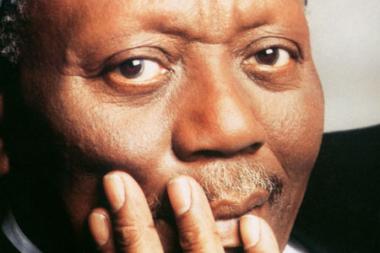
When pianist and composer Randy Weston takes the bandstand, people look up to him. This is not just because he stands six feet eight inches tall and often dresses flamboyantly in the bright colors of the African continent. It’s also because, at 84 years old, Weston has assumed the position of an elder statesman, a jazz grand master, and father of pan-African classical music.
2010 has been a busy year for Weston. He is currently touring the country with his African Rhythms Group, and releasing a new CD—The Storyteller—and an autobiography (African Rhythms: The Autobiography of Randy Weston, a collaboration with noted jazz writer Willard Jenkins). He performs at the University of Massachusetts on Nov. 18 as part of Art & Power in Movement—Rethinking the Black Power and Black Arts Movements, produced by the W.E.B. Du Bois Department of Afro-American Studies.
This year also marks the 50th anniversary of Weston’s first great recording, Uhuru Afrika, a spectacular four-part suite composed by Weston, arranged by long-time collaborator Melba Liston and with lyrics by the great Harlem Renaissance poet Langston Hughes. That album appeared when there was no such label as “world music,” and few jazz musicians were including elements of traditional African music into their recordings. A large-scale concert presentation of the work was held in New York last week, featuring several musicians who appeared on the original recording.
“Thank God Candido Camero [the original percussionist] is still around, and Charlie Persip, the original drummer, is still with us,” Weston said in a recent interview. “It was a great thing, the three of us together.”
At UMass, he will perform both solo and in a duo with percussion. “I’ll do tributes to Ellington, Gillespie, Monk—you know, my main influences. There’ll be some traditional music I heard in Africa,” Weston said, “but mostly I’ll do my own compositions [like] ‘Little Niles,’ ‘Hi-Fly’—a combination of all of them.”
Weston was born and raised in Brooklyn, at a time when New York was the musical center of a developing musical scene. His father, Frank Edward Weston, gave piano lessons, and introduced the young Randy to star musicians like drummer Max Roach, saxophonist Cecil Payne and his eventual mentor, pianist Thelonious Monk.
“My Dad gave me everything. He made me take piano lessons, and he gave me access to all that great music. And he was a great cook! I was really spoiled,” said Weston. “In Brooklyn we had our own nightclubs, and our own ballrooms to dance, and we had the best musicians, because they all came to New York,” Weston said. “There was no television, no disco—everything was live, and our parents made sure we heard it all, bringing it into the house on radio and maybe some records later. We were exposed to the black church, calypso, jazz, the blues, Latin music—it was wonderful.”
His father also instilled in Randy a strong belief that he was “an African born in America” and that only by exploring his native roots would he be able to understand the music he heard all around him.
“How could my ancestors come into contact with trombones and saxophones, which were made in Europe, and create something new? That music was how we survived slavery, we were able to survive racism, because the music kept our spirits up when our fortunes were down,” he said, “I had to do a lot of research, and came to realize that music was created in ancient Africa, and it was created as a healing force.”
After his groundbreaking recordings in the early ’60s, Weston traveled extensively in Africa to get a feel for each nation’s musical style. He lived in Morocco for a number of years, running the African Rhythms Club there. Since his return to the United States, he has recorded with African musicians and written extensive songs and larger pieces to showcase pan-African sounds for small and large jazz groups and symphony orchestras. “I played with the Boston Pops, when John Williams was conducting,” he said. “I wrote a piece called ‘Three African Queens’ and performed with 133 musicians. It was wild.”
He documents many of those travels and meetings in his autobiography. “My life is the story of music itself, and the spiritual power of music, and how music has taken me all over the planet to meet so many wonderful people. So the book may be the autobiography of my life, but music is the star,” he said. “Because of music, I’ve been to Asia, Europe& and it becomes apparent quickly that music is the universal language. I don’t speak German, I don’t speak Japanese, I don’t speak Portuguese—but when the music is right, people understand all over the planet. One of the great gifts I’ve received is being able to take the music all over the world and spread joy and happiness.”
The Storyteller is his first CD with the large African Rhythms ensemble since 1999. As he has done in the past, Weston reworks some of his older compositions, like “The African Cookbook Suite” to accommodate the sounds of this instrumentation. He enjoys revisiting these “old friends of mine” more and more these days.
“I hope the music is timeless, so that whether it’s just me playing or a large group, and whether it’s from 1964 or 2010, it still touches the listener’s heart and soul,” he said. “If I can do that, then I’ve done my job.”
Randy Weston: Magic Triangle Jazz Series, Nov. 18, 8 p.m. $5/students, $10/general, Bowker Auditorium, UMass-Amherst, Weston also signs copies of his autobiography, African Rhythms: The Autobiography of Randy Weston. For more information visit http://www.umass.edu/fac/magictriangle/.