
In the middle of Northampton, a small brick building stands on a grassy slope, and throughout the day a colorful banner flutters outside proclaiming, “Yes!”
Ivy has started to grow over the odd, cube-shaped structure, and it’s not immediately apparent what its inhabitants are so damn positive about. It looks like grandma’s house, if grandma ran some municipal utility like the water department. As it happens, the bare-bones building first housed the city’s telephone switchboard, and it’s where neighbors of yester year met as they paid their phone bills. Subsequently, it has housed offices for realtors and accountants.
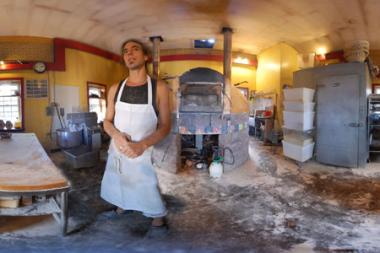
But the instant you crack the door these days, it’s clear what the excitement and affirmation is all about. Instead of drab carpeting, the cement floor is covered in a swirl of white flour. Instead of a switchboard or office desks, there is a large table with a wooden top, and in the center of the room is an even larger wood-burning oven.
When bakers Jonathan Stevens and Cheryl Maffei bought the building in 2003 to house Hungry Ghost Bread, it had most recently been a chiropractor’s office that somehow had seven rooms crammed in it. The first step was to gut the building to make room for the oven. Built by the new owners with stonemason Denis Lombardi and his daughter, the design is a hybrid between a wood-fired and masonry oven. Circled with a ring of colorful tiles, it looks a bit like an igloo, and it dominates the inside of the brick cube.
Seven days a week, every hour and a half, approximately 50 fresh loaves come out of the oven and are placed in a rack by the front door for sale. Along with their wide variety of handsomely swollen loaves of crusty sourdough breads (French Batard, 8-grain, Semolina Fennel, Kamut, Raisin, Double Wheat, to name a few), they also bake other delectables such as cookies, pies, savory turnovers, quiche, scones, brownies and buttermilk cornbread.
Stepping inside on a winter’s day can be like immersing yourself in an olfactory hot tub, and for years now, my wife and I have made it a regular stop on our Saturday morning errand run. We often get a loaf of the French Batard, if available, which fits snugly under the arm and is ready to go the moment we get home. As their website states, “Italian bread, French bread, Spanish bread, Portuguese bread: it’s all white crusty stuff. Here at Hungry Ghost, we call it French Batard.” But we’ve never been anything but deeply satisfied with any of the alternatives.
With a lump of cheese, some sliced apples, pickles, and a jar of chutney or mustard, our family makes efficient work of the loaf, slicing, tearing and picking at it all weekend long. Heading out of town to spend time with friends or family, we often grab a couple loaves to bring as gifts—something that seems to please everyone, hosts and guest alike.
In a constant ballet, moving between his oven, his counter and the cooling racks, Jonathan Stevens appears to take as much pleasure in his work as his customers do. Though he has a digital stopwatch next to the oven’s door, his personal clock seems to be in step with the rate that his dough rises. When interviewed last week, he had just positioned an oven full of bread-to-be, and then immediately launched into a discussion of what’s been new at the bakery. Fifteen minutes later, without missing a beat in the conversation, he whirled around to rearrange the baking loaves, taking several out for a few moments.
“These aren’t done,” he explained about the hot bread on his baking counter. “I’m just making certain they all get their time in the warm spot inside the oven.” Looking over my shoulder, he added, “Would you mind shutting the door?” A customer had accidentally left it ajar by a centimeter, and, while the place is toasty warm, Stevens knows even a slight fluctuation in temperature can affect his art. When all has been set right, he continues.
When he and Cheryl Maffei first began making bread, they baked chiefly with King Arthur flour. “Most people think it comes from Vermont,” he said. “Maybe they have offices up there and some kind of gift store, but the flour doesn’t come from there.” It’s grown in the Dakotas, milled in the Carolinas and trucked to New England. “If I ever had a problem with a batch of flour, I could spend the day on the phone, but no one could tell where that batch of flour had come from.”
Though Massachusetts once grew its own wheat, it was many decades ago, and when the owners of Hungry Ghost began looking for a local alternative to their nationally raised and produced flour, they found more interest than knowledge. Only when they met 93-year-old Steve Puffer of Amherst, whose family owned a mill where local farmers used to bring their grain, did they meet someone who had local experience. A conference on local grains at Hampshire College three years ago gave birth to the Little Red Hen initiative in which residents planted wheat in their own yards to be ground as flour.
“We got a lot of press for that,” Stevens said. “CNN even camped out for a couple days to do the story, but it’s what happened since then that’s more impressive, and we’ve got very little coverage for that.”
To some degree, getting residents to grow their own wheat was something of a stunt. As Puffer and others had told Hungry Ghost, there are many kinds of wheat (tens of thousands), and not all grow well in our climate or produce good bread. The Little Red Hen project allowed them to try many varieties, but until a full-scale farm devoted itself to harvesting the grains bakeries can use, locally raised bread was going to be a rare treat, rather than a staple.
Now, though, thanks to efforts at Four Star farm in Northfield and 35 acres they’ve devoted to wheat production, bread made from local grain is available every day at the Hungry Ghost. Stevens travels to the farm each week and mills for himself 500 pounds of “somewhat” white flour (it takes five hours to mill that much, so he brings a book) that he uses in his baking. Stevens and Maffei consider the extra buck for their wholly local bread a small tariff that allows their work to approach being truly sustainable. Customers seem happy to pay it.
“The heart of what’s going on here,” Jonathan Stevens says with excitement, “is the economy.” Not an economy based on abstractions or digital transactions, but something that is actual. “Four Star grows the grain, we mill it and bake it, and our local customers pay us directly, so we can do it all again.”