
One of the reasons Timothy Leary was so hot for folks to try LSD during the cultural revolutions of the 1960s was that he felt world peace could be achieved if everyone shared the revelations the hallucinogen had given him. Life is all a game, he had discovered. Or, more accurately, many different games going on consecutively: each of us adopting a truth and finding motivation in the rules we choose to live by. If we all could see that the politics and conflict between us were ephemeral—lies agreed upon—we’d see everyone as equals. Deep stuff.
Perhaps to a less intoxicating degree, some of the same revelations can be had (and enjoyed) without dosing up: actually playing a game can sometimes reveal similar truths.
After eons in which most board and card games have been competitive and adversarial (who hasn’t witnessed a Monopoly board dashed to the floor, pieces and all?), in the last few decades a new type of parlor entertainment has crept into our parlors. Instead of pitching players against one another to work out their strategies and fight for survival alone, these new games are collaborative. They require players to strategize together, figuring out ways to use the rules to overcome the events they face.
While perhaps inspired by role-playing games such as Dungeons & Dragons, collaborative board games don’t require anyone to adopt a silly voice or pretend to be anything they’re not. They’re more about problem-solving than melodrama. Instead of assuming a personality, players each perform a function in confronting a group challenge. In Forbidden Island, for instance, players are on a sinking island and need to rescue a set of artifacts before the waves crash in upon them. Each player has a unique ability (scuba diver, helicopter pilot, adventurer) that can contribute toward accomplishing the goal. Another game has players all trying to find their way out of a haunted house, and for something even scarier, another game simulates trying to stop a global pandemic.
By adopting a set of rules that realistically simulates (or approximates) the kinds of decisions people in these scenarios might face, you sometimes find yourself taking actions or thinking thoughts that you’d never typically consider.
*
Being a scuba diver on the Forbidden Island might rate low on the profundity scale, but the game offers an ideal entry point to collaborative gaming, and it was one of the most popular played by game testers here at the Valley Advocate Board Game Institute.
The game is thrilling, fairly simple to learn (ages 10 and above), and only takes a half hour or so to play. Designed by Matt Leacock for Gamewright (a Newton-based game publisher), Forbidden Island is made up of a collection of tiles that represent the title island and a stack of cards with special events. Since the distribution of the relics is always different and the flood waters never consume the island typography the same way twice, each harrowing rescue mission is fraught with different cliff-hanger situations. Every relic must be saved, and every player’s piece must make it back to the helicopter landing pad before the ocean consumes the island.
In competitive games it’s common for your best-laid plans to get ruined suddenly and inadvertently. In Scrabble, say, your word that uses all your letters and can be placed on a triple word score gets screwed up by someone spelling “it,” or maybe in poker a competitor draws a card that gives him a pair but would have given you a royal flush. In collaborative play, you’re spared such disappointments. Each player’s turn is discussed as a group and mapped out well in advance. Sharing resources (important playing cards) is the key to triumph. There are often several approaches to solving an issue, and debating the best one is the meat of the game. Instead of being frustrated by competing ambitions, players are challenged by the randomness of events (often represented by a deck of cards) and the imperative to work within the rules to react to circumstances as they arise. Believe it or not, the thrill of coordinating a successful team rescue can be equal to the high of vanquishing all challengers on your own.
*
As much as we here at the Game Institute enjoyed Forbidden Island, our expert gamers recognized that designer Leacock had reused several game mechanics from his earlier breakthrough collaborative game, Pandemic (Z-man Games). As crusty old pros, some of us felt Island was in some ways a watered-down version of the older title, which we preferred for its more dire, adult themes and complex resolution.
Like the classic board game of world conflict, Risk, the game board for Pandemic is a map of the globe, but the multicolored playing pieces don’t represent armies as they do in the game of global domination. In Pandemic, the little cubes represent infected victims of a global outbreak of several brand new, possibly incurable diseases. Racing against the spread of the diseases, players need to find cures and then disseminate the vaccines.
The outbreaks start slowly, and they’re easy to eradicate. But as the game progresses, the diseases break out in more locations and the number of infected steadily increases. Which cities become infected is determined by drawing cards at the start of each round. Once a city has initially been cleared of disease, the card with the city’s name on it isn’t discarded or put to the bottom of the deck, but shuffled back into the top of the deck. This means, once infected, chances are strong that these cities will see outbreaks continue to occur as players draw cards. At first, the logical approach seems to be to keep resources close to those key locations, but as the outbreaks spreads, you don’t have enough fingers for all the holes in the global dyke. It quickly becomes time for hard decisions.
Managing the crisis can become revelatory. Players start realizing they can’t be everywhere at once, and sometimes being fair with inoculations (spreading what little you have around equally) leaves your long-term success in jeopardy. In triage, to save one life, you may need to sacrifice others.
Saving the world from out-of-control biology can be even more satisfying than saving relics from a sinking island. But if neither scenario entices, there are many other options—many other scenarios or dilemmas to gang-tackle with your friends.
Arkham Horror (Chaosium) was one of the first collaborative games on the market, appearing in 1987. It recreates a really bad night in author H.P. Lovecraft’s fabled Massachusetts city of Arkham. Lovecraft, a Depression-era writer of supernatural fiction, was based in Providence, R. I. Many of his works imagined a world of seething, ancient horrors that lurked just below the surface of ours. Legions of monstrous creatures of extraterrestrial origin lay in wait for the day they would return to dominate our world. Players in the game act as investigators living in Arkham. Some work as professors of antiquities at the local Miskatonic University, others are clergy or gumshoe sleuths. Something evil is afoot in their home town, and only the players’ fortitude will prevent ungodly demons from breaking through to our world.
Reviews from other players indicate that the game successfully recreates the sense of panic and creep appropriate to a Lovecraft story, and though I’ve examined the beautifully designed game in some detail, I’ve yet to find a group willing to collaborate with me. It’s for die-hards only: games can run up to six hours in length.
Other options, with shorter play times, include Castle Panic, a game in which players need to work together to mount a defense against armies of monsters that appear from the woods that surround their battlements. A game based on the latest Battlestar Galactica television series offers a variation on the collaboration theme: treason. In it players get to fret over who amongst them on their space ship is an android intruder out to thwart their plans. Shadows Over Camelot offers a similar hidden-traitor challenge for the Knights of the Round Table.
*
One of the best collaborative games out there requires few props, is quick to play, and offers the richest food for mental mastication. Best of all, though several retail versions exist, the rules are in the public domain (see sidebar for instructions), and it’s free to play.
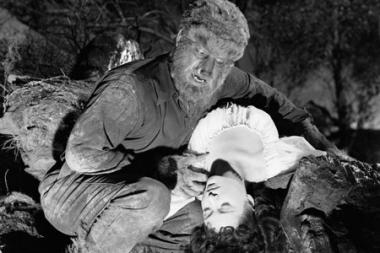
This summer, sitting outside by a fire one night at the Game Institute, my friends and I took a stab at playing Werewolf, a game I’d read about online. It’s a sort of collaborative mind-fuck masquerading as a parlor game. Instead of trivia, word play or charades, we plunged into a world of paranoia, subterfuge and cold vindictiveness. In half an hour of game play most of us ended up dead or dying, killed off by our loved ones, but we all came out laughing.
The game scenario goes like this:
You and your fellow players all live in a small, isolated village. Everyone knows everyone else. One morning, as you rise to meet the day, though, something’s just not right. You hear screaming, and as you step into your yard, you learn the awful truth: one of your neighbors has been savagely murdered.
But maybe “murdered” doesn’t tell the whole story. The grizzly corpse suggests parts of it may have been devoured. It appears you may not know your neighbors as well as you thought you did.
You’ve got a werewolf problem.
And there’s only one thing you can do about werewolves. It’s time to organize a lynch squad—one of those feel-good measures everyone can rally around when times are uncertain.
But whom to lynch is the question, and it’s a sticky one. There are no clues; it’s just one person’s testimony against everyone else’s. Though there’s open debate among the survivors each morning, victim and villain are indistinguishable. At least one, maybe two, of the people passionately defending themselves is the killer.
Not wanting to die, the hellish beasts are given to lying and employing subterfuge. To deflect blame, one of the lycanthropes might even accuse you. In turn, you can deny the charge, and even attempt to use it against your accuser. “Your warrantless accusation is evidence that you, in fact, are the killer!” you declare.
Cunning. But werewolves are cunning, too. If both of you survive that day’s lynching, when the sun sets the werewolf could be visiting your door…
Still, somehow, before night falls, you and the townspeople need to decide which of you is the bloodthirsty savage and kill him. Only when you wake up the next morning and find no one else has died will you know you’ve chosen correctly. Otherwise you need to debate and kill again.
*
Descending into a blood-thirsty mob mentality might not sound like a pleasant parlor activity, but let me assure you, Werewolf is a lot of fun. Once we got the hang of it, around 14 of us played several times in a row. Finishing the game takes no more than half an hour (townspeople win if any of them survive the nightly attacks), and in that time, you can argue vehemently with all your best chums and loved ones about why they deserve to be voted out of existence. Even the meekest and least bloodthirsty find their defiant and vindictive voices once the mob descends. It’s a great ice-breaker.
There are many variations on the basic rules, and when it was first developed by a Russian psychology professor, Dimma Davidoff, at the Moscow University in 1986, the game was known as Mafia. It became popular in European schools during the 1990s, and American interactive fiction author Andrew Plotkin added the werewolf spin to the rules in 1997.
While making the right decision about who should be lynched can seem overwhelmingly complex at times, reasoning tends to boil down to something quite primal. Instead of hand-wringing, people want action. Once players realize there’s no solid evidence to evaluate and no higher goal than survival, they get comfortable with making rash decisions quickly. Logic and reason give way to trying to influence the power of the mob.
Playing a game of Werewolf, you get a front row seat to observe the corrosive nature of fear. Ever wonder how seemingly reasonable people can rally behind tyrants or espouse ideologies that are utterly free of logic? This game gives players a glimmer of how that mindset feels. During the games our testers played, almost every time the mob first did away with those perceived either as weak (the few teens playing always met early demises) or those who had some kind of perceived advantage—since I introduced the game to the group, I apparently was a member of the elite, and wolf or not, I rarely survived the first lynching.
The game shows we’re all pretty capable of passionate and earnest deception, and many of us can be quite skilled at it. No matter how tightly the team works together, its fate is highly uncertain if it includes a traitor.
No matter what a high-resolution imagination you might have, playing a role in a collaborative game can offer a perspective impossible to achieve alone. The results can be enlightening and disturbing at the same time. Who knows how we would treat one another if everyone played them?