
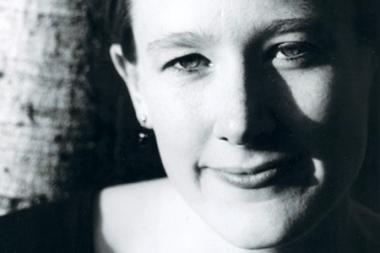
This year, I’ve seen over 100 plays by over 100 playwrights living and dead, conventional and experimental, brilliant and not-so. One dramatist has grabbed my attention more than any other, and not only because more of her plays have been performed around here than any other’s (well, except Shakespeare—there is always Shakespeare).
In this decade, Sarah Ruhl has written 10 plays and seen them all professionally performed—not only an impressive output but a rare achievement for a young playwright (she’s now 36). I saw four of them this year, three in Western Mass.; another, her 2004 breakout comedy The Clean House, was part of New Century Theatre’s 2009 season.
The adjective most frequently applied to her plays is “quirky,” and quirky they certainly are. She takes a freewheeling, almost daredevil approach to dramatic structure and isn’t afraid of putting laughter and tears side by side. Moments of magic realism—rainy elevators, intersecting geographies, Ovidian metamorphoses—are grounded in flesh-and-blood lives and passions. All her work is unabashedly heartfelt, adorably nutty and abundantly theatrical.
Dead Man’s Cell Phone, which was seen last spring at Holyoke Community College (and the previous season at TheaterWorks in Hartford), starts with the title’s what-if—a ringing cell phone whose owner has suddenly expired, answered by a bystander who then gets caught up in the life the deceased left behind. It’s an oddball comedy that looks compassionately at the lonely spaces we’ve created in this super-connected age.
Last month WAM Theater of Pittsfield produced Melancholy Play, about a young bank teller who is so exquisitely sad that people keep falling in love with her, but then get annoyed when she unaccountably becomes happy. In one of Ruhl’s most fanciful metaphors, a woman turns into an almond, emulating the brain’s almond-shaped amygdala, seat of emotions.
The Clean House, a Pulitzer Prize finalist (as was last season’s Broadway hit In the Next Room or The Vibrator Play, about Victorian women’s liberation), focuses on a houseful of women dealing with jealousy, infidelity, depression and the desire to literally die laughing.
Eurydice breaks from Ruhl’s usual contemporary settings to explore the myth of Orpheus and Eurydice, the loving couple separated forever by one moment of bad judgment. The play, staged last summer by Old Deerfield Productions, is perhaps Ruhl’s most poignant, a fable about loss—of love, home and memory.
The playwright’s most audacious work, and to my mind her masterpiece-so-far, is Passion Play, a three-part epic that looks at communities staging the passion of Jesus in three historical eras: Elizabethan England, Nazi Germany and Reagan’s America. Through that lens the play examines, passionately and poetically, the fraying and mending of faith, social bonds and individual responsibility. It was produced last spring in New York by the appropriately named Epic Theater Ensemble, co-founded by Amherst native Zak Berkman.
Recipient of a MacArthur “genius” fellowship in 2006, Ruhl especially appeals to me because she engages “big” themes playfully and with a glorious theatricality. She uses the stage to upend our preconceptions and challenge our imaginations. Old Deerfield Productions will remount Eurydice in Northampton’s Academy of Music in March—a harbinger, I hope, of still more area productions by this unique, witty, lyrical and quirky playwright.