
As Hamlet lies dying in Horatio’s arms, he implores his friend to “absent thee from felicity a while, and in this harsh world draw thy breath in pain to tell my story.” That dying wish, uttered at the end of Shakespeare’s play, inspired Zak Berkman, co-director of New York’s Epic Theatre Ensemble (and an Amherst native), to wonder how Prince Hamlet’s tragic tale would look if told from Horatio’s point of view.
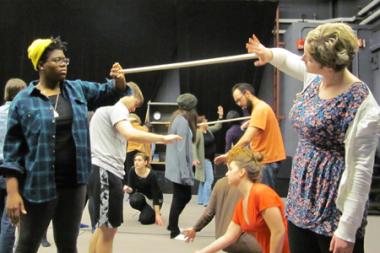
Berkman began exploring that what-if in a week-long experimental residency at Smith College last month. Some 40 students and community members worked with Epic artists on “The Horatio Project” and two other pieces in early stages of development. The participants served as both guinea pigs and co-creators—live bodies for the Epic folks to test some of their ideas, but whose contributions also created images, text and movement that will be integrated into the next stage of the development process.
I was able to sit in on some of the “Horatio” sessions as an observer and occasional participant. Berkman explained that he was interested in the idea of Horatio-as-biographer because it encompasses multiple themes, including the questions of viewpoint, identity, inclusion and omission, social/political pressures and biases that hover over every attempt at writing a person’s—or a nation’s—history. As Hamlet was instructed by his father’s ghost to “revenge his foul and most unnatural murder,” so Horatio is charged by Hamlet, soon to be a ghost himself, to “report me and my cause aright.”
During the workshop sessions, exercises in imagination—delivering a eulogy for a dear friend, finding “the ghost inside each of us”—mingled with scraps of dialogue from Shakespeare’s script and other texts, which were then included in improvised explorations. This process of deconstruction, Berkman explained, was aimed at “piecing together a mosaic from Horatio’s world—a collision of classic text and characters with new text and characters” to create “a very ‘now’ theatricality.”
Students were sent off to do research on topics as apparently diverse as ghost sightings, mourning rituals and neuroscience (one connection being the brain’s processing of visual phenomena and emotions such as grief) and created spontaneous mini-performance pieces that ranged all over the college’s theater building. The week’s work culminated in an informal performance of the beginnings of a script, overlaying Shakespearean text with fruits of the participants’ research, from diaries and spiritualist tracts to Patti Smith’s recent memoir of Robert Mapplethorpe.
The residency’s intensive week included work on two more Epic pieces a-birthing: an adaptation of The Pillars of Society, Ibsen’s study of personal and societal corruption, and The Natalya Piece, investigating issues of terrorism and human rights arising from the Chechen separatist movement. There were also ensemble-building workshops, led by Epic co-founder Teri Lamm, which contributed to the students’ own training while feeding their work in the developmental sessions.
One participant, Smith alumna Peggy Gillespie, later said she was impressed by “the organic way these ensemble building blocks led us to being able to work quickly and intuitively” in the creative workshops. “This condensed experience was deceptively simple at first, but took us deep.”