The ploughman’s lunch—the quintessential meal served in British pubs for millennia.
You can just picture the rugged gentleman farmer who started it all, sitting high atop his plough rig, parked in the shade of an oak. Morning’s work done, he unpacks a wooden box his wife had prepared for him: a hearty hunk of bread baked just that morning, a slab of sharp cheese that had ripened that week in their cellars, a selection of pickles or chutneys, a stone jar full of cider. Beneath him, his beasts of burden snort and puff, slapping flies with their tails. As he eats, the farmer can smell the dirt beneath his fingernails.
Robin Hood and his merry men must have carved up the cheese with their daggers, and it seems more than likely that Shakespeare composed at least a sonnet or two in the back corner of some pub, possibly balancing some chutney and cheddar on an apple slice between rhymes. While downing pints of bitter, no doubt both Tolkien and C.S. Lewis packed away their fair share of mustard and pickles while they met to read their manuscripts to one another at Oxford’s Eagle and Child.
You may assume all of this and more. But you’d be wrong.
Turns out the earliest reference the Oxford English Dictionary has to a “ploughman’s lunch” isn’t from ye olde times, but from 1960. The term was coined by the British Cheese Board in an effort to create a new marketplace for their product. (You always knew cheese-loving people must be smart, but not that smart, huh?)
Despite its recent and perhaps less-than-distinguished origins, the meal can be a delightful showcase of locally produced food staples if you happen to live in or near a bountiful agricultural region, as we do. While there are some substantial ploughman’s lunches served in area pubs (the Lady Killigrew has the best I’ve tried recently), unfortunately the meal is often treated as a cheap alternative to “real food”—skimpy offerings with uninspired ingredients.
You’re much better off assembling your own, as my family did for a winter dinner last weekend.
The bread and pickles were easy. I grabbed a loaf from the Hungry Ghost bakery in Northampton, and I already had a few jars of Greenfield’s Real Pickles on hand. (In England, instead of preserved cukes, “pickle” often refers to a kind of relish or chutney). There’s even some stuff called “ploughman’s pickles,” which I once thought were traditional. Now I’m not so sure, and I feel even more vindicated pickling as I please in my ploughman’s.
For fruit, we had some apples, but we also had cider. We agreed the Farnum Hill Extra Dry from Lebanon, N.H. was as good as any others we’d tried (see “A Certain Cider,” Jan. 13, 2011), but we were really floored by the growler of cider our neighbor had put down back in November—sweeter than the Farnum’s but very nicely balanced, with a nice, fizzy bite that leaves your nose twitching as it goes down. Once again, we reflected on the value of having a neighbor who brews the good stuff.
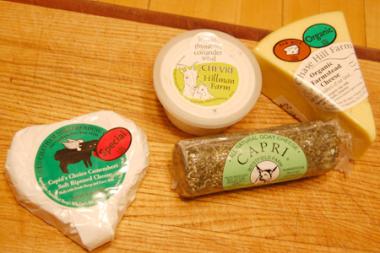
Finding local cheeses was the conundrum I faced, and one I solved by asking the friendly cheese purveyor at Whole Foods what were the most local cheeses he sold. He pointed to two goat cheeses; one log was from Westfield Farm in Hubbardston and another small container came from Hillman Farm in Colrain. The Westfield Farm log of goat cheese was rolled in parsley and thyme and offered the cleanest, least adulterated goat cheese flavor, but the one from Colrain was blended with lemon-thyme and coriander seed, and it disappeared the fastest. It had a lighter consistency (more heavily whipped?) and held on just fine to the crusty lumps of bread.
I also purchased two cheeses from farms slightly further afield. I bought a cheddar from Chase Hill Farm in Warwick and a camembert from Old Chatham, NY. I was trying to work out what I thought about the mild cheddar when my dining companion captured the taste exactly: “Too weak. Bland. I don’t like mild cheddars.” Neither do I, really, which is one of the reasons I was completely charmed by the creamy camembert.
The cheese from Old Chatham was perfectly piquant, offering that sharp, slightly noxious smell and taste that comes from the best oozing camemberts. Made from a mix of sheep and cow’s milk, the cheese was a small sampler, shaped like a heart for Valentine’s Day, and we both wished we’d gotten a larger portion of that.
Liberated from the bonds of following a time-honored list of consumables, we added a kielbasa to the mix along with a crock of French mustard I’d gotten for Christmas. The results were perfection: a slice of bread with a dollop of camembert, a kiss of mustard, and a sliver of sausage chased down by a mug of cider. Let a new Pioneer Valley tradition begin.