
Last month, Vice President Joseph Biden announced a plan to dedicate $53 billion over the next six years to investing in high-speed rail. Plans and funding are already in place to extend rail service throughout many regions of the country; this new funding would upgrade existing services and make them faster. Only in a few instances would new tracks be built. It’s his and President Obama’s goal that 80 percent of all Americans will have access to this high-speed train system within the next 25 years.
Citing a need to begin competing with France, Spain and Japan—countries that all have high-speed rail systems—Biden wrote in a recent statement, “There are key places where we cannot afford to sacrifice as a nation—one of which is infrastructure…. [A] modern rail system … will help connect communities, reduce congestion and create quality, skilled manufacturing jobs that cannot be outsourced.”
Biden unveiled the plan at Philadelphia’s 30th Street Station. “If we sit back, someone else is going to eat our lunch,” the Daily Philadelphian quotes him as saying.
As exciting as it is to hear of the government considering spending a huge hunk of tax money on something that may actually benefit the taxpayer, Biden’s pledge gives me pause.
America has a history of making bold announcements about transportation initiatives that cost a lot of money, are highly ambitious, but after promising starts, ultimately end up being ill-conceived. This was not the recipe that Europe or Japan followed to achieve high-speed rail. This stark winter has made me think Biden and Obama are attacking the national transit problem from the wrong direction. To really ease our dependence on the automobile, rather than devoting ourselves to building a high-speed system that gets us to distant places quickly, we first need to reduce the necessity for cars on a local level.
I wonder at the competitive justifications Biden gives for this endeavor. It all sounds like a tune the American people have been asked to dance to before.
*
Not Another Space Race, Please
This year will mark two historic occasions in America’s space race ambitions.
Next April 12 will be the fiftieth anniversary of the day when, at extravagant expense to the Soviet people, Yuri Gagarin left the atmosphere and orbited the Earth. On a fiery plume of brightly burning fossil fuels, the human race had catapulted the first man into space. It was a triumph of transportation technology and the most expensive first-class ticket to nowhere.
Did Yuri realize what a feud he’d ignited as he circled the globe? Could he imagine the many billions of dollars that would be spent to hurl other humans up after him? Did he realize that the trail he blazed would so quickly become overgrown and forgotten?
Alas, we can’t ask him. Less than a decade after his historic flight, a plane he was test-piloting crashed into a mountain.
One writer recently explained Yuri Gagarin’s significance this way:
“This April will see the 50th anniversary of the most important event in all of human history: the first time any of us left the planet…” the blogger trumpeted. “Admittedly, this is a bit like dipping the tip of your toe into the ocean and considering yourself a great mariner, but many of us hope this event will be remembered as the first day of the migration of humanity to the stars.”
I’m often reminded of all we have to be thankful for in terms of satellite technology (weather tracking, telecommunications, global positioning, Google Earth), but as far as I can see, in terms of advances in public transportation, the investment in the space race did not get us very far. Despite Yuri’s death-defying efforts and those of every other American astronaut who followed him, public transit options for most earthbound Americans dwindled while they were gaping skyward.
Ironically, options for American astronauts will soon be limited on this 50th anniversary of human space flight.
The last scheduled trip of the space shuttle Discovery was in February, and in June the Atlantis will retire the fleet with one final trip aloft. Overall, the cost of the space shuttle program has been roughly $150 billion dollars. Flights initially cost around a billion each, but advances in technology got the price down to around $500,000-$700,000 per journey. There are no immediate plans to return heavenward on American-made ships; when they want to tinker with their satellites or install new ones, for the time being, the U.S. government and the corporations will need to hitch a ride with the Europeans or Japanese instead.
These nations, as Biden noted, all also have high-speed rail.
*
On Track
While the U.S. was spending big hurling a few hand-chosen individuals skyward in the last 50 years, Europe and Japan—all of them rebuilding from a catastrophic war—were establishing the roots of transportation systems that thrive today.
Profit was rarely part of the concern in designing these foreign systems. Just as most Americans didn’t expect a return on investment in the space race or look to their military to make a profit for the taxpayer, people in other nations agreed to incur the costs of a public transportation system that met their everyday needs.
While American technicians and planners were focused on heat shields to protect their space craft from burning up while re-entering the atmosphere, their counterparts in other nations were working on how to make transit systems reliable and accessible to as many people as possible. Instead of reaching for a lunar landscape, they were working to get everyone—from toddlers to seniors—where they needed to go reliably, affordably and in all kinds of weather.
Any successful rail system, whatever its speed, requires much more than top-notch technology to make it successful. It needs riders. Not only have France, Spain and Japan made the investment in the science and planning that makes high-speed rail possible, they have populations for whom public, high-quality rail transportation is a regular ingredient in an ordinary lifestyle and has been so for generations.
Inflicting a rail system on a nation where public transportation is largely thought of as the poor man’s alternative to owning a car seems primed for being another expensive transit fiasco: fast trains that nobody rides are about as useful as a space capsule.
*
Why Roads Rule
Despite Biden’s concerns, the time for worrying about anyone eating America’s lunch in terms of rail superiority has long since passed. The last time the U.S. had a seat at the table was in the 1940s, and even then the world class rail system was beginning to erode.
In an address given at a rail summit last year, rail expert Mark Reutter pointed out that “between 1935 and 1950, the 10 fastest scheduled passenger trains in the world were all U.S. streamliners.” These trains, with names like the Silver Meteor, Denver Zephyr or Rocky Mountain Rocket, all traveled between cities, some approaching speeds of nearly 100 miles per hour. “American railroads and equipment suppliers had not only pioneered the diesel-electric locomotive—a quantum leap over from the old steam locomotive,” he said, “but [they] introduced lightweight cars with better wheel sets, couplers, braking systems and lower centers of gravity to negotiate curves at higher speeds.
“The interiors of these streamliners abounded in creature comforts—wide double-paned windows, recessed fluorescent lighting, luxurious reclining seats and the first air conditioning found in any commercial transport,” Reutter continued. “Streamliners attracted customers by the carload. In fact, they made money. Wall Street consultants Coverdale and Colpitts surveyed 58 streamliners in 1948 and found that they grossed $98 million and netted $48 million after out-of-pocket costs, for a return of 49 percent.”
It’s easy to assume that railway’s demise in America was somehow Darwinian, that rail could not compete against the superior, cheaper automobile. But that assessment forgets the hidden costs in America’s commitment to the car.
American taxpayers have spent hundreds of billions to build the highway system and hundreds of millions annually to maintain it, and in recent years have paid for massive financial bailouts to keep the auto industry afloat. In the years after the Second World War, under the influence of corporate lobbyists and new competing industries, the government began looking at its commitment to public transportation as a choice between rail and roads. Roads won.
At their most successful, most trolley and train lines were privately owned. When the government decided to invest in making cars a more viable option, owners of trolley and train companies found themselves competing against the roadways they paid for with their own taxes.
Throughout the ’30s and ’40s, bus manufacturer General Motors helped bus tycoon Roy Fitzgerald buy up street rail systems. Together they surprised passengers by switching systems overnight without notice: instead of the hum of an electric trolley appearing on the tracks to greet them in the morning, riders got a bus, burning fuel and belching exhaust. The tycoon had financial support from other big businesses buying up these local rail systems, and in return, he agreed to buy their products exclusively.
In 1949, the U.S. Supreme Court found the bus company, GM, Firestone, Mack Trucks, Phillips Petroleum, Standard Oil and others guilty of colluding to monopolize the sale of buses, petroleum products, tires and tubes used by those companies. Though it was estimated that profits from the collusion had already approached $50 million (and would surely climb exponentially), the companies were fined $5,000 apiece and the individuals $1. (See Getting There: The Epic Struggle between Road and Rail in the American Century by S. B. Goddard for a thorough retelling.)
In 1956, Eisenhower launched what was supposed to be a $27 billion interstate highway system. It ended up far short of its initial goal and cost more than $200 billion. That same year, Japan began making plans for a system that would one day be able to support high-speed rail.
When it was opened in time for the Tokyo Olympics of 1964, the state-of-the-art rail system, known as the Shinkansen, had imported most of its equipment from American manufacturers. More irony: to help the economically underdeveloped country, the U.S. offered Japan substantial foreign aid to assist with the building of the railway the Americans would covet nearly half a century later. As Mark Reutter noted in his address, “The latest-generation Shinkansen runs at 188 mph, and its ancestor [which ran at 125 mph] is in a museum.”
*
Start Small, Start Local
“Imagine boarding a train in the center of a city,” President Obama said in a 2009 statement supporting high-speed rail. “Imagine… walking only a few steps to public transportation, and ending up just blocks from your destination.”
It’s a vision I share with the president, but it’s not clear to me how high-speed rail will make it a reality.
Federal stimulus funding is already in place to upgrade the rail lines along the Pioneer Valley, and in about two years’ time new stations will open along the river. There’s already talk that some of these lines will be upgraded to allow high-speed travel. But beyond the promise of this train line, the local public transportation options in many of these cities and towns are limited or non-existent.
Step off the high-speed train in Brattleboro, and you’re in an alley behind some buildings down by the river. High-speed visitors getting off at the proposed station stop in Holyoke will find themselves surrounded mostly by abandoned buildings. Many of the attractions that might bring visitors to American towns, like hotels and restaurants, are located where there is ample parking—on the outskirts of town.
When many of the Valley’s fine old train stations were originally built, they didn’t have giant parking lots attached; they were built in proximity to existing local trolley systems. Walk down the train platform in Springfield toward the river and you can see the remnants of the trolley platform, where cars waited to take you along a Valley-wide network. Today, if the train were to stop in Northampton, departing passengers could get a steak or a plate of spaghetti, but if the Hotel Northampton or a taxi was beyond their price range, good luck figuring out the PVTA bus system.
“This is not some fanciful, pie-in-the-sky vision of the future,” Obama said of his imaginings. “It is now. It is happening right now. It’s been happening for decades. The problem is, it’s been happening elsewhere, not here.”
Another ingredient of working high-speed rail systems in other countries is that, beyond the ability to travel the main arteries between cities, there are also options on the capillary level. Stepping off the high-speed train in Europe or Japan, passengers aren’t just abandoned to their own devices. Clearly marked buses, trolleys or local train systems are available to take them to their next connection. These local routes didn’t spring up around a high-speed infrastructure, but conversely, they’re what make high-speed trains a viable alternative to the automobile. It’s what made the trains possible and profitable.
To make his announcement of the recent proposed high-speed rail funding, Biden chose the platform of the train station he once commuted from in his years as a senator. It’s been reported that he’d made upwards of 8,000 train trips from that station. While Obama’s promise to have 80 percent of Americans connected to high-speed rail by 2025 sounds like a trans-continental improvement, the plan is to upgrade mostly existing rail infrastructure along the coasts, particularly in the Northeast.
Investing in upgrading infrastructure is always a worthy venture, but it isn’t clear how shaving time off existing daily rail commutes will transform our transit future or decrease our reliance on fossil fuels.
While high-speed rail in Europe and Japan means trains reach speeds approaching and surpassing 200 mph, those lines were built to accommodate such speeds. American lines were not, and while the ultimate goal is to match foreign speeds, most trains will run at around 90 mph. Amtrak’s Acela trains on average travel at around 70 mph. A Department of Energy report found that the amount of electricity required to achieve speeds of 110 mph will make the trains even less energy-efficient than automobiles.
The age of the automobile means many Americans travel daily from their home in the suburbs to a job at an office park outside town, far from where these high-speed trains will stop. Without viable local public transportation in place, high-speed rail won’t reduce congestion in American regions that are only navigable by car.
If the U.S. government is going to start a serious campaign for rail to compete with the automobile for passengers, high-speed seems the wrong end of the track from which to start. It’s time to learn the lesson of Yuri’s flight: conquer the short distances before the long ones. Instead of boldly venturing forth at great haste, to conquer our dependency on rubber wheels, it’s time to return to something that worked.
Aesop knew a lot about transportation planning: in the long run, the tortoise will always beat the hare.
*
Long Live the Trolley!
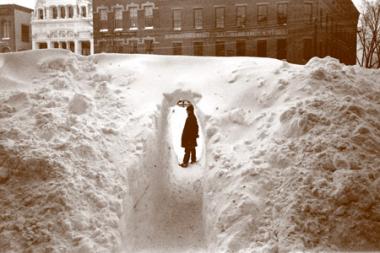
Recently, via a neighborhood email thread, I was sent a photo of the Northampton streets after a blizzard in 1888. The photograph appears to have been taken from the sidewalk outside where the retail store Faces now is, looking across Main Street to the corner where Ritz Camera resides.
Someone stands on the other side of a tunnel dug through the snow bank, looking up the street into the distance. After marveling at the height of the snow, the first question that comes to mind is: what is the person in the photo looking at?
Northampton had a horse-drawn trolley system in 1888 that ran through most of the city, eventually traveling all the way up into Williamsburg and Easthampton. I imagine this person’s searching the snowy length of Main Street for a sign of that trolley to take him, and perhaps his photographer friend, wherever it is they want to go. The person in the photo lived in a city with transportation options.
I live in a neighborhood along South Street, a mile from the center of downtown Northampton. Like many roads in the region (such as Route 5 between Northampton and Holyoke), South Street is a particularly wide boulevard. This is because when it was built, it accommodated both cars and a trolley system. The person who first lived in my home had a trolley stop at the end of his street that could take him to his job in Hadley—or just about anywhere in the city or Valley.
Last year, Smith College student Rosalie Ray submitted a report on Resilient Transportation in Northampton for her seminar paper. It compared the city’s current mostly-motorized transportations system with the system of a hundred years ago that included trolleys. In most categories (such as transporation options, flexible capacity and resource dependence), she found a Northampton with tracks along its streets to have been far more resilient and capable of meeting the public’s needs than what we’ve got today. To get an idea of current local transportation trends, she referred to a survey of staff commuting habits the college submits every other year to the Department of Environmental Protection.
Noting that Smith offers on-campus housing for some of its professors—which would skew the data in favor of pedestrian traffic compared to the rest of the city—Ray found: “The mode breakdown at Smith is 69 percent single occupancy vehicle, 15 percent walk, 9 percent carpool, 5 percent bike, and 1 percent take the bus. … 78 percent of employees ride in a car to work, and it is likely that over 80 percent of Northamptonites do.”
Eradicating the necessity of making these commutes by car seems our best bet for combating congestion.
Ray’s report points out that current bus systems in the Valley and elsewhere were not even designed to meet the needs of the general public. Once trains stopped transporting people in the late ’50s, Ray wrote, “The government, for the first time in those heady days of the automobile age, was forced to discover that there were people who could not afford transportation services via car, and people for whom cars were not an option. The public bus subsidies first seen in the Housing Act of 1961 were aimed at serving those populations. For the entire inception of the public transit problem, it was a housing and urban development problem, not a transportation one.”
Citing the cost of rebuilding a trolley system, Ray concludes that Northampton’s best option for returning to a balance of meaningful public transportation and private cars would be by improving its bus system. But a year ago, when she drew this conclusion, no one was talking about investing $53 billion into our transportation infrastructure.
The Republicans have already called the high-speed rail plan “insanity,” and the budget is likely to be whittled and cut dramatically, if it ever survives. My advice to the administration? Learn from the space race. Instead of trying to impress us with wild ambitions for future travel, begin building practical infrastructure that works for everyone today and endures long enough for our grandchildren to use it. Instead of worrying about getting us somewhere distant quickly, get us across town reliably.
Whether it’s buses, trolleys or monorails, we need to find ways to shrink our parking lots and give more people—in urban and rural environments—the option of living life comfortably without a car. Visitors can’t be left with their luggage at the train station. There is no short-cut for a strong national rail system: it begins locally.
In 1893, five years after that blizzard photo was taken, the Northampton Street Railway became electrified and expanded. Rosalie Ray’s report shows that for much of the next 40 years it was profitable—until the car was “proven” to be more affordable, and the government began to subsidize the oil-burning industry.
Next time we have a January filled with snow, it sure would be nice to hear that trolley bell as I trudge to work.