Growing up in Springfield, Amaad Rivera says, he didn’t have any openly gay adult role models. When he came out at 18, he didn’t have anyone to talk to about what he was feeling and experiencing, and neither did his mother.
“I grew up here, and I’ll be honest: I never met an openly gay person until I went to college,” Rivera recalls. He was in his 20s before he came upon Out Now, a queer youth group. “For 26 years, I never had anyone create space for me as a young gay man. I had to create spaces on my own,” he says.
Now 30, Rivera has found his way; he’s a graduate student, a community activist and, since January, Ward 6’s representative on the Springfield City Council. (Rivera, the second-place finisher in the 2009 election, assumed the seat after the mid-term resignation of that race’s winner, Keith Wright.)
Still, he says, his path would have been smoother with the support of a local LGBT community.
Make no mistake: Springfield does have a significant gay population. Last year, the national magazine The Advocate (no connection to this newspaper) named the city the nation’s 13th “gayest” city—a list, the Springfield Republican reported at the time, compiled somewhat unscientifically using criteria “including the number of same-sex couples, gay bars, gay films rented on Netflix, gay elected officials and statewide marriage equality.” And a website, glbtspringfield.com, promotes the city as a “gay and GLBT-friendly city of 150,000 in Western Massachusetts.”
“In the past few years, gay and GLBT folks have moved here from places such as Los Angeles, New Orleans, and Boston solely for the value of our houses and our ease of access to the region,” the site, co-founded by longtime civic activist Bob McCarroll, boasts. “Here, you can get a jumbo house without a jumbo mortgage, and you can get legally married!”
But somehow, Rivera says, his hometown’s sizeable-and-growing gay population is still, to a large extent, invisible. And, he adds, “It’s not that we’re just invisible. We’re not respected. & We’re in trouble as a LGBT community in Springfield. We don’t even have an agenda.”
Recently, Rivera says, he began pondering what could change that—what would help the city’s gay population coalesce, become vocal and visible. “What is the one thing that brings a LBGT community together?” he asked himself. His answer: “A Pride.”
Next week, Springfield will host its first Pride celebration in about a decade.
*
Once Rivera settled on the idea of re-establishing a Springfield Pride week, he called Holly Richardson, a community organizer with Out Now.
“‘Okay, yeah, it’s time to bring a Pride back,'” she recalls Rivera saying in that conversation a few months back. “‘It’s time to do it; let’s do it in May.'” Rivera, Richardson says with a laugh, was “talking a million miles a minute, a hundred things coming out of his mouth at once.”
Richardson’s first thought, she says, was, “May? No. No.” That was already a busy time for Out Now, with the group bringing its young members (its target demographic is youth up to age 22) to other Pride events, including those in Northampton and Boston. But the two kept talking, organized a small committee and decided to aim for a modest Pride week in June. “Amazingly, all this stuff started to come together,” Richardson says.
The celebration will begin with a June 8 screening of the documentary Out in the Silence. Other events will include a City Hall flag-raising ceremony, a Town Hall meeting, a youth celebration, and the culminating celebration on June 16. (See below for full details.)
*
Rivera and Richardson both describe this year’s Pride celebration as a possible warm-up for bigger events in the years to come, a chance for a somewhat fractured community to come together and start talking about ways it can do more.
Springfield, Rivera says, still has a good many “unresolved issues” regarding its LBGT community, from bullying of gay kids in city schools to a lack of city-backed HIV/AIDS programs that work specifically with gay people.
Rivera describes himself as the first openly gay city official (state rep Cheryl Coakley-Rivera—no relation to Amaad Rivera—is a lesbian who spoke openly about her sexuality during the legislative debate over gay marriage several years ago). On the campaign trail, he says, he’s faced both outright homophobia and oblique references to his sexual orientation, such as pointed questions about why he doesn’t have a family. Some of his City Hall colleagues, he says, had no idea what he was talking about when they first heard him use the acronym LGBT. (For those who missed the tutorial: “lesbian, gay, bisexual and transgendered.”)
“We don’t have a space for us,” Rivera says, noting that he and many other LGBT Springfield residents head out of town—to Northampton, Hartford, Boston—to go on dates, socialize or attend political or activist events. “They spend their money and enjoy their time outside of Springfield,” he says. “People feel there’s nothing here for them. That’s what I want to change.”
The city has a strong and vibrant LGBT community, Rivera adds. “Pride is a way to bring us together, get us together to work to get our voice.”
It’s also an opportunity for city government to acknowledge and show its support of that community, says Rivera: “It’s important, as an openly gay elected official, that I help make my community visible.”
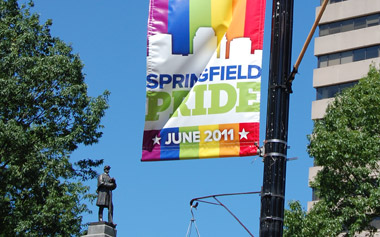
To mark the event, the city’s Department of Public Works has hung for organizers a dozen Pride banners—designed by Todd LeMieux, and featuring the Springfield skyline against a rainbow background—in the Court Square area. On June 9, Mayor Domenic Sarno will raise a rainbow flag outside City Hall, and Rivera and City Council President Jose Tosado, among others, will address the crowd.
All city councilors, as well as the members of Springfield’s legislative delegation, have been invited to attend, Rivera notes. ” I think it’s going to be fascinating to this community to see who’s going to support them,” he says. “I can’t wait to see who shows up.”
*
What is Rivera’s dream for Pride week? “I just want lots of people to show up,” he says. “It’s new—it’s newish. It’s a new approach. No one’s ever done a visibility week.” Neither he nor Richardson could say exactly when Springfield last held any kind of Pride event (the Republican reports that it’s been at least a decade). And those earlier events, they say, were more like large block parties, centered at city nightclubs—not exactly the right setting for the young people she works with at Out Now, Richardson points out.
For Richardson, the visibility aspect of Pride “is huge.” The week will be a chance to build connections within the LGBTQ (the term Richardson favors; the “q” stands for “queer”) community and with allies in the larger community. It will also be an opportunity for “somehow assessing the state of the LGBTQ community in Springfield,” and defining goals for the future, she says.
That process will have special significance for the youth she works with at Out Now, and for young LGBT people across the city. “I hope they get a chance to see that in Springfield, we care in the community,” she says. “You don’t have to just keep leaving the city to feel pride &
“It’s not just about pride, necessarily,” Richardson continues. “We don’t have equal rights. The fight isn’t over; we’re still in the liberation struggle. Some of the work is still before us, for equality and justice. I think for young people to become part of that can be, as we’ve seen in Out Now, so vital—for young people to really be able to express themselves.”
Pride week, she says, will be a chance for young people “to come out and be part of things.”
Richardson is particularly delighted by the presence of the Pride banners in downtown Springfield—and by the fact that it was city workers, not event organizers, who hung them. “It’s a cool thing that the city did that. There’s this sort of government, institutional recognition.” That along with the City Hall flag-raising are “sort of little things, but they’re symbolic, and they add up to bigger things,” she says.
And for young people who are still trying to find a community within their hometown, such symbols are especially important. “Those are not flags in Northampton, they’re not in Boston. They’re in Springfield,” Richardson says. “It tickles us all pink—and I say pink on purpose. It’s thrilling.”
*
Pride Events
• Wednesday, June 8, 6 to 8 p.m. Screening of the documentary Out in Silence, with filmmaker Joe Wilson. Springfield Technical Community College, Scibelli Hall Theater
• Thursday, June 9, noon. Flag raising at Springfield City Hall
• Thursday, June 9, 6 to 8 p.m.LGBT Town HallSpeakers include rep-resentatives from Mass Equality, GLAD (Gay and Lesbian Advocates and Defenders), Springfield’s faith community and LGBT youth groups.
Springfield Technical Community College, Scibelli Hall Theater
• Thursday, June 16, 7 to 9 p.m.Youth Pride CelebrationOut Now, 32 Hampden St.
• Thursday, June 16, 10 p.m.. Pride Week Celebration Party OZ Nightclub, 397 Dwight St.