
For decades after Woody Guthrie’s death in 1967, his children didn’t believe that any recordings of the legendary folk singer’s solo concerts had survived.
In 2001, though, 80-year-old Paul Braverman found two recording reels deep in his closet. They contained an almost complete Guthrie concert given in Newark, N.J. that Braverman attended and recorded over 50 years before, in 1949. He donated the two fragile reels to the Woody Guthrie Archives.
The concert was recorded with technology that’s since disappeared—an inexpensive wire recorder. Instead of spools of magnetic tape, as you’d find in a cassette, the spools were made of thin magnetic wire. It took years to extract the music and clean the recordings, but in 2007 a limited edition of the album was released along with a companion book, which—even though it was awarded a Grammy for Best Historical Recording—quickly went out of print.
In April, Burlington, Mass.-based Rounder Records re-released the album on CD, including the book as a PDF.
For those interested in Guthrie or folk music in general, the album is revelatory, giving a glimpse of an untamed folksinger, warts and all.
*
Though Guthrie performs his music solo on his Gibson guitar, he’s not alone on stage. He shares it with his second wife, Marjorie Mazia, who presents the songs and attempts to direct the show. She was a member of the Martha Graham Dance Company, and at the time, the breadwinner for their family of two boys.
Throughout his career, on many of his guitars, Guthrie had emblazoned “This Machine Kills Fascists” and, though he never was a member of any communist organization, his songs made his politics clear. In the early 1940s, he had been a member of the Almanac Singers, which included his friend Pete Seeger. By the time of the concert, Senator Joseph McCarthy’s black list had made his finding work alone almost impossible.
So from their home on Mermaid Avenue in Coney Island, Marjorie worked her connections and landed them this small gig at a distinguished brick and granite theater on Kinney and High streets which also served as the local Jewish community center. There were fewer than 50 people in the audience, and Marjorie was several months pregnant with their daughter Nora, who now runs her father’s archives and produced the album.
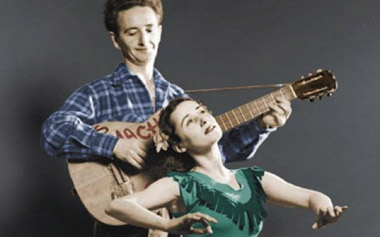
In the book accompanying the album, there’s a publicity photo of Woody and Marjorie that captures the tension between them perfectly. She is in the foreground in a long, elegant dress, sitting in a chair with her arms and head held in a refined and studied pose. There’s a flower in her hair. Her husband stands behind her in khakis and plaid shirt, guitar in hand. The slogan about fascists, painted in large red letters, is obscured by her lipsticked smile. His smile could be confused with a cringe.
*
At one point in the evening, she comments, “You know, every time children come into our house and see a guitar hanging around, they always figure Woody must be a cowboy of some kind.”
In introducing Woody and his songs, Marjorie tries to bridge a gap she sees between her husband’s “cowboy” ways and the expectations of the audience. It sounds as if her remarks were scripted (and the liner notes verify this), and she was trying her best to rein in his propensity to ramble. After a lengthy introduction that tries to define the importance of the folk music the audience is about to be subjected to, possibly for the first time, Marjorie offers Woody Guthrie a chance to speak.
“I think that you lived such a different life from anybody else, perhaps, in this room that I think it would be interesting to know the little bit of the background of your life so they’ll understand why you wrote the songs that you did at special times,” she says. “Want to tell us about Oklahoma? That’s a favorite subject. I’m going to time you.”
“How much?” he asks. “How long?”
“Oh, two or three sentences…”
Woody talks for 12 minutes, and of course, his ramblings are all pure gold, tales of “cowboys, American Indians, negroes” and the alcohol that bound them together. He talks about living on the plains, the transient work force and the tides of prospectors and corporate bosses who exploited the soil and the people who lived there.
Later, she suggests that the song he is about to sing explains itself and doesn’t require more explanation. There’s a pause, and, as the listener has come to expect, Woody eventually responds with a long “Well…” and provides his own introduction.
*
As remarkably clear as the audio transfer and restorations are, the performance is not always easy to listen to. Though he’s mostly charming and the complete gentleman, there are flashes of something ornery from Woody. Marjorie’s laughter sometimes sounds nervous.
But it’s not just marital discord that affects the recording. When Woody finally gets to singing a song—”Black Diamond,” a song about a race horse that his parents taught him—he plays too loud and mumbles the lyrics.
Marjorie points this out as he finishes the song, only she’s more polite. She asks the audience if they can hear the words, and suggests her husband strum less forcefully. He apparently ignores his wife, and it’s not until another half hour or so that he finds his groove.
My assessment, after repeat listens and reading between the lines in the liner notes, is that Woody had apparently been drinking.
In his earlier recordings, Woody Guthrie was usually a precise and clear ballad singer. He’d use his drawl for effect on occasion, but he was never careless with his pronunciation. The Almanac Singers were particularly clipped in their enunciation, and they wouldn’t have allowed a mumbler in their midst.
Though Guthrie eventually died from Huntington’s disease, a genetic neurological disorder, early misdiagnoses pinned his erratic behavior on, among other things, alcoholism. Drinking is a subject that comes up more than once during the show, and according to the accompanying book, he was facing a world of woes that might turn anyone to drink. Two years prior to the show, he lost a daughter tragically, and when he took the stage with his wife, Guthrie was also facing “obscenity charges for having mailed bawdy ‘love’ letters to his former singing partner’s sister in Los Angeles.” Several days after the performance captured on Live Wire, he “entered the West Street Jail in lower Manhattan” to serve 10 days of a six-month sentence.
Marjorie, it seems, was up against more than a man given to rambling yarns.
*
The set list Marjorie assembled started with stories from Woody’s youth, followed by a selection of his greatest hits from the Dust Bowl and songs he was hired by the U.S. government to write that document the building of several dams—marvels of civil engineering—out West.
Woody delivers these with gusto—particularly “Tom Joad”—but it’s when his songs turn political and he’s singing of bloody labor struggles and mining disasters that he gets his edge back.
The lyrics for “Goodbye Centralia” came from the actual last words miners had written in chalk on the slate walls of the mines they died in. “Dead or Alive,” performed upon a request from the audience, tells of a group of outlaws sitting around a fire, reading a letter from the new sheriff requesting their surrender, a request which they politely decline. He finishes with “Jesus Christ,” which builds in pace and strength, finishing to thunderous applause.
As satisfying as it is to hear raw Woody Guthrie vocal performances, the real delight comes from his interactions with the audience and his storytelling. Though he commands the spotlight, he doesn’t act, or seem like a performer. His songs and stories, like those of many modern folkies, aren’t about deep internal reflection, but relate stories about others. As he wrote in a notebook in 1952, after he had left his family and returned to traveling, “I am an educator, not an entertainer.”
While listening to Live Wire, it’s often tempting to wish that the single known recording of Guthrie performing were something a little less formal and forced—maybe something from years earlier when Guthrie and Seeger sang for their supper and supported unions on the road out West.
But in many ways, seeing this up-close clash of the traditional and mainstream, represented by a deeply loving but divided couple, is perhaps more rewarding. At every turn Woody fought being penned in, pinned down or pigeonholed, and Marjorie had her hands full. In the stark relief of this conflict, a much clearer image of the man appears.