
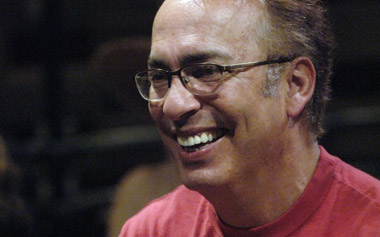
In late 2009, Tony Simotes took over Shakespeare & Company’s artistic directorship from its founder and guiding spirit, Tina Packer, who wanted to spend less time behind the scenes and more on stage. But no sooner had Simotes taken the reins and set about restructuring the theater’s sizable debt and plotting the 2010 season than he was sidelined with throat cancer.
Now he’s back, provisionally cancer-free, bursting with energy, and directing the season’s first mainstage show. As You Like It opened last week and will run throughout the summer in repertory with 10 other productions on the troupe’s Lenox campus. Last week I sat down with Simotes as he reflected on his 40-year relationship with Packer and Shakespeare.
You go way back with Shakespeare & Company, don’t you?
Simotes: Way back. I first met Tina at NYU in the early ’70s, even before the company began. She came in as a guest director. Kristin Linklater, Kevin Coleman and Dennis Krausnick were also there, and we became the nucleus of the company. But I was like the wayward son. I didn’t want to stay here in the Berkshires, I really wanted to be in New York, and get to Broadway and do movies and television. So I went away.
But you kept coming back.
As I grew with the company, I grew not only as an actor, but I took on the role of fight master. So I was constantly coming back, and watching us mature as artists. The things we take now for granted, in terms of our training methodologies, were really just forming at that time. It was really a lot of hit and miss as to what worked and what didn’t. We had our disasters along the way, trying to sort out what really helps the creative artist, the actor, achieve a deeper meaning within the text, as well as their own sense of themselves.
Working with Shakespeare’s language must affect the approach.
Years ago, Kristin Linklater mentioned that she felt orchestra conductors have special lives. They’re constantly feeling the music and the harmony move through them, and somehow this positive vibration gives them a better life. I think the same thing happens to us doing theater, doing Shakespeare. When you’re in the room, and you hear the vibration of this language, you can’t not be affected by it. I started off as a musician, and I still deal so much with rhythm and almost the melody of language.
Is that true of your work with As You Like It?
The play is full of music—there are songs all over the place. It starts off with deception, disguise, banishment and threat of death, and by the end of it there are eight people getting married. It’s a magical moment, and there’s music and dance and celebration. I feel that Shakespeare’s language is a kind of music that is truly transformational.
It’s not just poetry—you feel somehow you’re in a place that’s truly magical. Something spiritual is really happening. I feel very fortunate to hear and feel the language that Shakespeare, touched by the hands of angels, gives us every day in the rehearsal room.