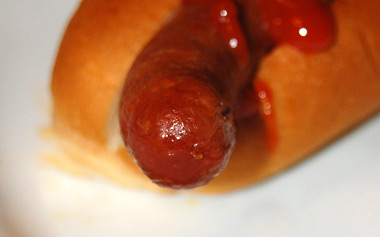
Like most kids growing up in America, early on I developed a soft spot for the hot dog.
While others were balancing their plates with one dog and a cheeseburger, I was going for two dogs. I grew up in the suburbs, so my first introduction to this delicacy was eating plastic-wrapped wieners from the supermarket, smothered in catsup at some kid’s birthday party. When I was about six, my parents house-sat for some friends who had a place in New York City, and in one day I ate a Sabrett dog from a vendor outside Central Park and another from Nathan’s out on Coney Island.
I had something of a hot dog epiphany that day. A really good hot dog didn’t need to taste like a bologna stick; it didn’t need to be drowned in catsup (or any other condiment); and in the world of the quality dog, there was a spectrum of flavor between dogs from different locations.
Having spent most of my adulthood in New England, I’ve learned that this kind of regional pride in what we put between our buns extends across the Northeast. Wiener production seems to have once been a cottage industry in Connecticut, given the number of times I’ve heard former residents brag about their home town hot dogs.
I’ve also been party to heated disputes between those who frequent Whately’s Tom’s Long Dog and those who prefer Holyoke’s Nick’s Nest. But while each vendor’s dog is made from a many-decades-old family recipe, neither is made on premises (Nick’s gets its dogs from Muckie’s in Connecticut, and while Tom’s doesn’t “share vendor information,” it does concede that its wieners are not made at their point of sale).
Until recently, it was something of a trick finding a local dog.
The last time I’d spoken to Mike Pekarski of Pekarski’s Sausages in South Deerfield, it was just before Easter (see “The Honest Sausage Maker,” March 31, 2011). When I’d asked him if he had any future ambitions for expanding his craft, he’d instantly said, “Hot dogs.”
On a visit in July, I discovered he’d already started his quest to craft the perfect dog. I bought a half dozen to try them out.
Whether grilled outside or zapped in the microwave, these dogs were ideal. Rich with flavor, but without the saltiness of a store-bought dog, they needed no condiments. Particularly satisfying was the snap of the natural casing when you bit down, and the burst of flavor that followed. In the first hot dog I’d ever eaten that was made anywhere near my home, I was delighted to find perfection.
When I called Mike to congratulate him and learn more about his creation, he wanted me to understand that it was still a work in progress.
“Ideally, the hot dogs should only be smoked for 45 minutes to an hour,” he said, “and then they’d be put in a steam cabinet that would finish them off.” Steaming them would make them a little lighter in color, and he thought it would preserve more of their juiciness. Currently they’re smoked for between two and two and a half hours until cooked.
He might have waited until he could afford the steam cabinet, but since he first made his declaration that he hoped to make the perfect dog, he said everyone’s been hounding him for it.
“Old customers and new keep coming in, asking if I’d tried to make hot dogs yet,” he said. “So I dusted off an old recipe and gave it a go. It’s a mix of both pork and beef—just a little beef—and it has a sheep casing.”
He’s also been fine-tuning the ingredients some, and he said each attempt is getting a little closer to perfection. He recently added a large batch to his inventory, but he’s taking half a week off to vacation at Old Orchard Beach with the family. After that, he promises to return to work on the Valley-defining hot dog.”