
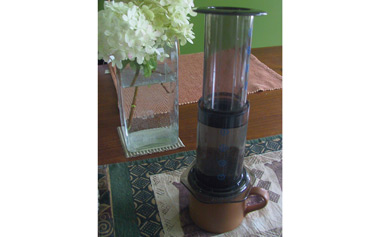
In the age of the ever more common GERD (gastroesophageal reflux disease), not to mention the increasingly sophisticated palates of coffee drinkers, the search for a really fine cup of coffee can get complicated. If you want something low acid (some American stores now carry Idee Kaffee, for instance, a Dutch brand with a patented low-acid roasting process), it can be thin and unsatisfying, more what a friend of mine calls a “cup of brown.” Unfortunately, acidity is responsible for a prominent portion of coffee’s taste profile.
If low acid is your only hope for continuing to quaff the bitter bean, you may, like me, find yourself on a long search for really good coffee that meets that low-acid demand. That part of my quest ended a while back. Local coffee roasters extraordinaire Indigo Coffee produce an Italian Roast touted as their lowest acid offering. It turns out that darker roasting reduces acidity, and to my palate, that’s a fine thing. Indigo’s Italian is a nearly black bean, and it’s uncompromising in the flavor department. I regularly march over to Northampton’s State Street Fruit Store to stock up (you won’t necessarily find Italian Roast everywhere Indigo is sold).
So far, so good. But once you have the beans, you have to turn them into coffee. How you do it makes a tremendous difference to the acidity of the finished product. My own quest has involved the usual suspects—the old reliable drip maker, a home espresso machine, a French press—and less common methods like a vacuum pot, cold-brewing, and the stovetop espresso, or “moka,” pot.
Because the results seem maddeningly dependent on how one’s biology happens to deal with acidity, as well as the flavor profile each method produces, it’s hard to make blanket statements. For me, the worst offenders are clear: drip, often dull anyway, brings out the worst in low-acid coffees, accentuating bitterness at the expense of subtler elements of taste. Because I love making coffee with it, I reluctantly admit that the vacuum pot, which bubbles up mad scientist-style on the stovetop, makes very clean-tasting and subtler coffee that nonetheless proves, for me, too acidic. Cold-brewing is low acid, if not particularly a flavor standout (too much like drip for me).
The best coffee of the lot in terms of intensity of flavor and tolerability comes from the moka pot, that Italian icon that produces espresso-like stuff that’ll snap your eyes wide. For a year or so, that’s been my go-to, a reliable way of making a little coffee that goes a long way. In fact, it saved me from having to give up coffee completely.
Now my moka pot has received its only major challenge, and stands in serious danger of retirement. I’d seen the AeroPress before, but never felt particularly drawn to try the thing—its smoky plastic tube and black accessories make it seem too much like the gaudy Delorean of coffeemakers. That kind of coolness deficit is generally unacceptable. But recently, new information came to light. The AeroPress makes measurably lower acid coffee.
This unusual contraption works in a manner that’s not quite like anything else. It’s the brainchild of Alan Adler, most famous for designing the Aerobie flying ring. He’s also a coffee fan, so he turned his inventive spirit toward producing the best possible cup. His coffeemaker may look funny, but it produces astoundingly good coffee. A top-end espresso machine would have serious trouble matching its results, not to mention its consistency. This weird (if BPA-free) tube makes some seriously excellent brew.
I’m not alone in that opinion—the Aerobie site touts quotes from some heavyweights. Kenneth Davids, author of Coffee: A Guide to Buying Brewing and Enjoying, Espresso: Ultimate Coffee, and Coffee Roasting: Romance and Revival, said, “When used properly, AeroPress produces a remarkably good straight espresso-style coffee and an excellent American-style taller cup. In fact, it produces a better espresso-style coffee than many home machines that cost 20 or 30 times as much.” And Vogue food editor Jeffrey Steingarten said, “I was able to taste qualities that I had mainly read about before, particularly on the floral, fruity, and sweet end of the spectrum.”
The AeroPress is sort of an upside-down French press, complete with a paper filter. When you hear the directions it may seem hard to believe, but the coffee it creates is even more intensely flavorful than French press brew. It’s closest to espresso. It may even be espresso, though the coffee geek community is fond of denying that name to anything that doesn’t employ the exact methodology of traditional espresso machines.
To use the AeroPress, you pop it atop a mug, then put in one scoop of very finely ground coffee per espresso cup. You then pour in heated water, up to the number of cups. Stir 10 seconds, then put in the plunger. Slowly press the plunger all the way to the bottom. Total time: about 30 seconds.
The short brew time seems as counterintuitive as the other key element of the process: water that’s 175 degrees Fahrenheit. This is reportedly the process of much testing and tasting by experts and non-experts, and it’s much lower than that of more usual coffeemaking methods. That element is the only part of the process that’s at all difficult—to get the water right, you must learn how long to microwave a cup of water, learn how long to let boiled water cool, or, as I do, employ a variable temperature tea kettle.
It’s a minor annoyance, but it’s worth the trouble. Everything else, even the clean-up (eject puck of grounds, rinse plunger, done), is incredibly simple. If you’ve used a French press, a 10-second brewing time may seem comical. It makes more sense when you consider how quickly espresso machines work. However Adler arrived at the figure, it works beautifully.
After you’ve brewed your cup (from a single shot of espresso to four), you can top it up with hot water to make an Americano, top with milk to make a latte, or drink straight. Especially if you drink it straight, you’ll discover all kinds of flavors that are often overwhelmed by bitterness and acidity. In place of bitterness, there’s a hint of sweetness, and the harder-to-define middle notes of good espresso arrive in abundance. This is serious stuff that only happens, through sheer good fortune, to be low-acid as well.
The only bad part of discovering the AeroPress arrived after I’d used it a few times. I placed my beloved moka pot onto the stove and cranked out a cup. It took comparing the two to realize that the moka pot makes a brew that, excellent though it is, lacks the complexity of what comes from that comical-looking plastic tube. At the end of the day, that’s not a bitter pill to swallow.