
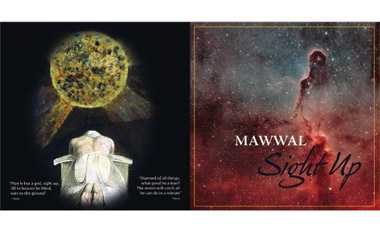
In last week’s Art in Paradise, Valley musician Jim Matus discussed his work with Mawwal, his innovative acoustic world fusion band. The band just released Sight Up, a disc Matus celebrated at an Iron Horse show with his other project, Impulse Ensemble.
In both those projects, Matus takes to the stage with his unusual instrument called the laoutar, a cross between the Greek laouto, a mandocello and a guitar. In this continuation of a recent interview, Matus discusses his laoutar, the unusual source of inspiration for Sight Up, and his other musical projects.
I asked Matus about the differences between a regular guitar and his laoutar, a similarly sized but very different-sounding instrument. He explains, “The laoutar is tuned … like a cello, C-G-D-G.” The instrument has eight strings, arranged in pairs tuned to the same note, and guitar has six strings, tuned differently. “[The laoutar] also has an acoustic/electric sound, and I use a traditional long floppy Middle Eastern-style pick, which gives it a more percussive sound.”
Matus first discovered the laouto (the inspiration for his instrument) in 1999, while engineering an album of traditional Greek music. “When I picked it up for the first time, I felt right at home,” he says, “since I had been experimenting with drop C tunings on my Stratocaster for some time in my progressive world fusion band, Paranoise.” (A drop C tuning is a much lower alternative to the standard guitar tuning.)
Matus says the laouto even inspired the creation of a new band: “It eventually became the inspiration for the prototype Mawwal band, which did acoustic arrangements of Paranoise songs.
“In Paranoise I created loops of traditional Middle Eastern melodies and wrote music around them. With Mawwal, I learned to play those songs on the laouto and sing the melodies from the loops.”
Matus seems like a restless musician, one whose ideas spawn new conglomerations of sound on a regular basis. He’s just teamed up with one of the guests from Sight Up, Laila Salins, to create a new project called Talamana. It combines Salins’ music based on Latvian poetry with folk songs.
In another new (and unnamed) instrumental project, Matus joins forces with Amherst-based jazz drummer Bob Weiner to play “jazzy versions” of Middle Eastern and other world music.
These days, Mawwal music, a highly personal brand of world fusion, finds inspiration in some heady places.
“Much of the material was written over three years ago,” Matus explains. “Although I mostly stick to my formula of combining reharmonized indigenous melodies with original music, there’s more emphasis on lyrics and less of a political message. Many of the titles and text came from lucid dreams where I could actually see the words written out in front of me or ‘hear’ them spoken. It sounds spooky, but it’s true.
“On the CD I used photos from the Hubble telescope and a painting by William Blake of a man bowing down to a mysterious object in the sky. For me, this summed up the feeling I got,” says Matus. “Blake’s language has a similar style, and his work The Marriage of Heaven and Hell has a resonant tone for this music.”
High-concept origins or no, Sight Up is an album that doesn’t sound like much of anything else, a combination of sounds Eastern and Western held together by the lyrical glue of Matus’ visions. It’s a disc full of accomplished musicians delivering sounds that channel a wide-ranging brand of mysticism, and a rewarding listen.