
Last week, as the Patriots prepared for a nationally televised Sunday Night Football game against their rival Jets for first place in the AFC East, the Red Sox continued to interview candidates for their vaunted managerial position, and the defending Stanley Cup Champion Boston Bruins finally put together a multi-game win streak, the only topic our sports-obsessed community wanted to talk about was the horrific child sex abuse scandal and apparent coverup by the prestigious football program at Penn State University—as was appropriate, with those suddenly mundane storylines rendered irrelevant amidst what many are calling the biggest scandal in sports history.
Sports and scandal, unfortunately, often go hand in hand. From Pete Rose to Barry Bonds, from “Spygate” to Marcus Camby, from SMU to USC to Ohio State University, rules and regulations are regularly broken in the name of gaining a competitive edge, or making obscene amounts of money.
But nothing prepared the sports community for this.
“This is the single biggest story in the history of college sports, an activity that began with a quasi-rugby ‘football’ game between Princeton and Rutgers in 1869,” writes Boston Globe columnist Bob Ryan. “The issue before us is a repugnant crime, not a relatively trivial matter such as a recruiting violation, or a dishonest act such as point shaving.”
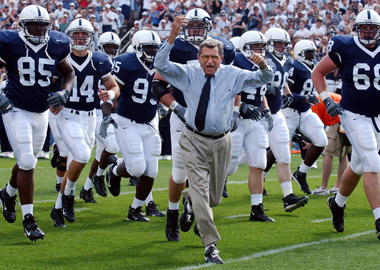
On Nov. 5 Jerry Sandusky, the longtime former assistant football coach at Penn State University, was arrested on 40 counts of sex crimes against children, crimes that allegedly occurred over a period of 15 years. Sandusky, who remained an active presence on campus despite retiring over a decade ago, was once considered the heir apparent to legendary coach Joe Paterno, who at 84 years of age became the winningest coach in Division I college football history a little over two weeks ago.
It gets worse.
Sandusky joined the Penn State coaching staff in 1969. In 1977, he founded The Second Mile Foundation, a charitable organization dedicated to serving at-risk youth. In 1998, allegations that he had showered with an 11-year-old boy, known in the grand jury testimony as Victim 6, were investigated, but Sandusky was not charged. (Ray Gricar, the Central County district attorney who did not press charges, is currently missing.) The next year, at the height of his coaching career, Sandusky retired, but retained access to the football facilities as part of his retirement package.
All of which is odd at best. The architect of Penn State’s vaunted “Linebacker U” defense, Sandusky seemingly would have been a top choice for any other big-time football school. Instead, he retired from coaching, saying he wanted to devote more time to his Second Mile Foundation.
“Did Penn State not make an issue of Sandusky’s alleged behavior in 1998 in exchange for him walking away from the program at an age premature for most coaches? Did Penn State’s considerable influence help get Sandusky off the hook?” asks Mark Madden in his Beaver County Times article which, shockingly, was printed last April. (Sandusky was arrested earlier this month, after Paterno won his historic 409th game.)
“Don’t kid yourself,” Madden continues. “That could happen. Don’t underestimate the power of Paterno and Penn State in central Pennsylvania when it comes to politicians, the police and the media.”
The world of big-time college athletics, especially football, is an arena of big-time money. “The richest college football programs got richer in 2010, pocketing more than $1 billion in profits for the first time,” reports CNNMoney.com. And that list of uber-affluent athletics includes Penn State, which reported over $70 million in revenue to the Department of Education, with a profit north of $50 million.
So much for amateur sports.
“This is what happens when a football program becomes the economic and spiritual heartbeat of an entire section of a state,” Dave Zirin writes for The Nation. “It’s no wonder that Paterno is revered. He took a football team and turned it into an economic life raft for a university and a region.”
When a system, like big-time college football, relies on institutions, like the Penn State football program, that are seen as “too big to fail,” it inherently serves the more powerful, often at the all-too-real expense of the less powerful.
In doing nothing to stop the alleged atrocities, Joe Paterno, his long-time coaching staff and many Penn State officials effectively enabled the horrific acts perpetrated by Sandusky. “[They] likely allowed a child predator to continue to victimize children for many, many years,” suggests Linda Kelly, Pennsylvania’s Attorney General. But it was their unchecked power, wielded within a system of college sports that reaps ridiculously large profits, that provided the ultimate cover for this scandal. That system is in need of thorough reform as well.