In early November, many buildings in Wilmington, Vermont’s small downtown bore posters warning “Limited Entry.” Step into what appeared to be a bakery, and you’d be met with midday gloom. Traffic roared by, but nobody was around, and everything seemed to be in the teardown stage of renovations.
Things are always a bit dead in southern Vermont after the fall foliage season and before skiing gets underway, but this was different. Wilmington—perhaps better known to skiers as home to the traffic light where you turn right to get to Mount Snow—was the scene of a disaster in the wake of Hurricane Irene. When you don’t live near such devastation, it’s easy to forget that victims of it are still caught in the struggle to reassemble their lives.
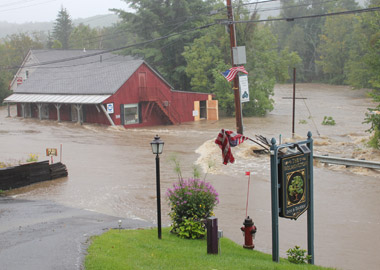
On Sunday, Aug. 28, the Deerfield River turned to a churning mass of dangerous brown water, overspilled its banks, and rampaged through downtown. Downstream, the same river rose to frightening levels in Shelburne Falls.
At the Wilmington Inn, a comfortable old rambler of a house that the affable John Pilcher and his wife Rachel took over a couple of years ago, the Pilchers, Chris and Steve Jalbert (owners of Wilmington’s Apres Vous bistro) and musician Peter Miles sat at the bar, watching the water surge through town. In John’s video of the flood, the brown water laps at the bottom of the Wilmington Inn’s lawn, and flows, several feet deep, through most of the buildings in sight. The Inn itself was untouched, thanks to its hilltop location.
The flood waters came and went, Pilcher explains, in just a few hours. The Pilchers relocated to southern Vermont from New York City just two years ago, but they felt an urgent need to do whatever they could to help their fellow business owners recover from the extensive damage. Their talk over beverages resulted in Floodstock, a sprawling musical benefit with bands from all over the region, held at Mount Snow and at Adams Farm.
“We started out talking about doing a dinner benefit,” says Pilcher, “but Peter and Apres Vous—who do a lot of live music—suggested a music festival. By the next day, Peter had committed to it, and Apres Vous had six other bands committed.”
The event raised almost $70,000. Pilcher explains that Floodstock funds were distributed to downtown businesses according to a formula that took into consideration things like extent of damage and whether owners had insurance. The money seems to have quickly helped—construction is underway up and down the main drag on both sides of the street, and a few businesses, even one right on the riverbank, had re-opened in November. Contractor trucks bore plates from as far away as Georgia.
Still, the consequences of the flood remained in evidence—garbage hung high up in riverside trees, and mud caked the edges of some parking lots.
*
Wilmington is a spread-out, rural enclave like many in the area, a web of old roads that seem to meander through the hills on their own fickle terms. The economy of Wilmington and southern Vermont in general is, of course, heavily reliant on seasonal business from skiers and leaf peepers. Recovering from Irene before the arrival of winter was vital.
The Valley saw its share of flooding, but as bad as it was, Vermont got hit even worse. Videos of floodwaters crashing through downtown Brattleboro are hair-raising, and such devastation was widespread. Roads and bridges washed out, and 13 towns, including Wilmington, became inaccessible.
David Meeker, communications manager for Mount Snow, said, “Oh, it was bad. Like nothing I have ever seen before, and hopefully I will never see again. Smaller rivers, brooks and streams turned into raging torrents. It did damage to roadways, to businesses, to homes. I’ve never seen that much water. It was quite a sight to behold.”
The damage did not end with the lowering of floodwaters, and the repairs themselves sometimes caused more. Deb Markowitz, Secretary of the Agency of Natural Resources in Vermont, explained in a press release, “Rain-swollen rivers eroded their banks, realigning their contours, sweeping fertile agricultural land downstream. Pollution washed into our watersheds and as we repaired our infrastructure, work in the rivers compounded the damage.”
The Deerfield Valley News, still full of updates about flood repair, recently reported that Wilmington alone—a town of only around 2,000 residents—sustained infrastructure damage to the tune of $2,022,000. And that’s only municipal infrastructure; the figure doesn’t include damage to private property.
Beyond the immediate damage, there’s the potential reluctance of tourists to visit an area that’s been so hard-hit. For southern Vermont, that can only compound a bad situation. Jeffrey Carr, a regional economist and consultant for Vermont, told the Boston Globe in September that tourism accounts for around 11 percent of Vermont’s overall economy. The report pegged Vermont’s fall tourism income at $332 million.
In the wake of the August storm, it wasn’t at all clear that enough roads would be open for the rapidly approaching fall foliage season. But, Meeker explains, “The more impressive thing has been our recovery. It’s been incredible. In the midweek after the Sunday storm, we had over 40 men and women from the Army National Guard Corps of Engineers who arrived. They stayed about a month, rebuilding roads and culverts.”
That and other reconstruction work brought roads so nearly back to normal that repairs are often only obvious if you know where to look. Here and there, stretches of guardrail gleam more brightly than others beside new stretches of pavement. On a steep part of Route 100, traffic cones still surrounded a major gash of a washout in early November, but it was a rare remnant of the road damage.
Meeker says that fears of tourists staying away have so far proved unfounded. “We’ve seen and we’re kind of expecting just the opposite. Just a few weeks before the fall foliage season, accessibility was a major concern. Routes 9, 12, and 100 [the region’s main thoroughfares] were severely damaged. They were repaired quicker than I ever thought possible,” he says. “Folks came despite businesses rebuilding. They came to spend their money to support what we did have open.
“Initially, with the press coverage, people were seeing damage—not a very pretty picture. That was the story. But I think, instead of scaring people away, they were concerned,” Meeker says. “They wanted to help.”
Now that the winter season is (slowly) arriving, southern Vermont seems prepared. “For this winter, everything is fully accessible,” Meeker says. “We’re expecting folks to come up here to support the Mount Snow Valley. I’ve heard a lot of folks say they’re planning to come up here more.”
On the other hand, nature doesn’t seem to have gotten the memo this year. In the wake of flood recovery, unseasonable warmth has provided the next challenge for an area in desperate need of snow. “I’ve never seen such a tough beginning,” says Meeker. “It’s been one challenge after the other.”
Vermont has never managed to sidestep winter, so it’s only a matter of time. Once it arrives, Meeker is confident the region will be ready. “The only reason we can’t say we’re fully recovered is that there are some businesses that are still working to open their doors as we speak. But at Mount Snow and most of the Mount Snow valley, we are open for business,” he says. “This year, we made a $9.5 million capital improvement at the mountain. I think the message is that we are open for business and better than ever.”
Downtown Wilmington will, no doubt, be patched back together, and few reminders of the flood waters will remain. But many of the quaint facades of bakeries, cheese shops and colonial inns across the region stand because of weeks and months of work. Thanks to large-scale intervention by government and the military, and thanks to grassroots projects like Floodstock, Deerfield River Valley Human Web, and The Wilmington Flood Relief Fund, these small and sometimes vulnerable businesses have a fighting chance when the snow finally flies.
The Pilchers and the other organizers of Floodstock finalized their awards on Oct. 31, and posted the list of recipients. They’re humble about the results: “It doesn’t do enough for anyone, really, but it distributes money to many who really need it, and will undoubtedly bring some businesses back who might otherwise not re-open.”
The view from the Wilmington Inn is peaceful now, and the river only meanders where once it raged.