
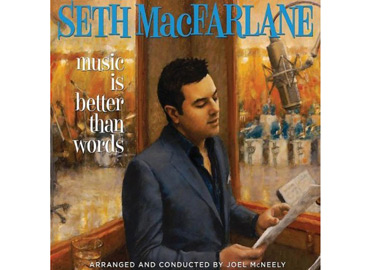
Seth MacFarlane
Music Is Better Than Words
(Universal Republic)
Who knew? The omnivore of Gen X pop culture behind Family Guy turns out to have a parallel obsession with the details of mid-’50s classic pop. Rather than the later hard swing of Bobby Darin or the loose swagger of the Rat Pack, this recording evokes the more subtle heartbeat rhythm of balladeers Dick Haymes, Vic Damone, and earlier Sinatra—specifically their Capitol recordings. Using the original Capitol studio and some old-school recording techniques for a set of under-exposed songs of the era, MacFarlane and arranger Joel McNeely create something that is neither pastiche nor nostalgia: “The Sadder but Wiser Girl” becomes an up-tempo swinger, and “Laura” is all atmospheric noir. And duets with Norah Jones and Sara Bareilles show that MacFarlane sings in the big leagues with swing and style. No joke. —Peter Sokolowski
*
The Strange Boys
Live Music
(Rough Trade)
On their third full-length album and first away from indie label In the Red since 2007, this sextet of Texas-based garage rockers finally allows its music room to breathe. And it’s no wonder. After all, this is not a live album. The “live” in the title rhymes with “give” not “five,” but that doesn’t mean the music from the band lacks energy. Instead, the slower tempo here creates an engaging country rock vibe that wouldn’t be out of place in a Deep South honky-tonk or Delta juke joint. Opening cut “Me and You” begins with twinkling piano before culminating in ecstatic group shouts led by singer Ryan Sambol. And later harmonica parts join with spindly guitar lines and organ to underscore his unique vision. Though cobbled together from separate sessions that caused the halves of the record to be recorded in different locations, the end results override any fears of schism. —Michael Cimaomo
*
Mariam Massaro
Gaea Godesses
(Spirits of The Sun)
Looking at the cover of this overtly New Age-y recording, I fully anticipated tearing it to pieces with my cynical claws of critical evisceration. While I appreciate that music is a deeply spiritual thing, releasing “devotional” music is generally, in my opinion, a bad idea. Even so, Gaea Goddesses takes varieties of music from Indian, African, Peruvian and Hawaiian traditions and effectively combines them with a George Harrison-meets-Stevie Nicks musical piety for an adopted religion. Production/arrangement that includes banjos, tablas, ukuleles, flutes, gorgeous string parts and sound effects really adds value and texture, and vocals, though typically singing not-so-poetic, prayer-ish lyrics, are nonetheless well executed, with pleasing melodies and harmonies. Its primary purpose seems to be worship rather than composition, so sometimes it stumbles as a record, but not nearly so badly as some similar efforts. —Tom Sturm