
“Hey, you can’t just stand up there, taking pictures,” a man yelled up at me. “The police are watching you.”
No shit. Where there had been an encampment of protesters only weeks ago, there were now dozens of cops and their vehicles surrounding Zuccotti Park, all staring at a mostly empty park surrounded by barricades. If police weren’t looking at me standing on a bench taking pictures, they only had half a dozen others to choose from: a couple guys playing chess, a family eating hot dogs, and a news crew.
At the corner of the park adjacent to the new World Trade Center tower, police had set up a surveillance booth. It was operated by a truck equipped with a boom lift. When I’d climbed on top of an empty bench to get a panoramic photograph of the heavily guarded park, the booth lifted above the park, alert.
“I’ll just be a few more minutes,” I told the man standing beneath me.
“Better be just a few more minutes. They’ve taken an interest in you.”
I finished my picture and spent a few more minutes taking random shots, not wanting to be too easily cowed. The place felt ominous—like Berlin during the Cold War.
*
Back in November, I’d interviewed Occupy Wall Street protester Andrew Huckins (“The Commuting Anarchist,” Nov. 24, 2011). A Valley local, he had been devoting much of his time to supporting the movement that had taken over Zuccotti in downtown Manhattan. While the movement has been criticized for its lack of apparent structure and focus, Huckins had argued that these traits were strengths, not weaknesses. By being leaderless and by providing a forum open to all agendas and grievances, they had made it impossible to marginalize and isolate them. Cut off one head and 10 more would grow.
Not long after our interview, billionaire mayor Michael Bloomberg put this theory to the test, sweeping the park clear of protesters with an army of cops in riot gear.
Many in the media were quick to predict that the eviction meant the demise of the movement, but Huckins assured me that what he was a part of would live on. Even before the eviction, protesters had been working on a next phase. Huckins urged me to come to Wall Street to see the gears of revolution turning for myself.
Weeks later, I did just that. But I had trouble tracking Huckins down. He’d said that he and other protesters were planning a second occupation at another park further uptown, that he didn’t always know where he was going to be or what he was up to until he was there and doing it. I got tired of waiting to hear from him and decided to head down to Zuccotti to try my luck. But the herds of police and the barricades they’d set up made me dubious about finding any sign of an opposition that was still vital.
So I left the park and headed down Broadway toward Trinity Church. In the few blocks between the park and the church, I saw no sign of the occupation, just a bustling normalcy. Would I even recognize what was left of the revolution should I happen to pass it?
Then, as I walked along the historic cemetery, I heard voices singing.
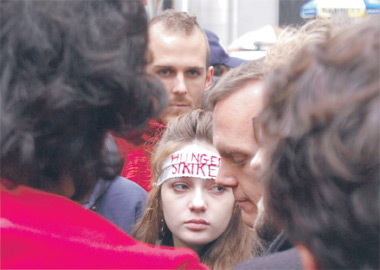
“We shall— we shall— we shall not be moved!” belted out a dozen or so protesters. Sirens wailed. Huddled next to the singers on the church steps were two protesters, thin and pale, on day 13 of a hunger strike. Despite the songs of defiance and protest, the whole thing had a sort of benign, Christmastime feel to it. Pedestrians—mostly tourists and bankers—walked by, paying little attention to the protest.
Only the highly agitated police and camera-happy news media made it clear: I’d hit revolutionary pay dirt.
A few police officers stood almost protectively between the protesters and the passersby, apparently trying to keep a crowd of spectators from gathering. “Take your picture and move along,” they told me several times. As I watched, more police arrived. Sirens wailed. A line of police vans stretched along the street across from the protest. While the chorus broke into “Silent Night,” a phalanx of New York cops lined up along the wall of the facing building.
Just then, two young men dressed like elves—one in green and the other in red—crossed my line of sight. The red elf was Huckins. “Andrew!” I yelled.
He urged me to follow him across the street, where the other elf waited in front of the wall of officers.
*
The protest singers at Trinity Church were part of a planned preamble to a bigger action, Huckins explained under his breath as we crossed through traffic. More was to come. Through a series of progressively more theatrical stunts to draw public attention and sympathy, protesters hoped to convince Trinity Church officials to grant them access to Duarte Square, a park further uptown that they planned to occupy in two days’ time.
In the early months of the occupation, Trinity officials had been supportive of the Zuccotti protesters, offering them blankets and serving hot chocolate. Now they seemed to be wavering, Huckins explained, in their intention to help the movement find a new home.
“So glad to see someone from back in the Valley,” Huckins said, introducing me to his companions, including the green elf and a woman who’d been involved in an earlier action I’d reported on. (In that one, Huckins, dressed as a matador atop a NYPD cruiser, taunted the massive statue of the Merrill Lynch bull at the end of Broadway.)
“We’ve got an Occupy Wall Street nativity scene we’re going to set up,” he told me as he typed on his Blackberry, sounding distracted, “and then we’re going to wrap Trinity Church in gift paper.” That explained why his green elf friend was holding a box with two rolls of paper in it. Explained it—sort of. Two rolls of paper to wrap Trinity? It’s a large church. How, exactly, was that going to work?
Before I could ask, the activists headed back across the street. I followed, half expecting to find more elves with a truck full of wrapping paper. Instead, they met up with what appeared to be their own media posse. In a huddle just up the street from the church, Huckins and his companions met with three other photographers, a film crew and a man with a clipboard. They conferred for a few intense minutes, apparently reaching consensus that it was premature to embark on the next step of their plan. For now, they’d split up and reconvene later. The elves went in different directions, each with a small contingent of reporters following.
*
Instead of waiting in the wings for the action, I wanted to get a better sense of the stage. I headed south to the Merrill Lynch bull.
The Wall Street section of New York is the oldest. Unlike the rest of Manhattan, where the streets were laid out in grids with room for sidewalks, the skyscrapers at the tip of the island are tightly packed together and the routes between them are narrow and winding. The alley-like streets make the giant monoliths along them seem larger.
Forever in shadow, even at midday you feel that you’re walking at the bottom of a tomb. At street level, the masses jostle shoulder to shoulder while captains of finance work and play in the towers far above. Wall Street seemed an ideal battleground for class warfare, full of theatrical potential. I couldn’t help but wonder what kind of stage Duarte Square offered. How could it improve on this?
Failing to find any indication that pedestrians elsewhere in the Wall Street area were attuned to any sort of protest at all, I headed back to Trinity. The numbers of both protesters and police had grown substantially during my short trip to Wall Street. The police had changed their look somewhat. Instead of standard-issue dark blue police uniforms, the new arrivals wore sky blue windbreakers marked “NYPD Community Affairs.”
With so many costumed players on hand, pedestrian traffic became congested. Inconvenienced, curious tourists asked what was going on; when told that this was part of the Occupy Wall Street movement, most reacted with indifference.
Then the mood changed. The singing stopped. Singers stepped aside, making way for a team chosen by the activists to talk to church officials, who were coming out of Trinity to meet the protesters on the sidewalk.
“We didn’t think they’d come out,” Huckins said when I found him on the far side of the crowd.
He looked crestfallen and concerned. Forcing a dialogue had been a key goal of the action against the church. But when church officials agreed to talk, the action involving the wrapping paper became pointless. That seemed to bother Huckins, but while he turned his attention to the meeting between protesters and clergy, the green elf pulled a small cr?che from his backpack. He set up the Nativity scene just inside the church gates as a mass of image-hungry press photographers swarmed around him.
Instead of a manger, the scene of Christ’s birth was a burgundy vinyl camping tent much like the ones police forcibly removed from Zuccotti. Outside the tent, a placard read, “Luke 2:7. There was no room for them in the inn, but with $10 billion in real estate, Trinity has plenty of room. #Occupyfaith, #OWS.” The whole thing was less than a foot tall, so photographers had to get on their bellies and zoom in tight to capture it clearly.
If the creche provided an easy photo-op, it only briefly distracted the gathered media from what was happening on the church steps, where two church officials—a young, clean-shaven pastor and a middle-aged woman in a trench coat—spoke with a wavy-haired and bearded clergyman representing the protesters.
They talked for about 15 minutes. While reporters struggled to hear what was being said, the outcome became clear. Protesters wanted to occupy Trinity’s park, but the church refused.
Was this the revolution I’d come to find? Protesters were asking the church to defy the mayor and the law on their behalf, effectively seeking to sidestep the need for civil disobedience. They were seeking permission to continue.
Eventually the bearded priest called out to the crowd, “Trinity’s position is clear. We don’t like it, but we hope to talk again. In the meantime, let’s politely disassemble.”
The police and media were gone before the crowd had a chance to disperse. As the traffic returned to normal, the activists shuffled about, commiserating with one another on the steps of the church that had just refused them. Churches weren’t supposed to do that, were they?
I managed to find Huckins before his media posse did. He still seemed distracted, but eager to talk. Instead of launching into a post mortem on their recent defeat, though, he told me where else I might find evidence of a still-vital movement getting ready for the next phase.
“Have you been to 60 Wall Street?” he asked me. “The atrium? It’s a pretty amazing space, and there’s usually something going on there. At 5:30 this afternoon, there will be a planning meeting for Saturday’s action at Duarte Park, but there’s several meetings planned before that. Also, tomorrow in Brooklyn there’s going to be an artwork session. Making signs and props for Saturday. Lou Reed and Laurie Anderson are going to be there, working with a whole bunch of other incredible artists.”
“Andrew, there you are!” the producer from his media posse called out as she and her cameraman found us. “Can we do a setup here, just outside the church?”
“I need to go check in with my affinity group,” Huckins said. “Let me go do that and I’ll be right back.”
“Okay, but be quick, if you can,” she said as he began running off down the sidewalk. “This documentary is nothing without you!”
When I saw Huckins again, the film crew had him pinned against the church gates.
“Explain to the camera what just happened here,” the producer told him. Huckins began to oblige, but the cameraman stopped him mid-sentence.
“Say it in the present tense,” he said. “It sounds more immediate that way.”
I headed off to the atrium.
*
“No photography! That person is taking pictures! Would someone please problem-solve this situation? Please!” the moderator called out. She pointed a finger over the heads of the assembled crowd right at me.
“I’m on it,” a young man said, jumping up from the front row of the circle and making his way over to me.
“Please, given the sensitive nature of our discussion, we ask that you respect the privacy of our participants and please not take any pictures,” he told me.
“I’m more interested in the space, really, than the meeting. I wasn’t trying to intrude,” I explained. “Is there somewhere I can take pictures?”
“Well, it is a public space,” he said, “but we just ask you don’t take pictures of our meeting. People are talking about some really personal stuff.”
I walked 10 yards away and set up my tripod near a pair of security guards.
The atrium at 60 Wall Street is a massive indoor space that serves as the lobby for the 55-floor Deutsche Bank tower above it. Compared to dark, cramped Wall Street, it has the expansive sparkle of a Vegas casino. Massive pillars, ceiling and walls are covered in a mosaic of mirrors. Kicked out of Zuccotti, protesters started congregating here, inside, free from the winter chill.
Several members of the crowd were visibly angry; there was yelling, finger pointing. A moderator tried to keep the conversation moving. Several times she refused offers from other protesters to take over the meeting.
“No,” she insisted. “God knows why, but for some reason I volunteered to do this, and I’ll be damned if I don’t see it through.”
I listened for nearly an hour, but never learned exactly what the crowd of more than a hundred had gathered to discuss, what objective the moderator was trying to achieve. Protesters expressed so many grievances that it was hard to find the central issue.
“Blatant sexism! Blatant! It doesn’t need to be blatant to be offensive,” one participant shared. “Some people come in here acting so damn PC, but just the way you come in swaggering—I’m not naming names, but you know who you are. That’s right, I’m looking right at you.”
Another participant made an impassioned plea that everyone be sensitive to everyone’s issues—that, rather than complaining, they look for solutions. The complaining continued.
Finally, her patience worn thin, the moderator brought the meeting to a bumpy conclusion and the circle quickly disbanded. As I watched, an elderly man took a chair across from me.
“They didn’t let you take any pictures, huh?” he said. I shrugged and nodded. He introduced himself as Frank and told me he was Irish Catholic.
“I’m the kind of guy who, if I see something wrong, I try to do something about it,” Frank said. “My wife thinks I’m crazy. People don’t want to hear from me. But I need to say something anyway.”
Frank told me a series of stories of different ways he’d averted certain disaster for trains, hotels and other businesses by steadfastly insisting that they listen to his warnings. He also told me how I could treat arthritis by taping bars of pure soap to my afflicted joints.
“These days, though,” he said, “it’s a lot harder to get people to listen. I call, I write letters to city officials, but they don’t want to hear it. Seems like they’d rather there be a problem than get involved. I thought these people might be different. That’s what they keep saying. I’m part of the 99 percent, but I couldn’t get a word in edgewise.”
*
The poster that announced Occupation 2.0 didn’t actually name the park the movement hoped to occupy, and the map they provided had the streets incorrectly marked. Until I was standing in front of the statue of Juan Pablo Duarte, I wasn’t certain I’d found the right place.
The park was mostly empty. Even at the center of the biggest city on earth, the location felt remote. If possible, it was even less hospitable than Zuccotti. Aside from the steady stream of traffic to and from the Holland Tunnel, I couldn’t imagine whose attention protesters thought they’d attract here or how occupying the park would help their cause.
I couldn’t help but wonder if Occupy Wall Street was in danger of losing its audience and its significance.