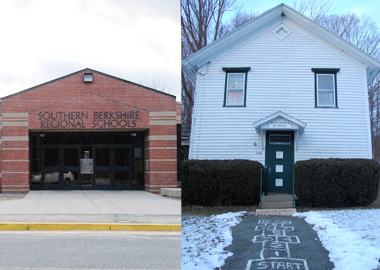
On January 31, 2012, as parents arrived to collect their children from the two-room school house in the center of South Egremont, teacher Julie Milani was outside to greet them. One after the other, the topic of discussion was the same: who was going to the meeting with the Southern Berkshire Regional School District’s committee and superintendent scheduled for that evening.
“No, I’m not going,” Milani replied repeatedly to parents who asked.
At stake is the future of the 1834 school house and two other small schools in neighboring communities that serve the youngest students of those towns.
The five towns that make up the Southern Berkshire district-Monterey, New Marlborough South Egremont, Alford and Sheffield-are arranged in a horseshoe around Great Barrington, which is in a school district of its own. Four of the five towns have fewer than 1,500 residents; Sheffield, the largest town, has 3,300. The district’s school committee is made up of representatives from all the towns, and decisions must be approved by voters in four of the five towns.
In 1990, the voters agreed to build a large campus in Sheffield to house elementary, junior and high school classes for the district. Two years ago, taxpayers in the five towns finally paid off the bond that paid for construction. Last year, the committee proposed a second bond to pay for maintenance needed at all the schools, including the small satellite early elementary schools that serve three of the four smallest towns. Voters from Sheffield and New Marlborough rejected that $3 million bond.
Without sufficient funding to maintain all the schools, the district’s superintendent and treasurer proposed consolidation by closing the three satellite schools-located in South Egremont, New Marlborough and Monterey-and moving the 102 affected students and their teachers to the Sheffield school.
The public meeting held that night to discuss the proposal was the third in a series of meetings that had gotten progressively more heated and argumentative. Residents from the towns with the threatened schools questioned the rationale and motives behind the proposal; committee members chastised residents for what they saw as uncivil behavior.
When asked why she wasn’t attending the meeting that night at the New Marlborough town hall, Milani told the Advocate that she feared more conflict.
“In addition to being the teacher,” she said, leading the way inside the school house, “I’m also the nurse, custodian, lunch lady, guidance counselor, you name it. I’m not sure it’s appropriate for me to take a central role in deciding this.”
She had no problem showing off the class rooms, though, and was quick to emphasize that aside from its potential closure, the school has a lot to celebrate.
In December, an anonymous local benefactor donated $15,000 to replace the windows. Now, a month later, men from the cable company were up on ladders, busy at work attaching Internet cabling to the building. After years of slow access to the web, Broadband had arrived.
The South Egremont school is located across from the town’s post office in a small white colonial building that blends in with its historic surroundings. Currently it serves 17 students, a mix of kindergarteners and first graders. Inside, besides a mudroom and a closet-sized office for Milani, the school consists of two large rooms. One is for study-it’s full of chairs, books, posters, and computers-and the other has sinks and tables for messier work and play.
Milani said the school’s success has long been tied to support and close involvement from parents and the nearby community. South Egremont students currently go skating once a week at a local rink, thanks to a parent who works there. In between responding to questions during the interview, she was trying to schedule times for a parent to offer a cooking lesson and another who was helping with a poetry reading.
While the school district has listed the library at the Sheffield school as one of the advantages a consolidation would afford the students who don’t currently have libraries in their schools, Milani pointed out that her students regularly visit the local library as a group, enjoying a sense of ownership and access they wouldn’t have from a library they can only visit during school hours.
The Undermountain Elementary School in Sheffield-where Milani and her students will be relocated should the South Egremont school close-is part of the sprawling, institutional campus that also houses the Mount Everett High School for grades 7-12. Instead of being located close to the center of any community, the Sheffield campus is located in an isolated area more than a mile from downtown.
While South Egremont is only 10 minutes or so from Sheffield, given the disparate, rural geography of the district, consolidating the schools will mean that some kindergartners and first graders share one-hour bus commutes along with junior and high school students. It’s a prospect Milani does not relish.
“I can’t believe we’re finally getting Broadband,” she said, looking out the new windows.
*
The New Marlborough town hall was packed almost to capacity.
In front of the stage, the Southern Berkshire Regional School District’s school committee sat in a row of folding chairs. While members moderated the meeting and interjected occasionally, most of the two-hour meeting was taken up with residents voicing their concerns and questions to Superintendent Michael Singleton and the district’s business administrator, Bruce Turner.
Singleton opened the meeting by reading a detailed response to questions that had been raised at a previous meeting. Included was a list of education specialists, clubs and events the newly relocated students will be able to take advantage of should consolidation occur. Currently, itinerant reading teachers and special education instructors travel between the schools, offering only sporadic support; having students and educators in one place would offer a wider range of options more efficiently, he said.
The superintendent ended his opening remarks by reminding the audience that consolidation was a only a proposal. Before anything happened voters needed to weigh in.
From the outset, Singleton appeared on the defensive. When asked where the responses he had read were to be posted, he replied curtly that he had sent them to the person who had submitted the questions.
“It’s up to her if and how she’s going to disseminate them,” he said.
When committee member and moderator H. Dennis Sears suggested the responses could be posted on the district’s website, Singleton relented.
Responding to questions from the audience, committee members repeatedly pointed to the failed bond as the reason the district was in this predicament.
“Perhaps naively, we really thought the bond would pass. It was a slam dunk,” committee member Vito Valentini of Sheffield said. This misplaced confidence, he said, meant that they had deferred some maintenance projects that had been previously budgeted for.
Pointing to an engineering report, Singleton and Turner reminded the audience that despite the windows recently donated to the South Egremont school, the three schools were in need of major repairs. The kitchen at the Monterey school was in danger of being cited for code violations and the boiler in the New Marlborough school was on its last legs, Singleton warned.
“It could go next week,” he said, “it could go tomorrow. I don’t know.”
Historic preservation funds, Turner said, were not available because the towns, not the district owned the historic school houses.
Closing the schools and consolidating services, the superintendent and treasurer said, will save the district approximately $300,000-an amount one resident pointed out was less than five percent of the district’s overall budget.
The parents and residents attending the meeting did not appear to accept this reasoning.
A South Egremont parent, Matthew Syrett, distributed a printout that analyzed the proposed savings. Many of the students at the smaller schools are from outside the district, his data showed, and their parents enrolled them using school choice. Students who “choice in” bring with them $5,000 to the district. Syrett’s chart showed that given the popularity of the small schools, the potential loss of income in terms of “choice” dollars could negate any savings gained by closing them.
There was an underlying sense of betrayal in the audience’s commentary. At one point, a former school committee member from New Marlborough charged Bruce Turner with breaking a promise.
“I was with you on the committee from between ’87 and ’93, when we were trying to get the [Undermountain and Mount Everett schools] built in Sheffield,” she recalled, “and we promised building that school wouldn’t put the smaller schools in danger. We promised we’d never close those schools.”
Turner said that did not match his recollection of events.
“As I see it, my job is to make certain those students are safe,” he said.
*
The challenges confronting the Southern Berkshire School District are not unique. Over the last half-century communities across America have reduced the number of schools available, employing the same management logic that has yielded such impressive financial returns in industry: bigger, centralized operations are better, cheaper and more efficient than many smaller ones.
Several parents pointed to recent studies that show how beneficial small schools can be for a student’s education. Consolidation, they argued, would jeopardize these benefits for their children.
“I went and looked at those reports,” Singleton told the audience at New Marlborough, “and they were all talking about schools the size of Undermountain. It’s got about 350 students; that’s a small school. The schools we’re talking about consolidating are micro-schools.”
“South Egremont, Monterey and New Marlborough are less than small schools,” agreed Carl Stewart, a school committee member from Alford. “I did some research over the weekend on one-room school houses. A hundred years ago, there were 190,000 operating one-room school houses in this country. In 2000, there were 380. Last year, there were fewer than 100. More than half of them are in two states: Nebraska and Montana.
“Whether you like it or not, one- and two-room school houses are becoming a thing of the past,” Stewart concluded. “Keeping them alive is expensive, inefficient, and even if we think it’s a good thing, it may not be possible to continue to do it.”
He said he’d consider keeping them open one more year, but he thought their demise inevitable.
Part of Superintendent Singleton’s argument for consolidation was that students at the larger school had a higher rate of achievement than those from the “micro-schools.”
“The only comparable test results available [between the schools] are the MCAS results,” he said in the statement he read at the opening of the meeting. “MCAS testing is done in grades three and four only. The students at Undermountain consistently scored above their counterparts at New Marlborough Central School.”
Later, though, in a letter to parents, committee member Charles Flynn refuted those findings. According to the Massachusetts Department of Elementary School and Secondary Education website, he wrote, both schools achieved “adequate yearly progress” (AYP) in language arts last year, but only the smaller school did so in mathematics. The larger school, he wrote, “did not meet target or make AYP [in math], showed declining performance, [and] is identified for corrective action.”
“As a school committee member and educator,” Flynn wrote, “I am embarrassed that this type of inaccurate information/interpretation of information is being presented to the general public.”
Matthew Syrett, the South Egremont parent who questioned the financial value of consolidating the schools, also had doubts about the “bigger is better” perspective of the superintendent.
“The crazy thing in this debate,” he wrote in a email to the Advocate, “is that 40 years of literature on school consolidation shows it does not produce economies of scale savings, and it does not educate better. It does, however, create schools with more disciplinary issues, kids disconnected from their communities, and incredibly long bus rides. … If you run the numbers, these school closings do not make sense except as a ploy to shake down the local towns for more tax money, or as a crusade by people who are living mentally in the past.”
At least two local teachers agreed that the decentralized approach to education had rewards money could not buy.
“When the school is in your town, you get a sense of ownership that’s very important,” Georgiana O’Connell said at the town hall meeting. O’Connell taught in the Monterey and New Marlborough schools from 1963 until the early 1980s before retiring. She asked the committee to consider educational philosophy as well as finances.
The small size of the school meant each student was known as an individual, and fostered a stronger relationship with the parents. “It’s an incredible thing knowing you have a community behind you, like the schools have behind them tonight,” O’Connell said.
A current teacher in the district seconded this sentiment.
“I was hesitant to speak,” said Will Conklin, an environmental science teacher at the Sheffield high school. “But Ms. O’Connell inspired me. She taught me second grade here in New Marlborough.”
Conklin made an “ecological analogy,” comparing the health of the school system to that of an organism fighting for survival. When all resources are allocated to a central point and there aren’t sustainable systems in place to keep the extremities alive, he said, they will “fail miserably.”
The school committee’s job is not about informing the towns “whether we have the money,” he said. “It’s about finding the money.”
The school committee will decide the fate of their schools on February 27.