
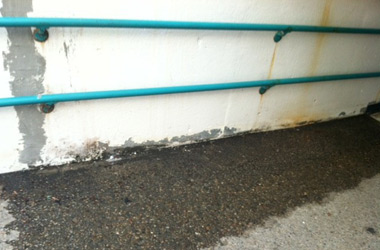
As you drive along Birnie Avenue in Springfield, it’s a surprise to see a school—the German Gerena Elementary School—under the shadow of I-91 and sitting on low ground not far from the Connecticut River. The situation is so inconvenient for walking that children have to enter the school through a tunnel. The school is actually situated below the water table, so the tunnel and the school itself are constantly plagued by leaks, mold, even standing water.
Sump pumps have to run 24 hours a day, seven days a week. In 2000, a burst pipe covered the school floor with six inches of water. Today, water trails down the walls, loosening paint, and stands in the tunnel. Walls and pieces of infrastructure such as ventilators are streaked with mold. The school has room for community programs, but the spaces are too musty and ravaged with mold to be used.
The school serves children from Springfield’s North End, a neighborhood whose residents are mostly Latino. Now a group of North End residents has taken on the task of getting the school repaired and made safer for its very young students and for adults who come to the community center in the building, which is not often used now.
“The Gerena tunnel leaks chronically,” the group stated in a list of demands presented to the city in February. “Often days pass without anyone cleaning the water intrusion. Children and adults from the neighborhood have to navigate large puddles when passing under the highway. The situation is hazardous not only because of the possible illnesses that can result, but because of the safety risks. Anyone—children, parents, seniors—can slip and fall on the concrete, potentially hurting themselves badly.”
And early this year, a Buildings Department memo noted alarmingly: “Hurricane/Tropical Storm Irene was especially troubling, since the connector to the school needed to remain open, but the possibility of tunnel flooding could have jeopardized people in the tunnel if that had occurred; luckily nothing happened.”
Neighborhood parents and activists want the city’s help to get an answer to a central question: “Can this building be fixed, or must we build a new one?” The city’s Parks and Buildings Department has promised to help, says the group, but so far nothing has happened. “Originally a report was to be prepared for December, 2011,” the group wrote in its list of demands. “While some information was gathered, the question still went unanswered at the end of last year. Preparing to perform a final feasibility study, Department officials had not yet completed the bidding process, contracted a company to conduct the study, or begun the evaluation. They offered no timeline for when this work would be completed.”
Concerned North End residents want to the city to repair the school, and they want the repairs to be done by local contractors so as to boost employment in the city and reinvest locally the millions it will take to do the work. “If it is a challenge to find local unionized contractors,” the group says, “we need the city to pressure unionized firms to hire local workers.”