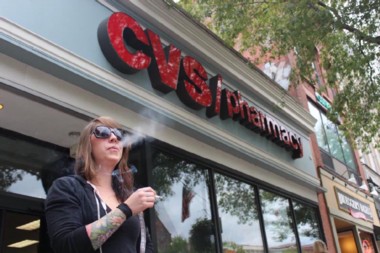
Three male 20-somethings walk into a CVS. All three immediately double back and walk out, murmuring about what this country is coming to and who CVS thinks they are. Why?
In a sudden move, CVS stopped selling tobacco products at the beginning of September—a month sooner than was announced earlier this year. Where the cigarettes, cigars, and chewing tobaccos once resided sits an oversized poster that reads, “Let’s quit together,” and “You’re not alone.” Each store has been equipped with motivational pamphlets to give to smokers thinking about quitting. The doors have been caked in mini versions of the poster, with the image of a large hand snuffing out what looks to be an un-smoked cigarette. With the new door signs, the stickers that prohibit smoking within 20 feet of the door, and the now irrelevant signs that read, “Under 18, No tobacco—We Card,” the entire entranceway is an anti-smoking ad.
“They’re ostracizing smokers,” said Zac Baroski upon exiting the CVS on Main Street in Northampton. “I’m not going to quit smoking.”
In Massachusetts, a pack of cigarettes costs around $8.77—$3.51 of that is state excise tax and $1.01 goes to the federal government. With more than half of a pack’s price going to taxes, plus a smoking population on the decline (not to mention a growing number of municipalities banning the sale of tobacco products in stores that contain pharmacies), CVS faces a turning point. “When we think about where we expect to be in the future as a health care company, it is clear that this is the right thing to do,” said CVS Public Relations Director Michael DeAngelis. Evidently, the company has opted to brand themselves around the notion of health and leave the vices to the gas station convenience stores.
“It’s wicked annoying that they’re not selling them anymore,” said Marjorie Britton of Northampton. “Now there are only two places in town that sell them,” she said, pointing in the direction of 7-11 on King Street and Pop’s Package Store on Bridge Road. As a server and bartender, Britton works in an industry where non-smokers comprise the minority. “I’m going to smoke whenever I want,” she said. “It’s my decision.”
Several smokers outside the CVS on Granby Road in Chicopee claimed they would not be affected by CVS’s decision because they didn’t buy their cigarettes there, anyway—they were too expensive. They instead go to one of many nearby gas stations that sell them at cheaper prices. Other smokers said that, though it’s less convenient for them (they no longer enjoy “one-stop shopping”), they understand and support the decision.
“As smokers, we choose to smoke,” said Ann Guertin of Chicopee. “We all pick our battles.”
“It seems a bit hypocritical for a pharmacy to sell cigarettes,” conceded Nathaniel Foss of Northampton, who said he bought cigarettes at the CVS on Main Street almost every day. “It kind of makes sense. I’m not mad at them.” When asked whether more unhealthy products such as high-sugar candy and energy drinks should be removed from the shelves, Foss said, “If they stopped selling everything that’s harmful, they’d be Cornucopia.” Non-smoker Sarah Taleb, a neuroscience student at Smith, praised the decision wholeheartedly. She said more stores should stop selling tobacco products, citing their addictive and carcinogenic properties.
Springfield Director of the Department of Health and Human Services Helen Caulton-Harris praised CVS for the move. “I applaud CVS for taking a bold stance and banning cigarettes in their stores,” she said. In 2009, Springfield was among the first Massachusetts towns to prohibit the sale of tobacco products in stores with pharmacies. “Springfield has been ahead of that national trend,” Caulton-Harris said. “From a public health perspective it is critical that we take steps to ensure a healthy population. Other corporate entities should follow CVS’ lead.”
The pro-CVS responses may point to the success of anti-smoking education launched over the past two decades. At the same time, nearly 10 percent of the country’s population still suffers from diabetes and 69 percent are considered overweight or obese. Since heart disease tops the Center for Disease Control’s leading causes of death list, and since diabetes and obesity are closely linked with heart disease, it could easily be argued that more harm is caused by junk food than cigarettes. How far should corporate America go to ensure we make healthy decisions? Should sugary foods devoid of nutrition also be nixed from store shelves? And those increasingly popular energy drinks that make your heart feel funny and give you the sweats?
“It’s a slippery slope,” agreed Doron Goldman of Northampton. “However, cigarettes are sticks of death.”•