
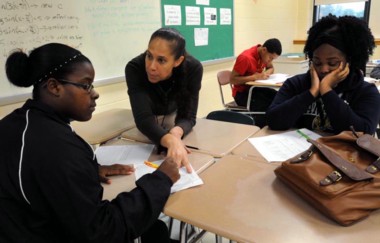
In a pre-calculus class that began at 7:35 a.m., honors students at Springfield’s Renaissance School were learning how to find the periods, phase shifts, and amplitudes on a graphed equation.
But first, they needed to peel their eyes open.
Teacher Rebecca Jackson asked three students to write equations from their homework on a white board at the front of the room. “Come up with me,” one student said, grabbing his homework sheet and heading up.
“I’m too tired,” moaned his neighbor.
In this classroom and hundreds like it across the Pioneer Valley, students and teachers provide a living laboratory early each day in the debate over whether to align school schedules with teenagers’ natural body rhythms. In other words, to let them grab an extra hour of sleep before reporting to class.
The movement gained momentum recently when the American Academy of Pediatrics published a report detailing the causes and consequences of insufficient sleep in teenagers. Following the report, the physicians’ organization urged the nation’s middle and high schools to start classes at 8:30 a.m.—at the earliest.
Despite pushes for earlier start times in some communities, Valley high schools have continued to begin the day at 7:30 a.m. or thereabouts. That means students often roll out of bed with far less than the recommended 8 hours of sleep, wait for the bus or a car ride in the gloom and slog through their first classes with less-than-alert brains.
The Valley is not alone; about 43 percent of the country’s high schools start before 8 a.m., according to U.S. Department of Education statistics.
Gavin Mahoney, a senior and one of the students in the Renaissance pre-calculus class, said he is more of a morning person than his peers. He likes the fact that an early start gets him out of school at a reasonable hour for afternoon soccer practice. Still, he said, he and others would benefit from a later start time.
He said he often skips breakfast in the morning rush to school and that he feels sluggish through the first period. His saving grace: playing soccer usually makes him tired enough to go to bed earlier than many other kids.
Another Renaissance senior, 17-year-old Danielle Brown said she goes to bed around 11:30 p.m. and wakes up at 6 a.m. for school. She said she doesn’t actually feel awake until her second class. For her, advanced-placement calculus is especially difficult to have first period—at Renaissance, the schedule rotates so that everyday the students start with a different class.
“It’s hard to concentrate on a test when you’re so tired,” Brown said.
SUBHEAD: Many proposals, little change
Evidence that adolescents are healthier, more rational, and better-performing with later school start times emerged two decades ago. But change doesn’t come easily. Even enthusiastic supporters of a later start acknowledge the practical hurdles to making the move.
Because school buses are occupied delivering younger students to school in the 8 o’clock hour, adding high schoolers to the mix could require an expensive additional fleet of vehicles. Later morning start times would require sports practices and games to begin later in the afternoon, a problem compounded by early darkness and the need to coordinate the schedules of multiple schools. Finally, a shift in the school day could pose a problem for family schedules, as working parents reconcile student schedules with their own.
The issue has popped up in Valley schools throughout the last decade, but none has adopted a later start time. The Amherst School Committee considered moving its high school start time a half hour later —from 7:45 to 8:15— in 2011, but concerns about the impact on athletics led to the measure’s defeat.
Last spring, the Northampton School Committee tabled a resolution to initiate a later start time, saying that the district didn’t have money budgeted for the necessary busing changes. Board members vowed to collect busing data and resume the conversation during the next budgetary discussion in spring 2015. Currently, the start time at Northampton High School is 7:30.
Recently hired Northampton Superintendent John Provost said the district currently spends about $1.2 million on a dozen buses; a later start time for high schools would likely require an additional two or three buses. “My role is to make the true costs known in as accurate a way possible so we can plan for the future.”
Greenfield High School Principal Donna Woodcock, who has worked at the school for 30-plus years, said school starts at 7:45 a.m. Woodcock said school committee members talked about a later start time at some point in recent years, but that’s as far as it went. She added that while there are some students that find the start time challenging, there are just as many students who arrive bright and early—some well before the first bell.
Mark Jackson, principal of Amherst Regional High School, said the school committee’s proposal to move up the start time met resistance from students. Many worried that the change would diminish the school’s “robust” 26-sport offering by pushing practice times farther into the evening and putting the schedule at odds with competing schools.
“They saw only dark days ahead for the athletic program,” Jackson said.
Jackson said that although many students and parents were against changing the start time, the school committee will likely reconsider the issue. He said that while the logistics may be difficult to work out, the administration finds it a worthwhile endeavor.
“We have a standing interest in this independent of what everybody else does,” said Jackson. “I think the issue is trying to figure out how to overcome the hurdles that were presented last time. Nothing has shaken the district’s interest.”
SUBHEAD: The science of sleep
University of Massachusetts-Amherst psychology professor Rebecca Spencer, whose research focuses on the influence of sleep on cognitive functioning and development, said the Valley is “behind the times.” Based on the research, she said, there’s no reason to have high school start times before 8 a.m.
“The science in favor of a delayed school start time just has no counter-argument in the scientific literature,” Spencer said.
Spencer said there is a reason it’s so hard to get adolescents to turn in at night—they are programmed to stay up late. From puberty’s onset through adulthood, commonly from ages 13 to 18, hormonal changes alter circadian rhythms, triggering “delayed sleep phase syndrome.” The syndrome is a diagnosable problem in adults, but is considered the natural state of affairs for many teenagers. Spencer said most adolescents are naturally programmed to fall asleep between 11 p.m. and 12 a.m.— meaning their peak learning time is between 11 a.m. and 3 p.m.
Teenagers who get only 5, 6 or 7 hours of sleep are chronically sleep deprived—adolescents require at least eight hours of sleep, Spencer said. She cited a Harvard study in which the relationship between sleep and performance in organic chemistry was carefully observed.
“It wasn’t how many hours of sleep that predicted performance, it was how consistent your sleep was,” she said. “Sleep inconsistency really puts you in a spiral.”
Spencer said that disrupted sleep patterns cause stress and anxiety, and are linked to eating disorders and substance abuse. Symptoms of attention-deficit disorders and sleep deprivation are the same, and the two are intrinsically linked, she added.
Spencer said small bumps to the start time make a big difference. Studies show that by increasing sleep to 7.5 hours, academic performance improves by one full grade level and tardiness and absences decrease. Evidence also shows dietary choices and overall decision making improves—sleep deprived kids are more likely to grab the Doritos over the apple, whereas better-rested youths are more likely to make the healthier choice.
Spencer said that good “sleep hygiene” is just as important as a healthy diet and that our schools should be promoting both.
“I think our local school districts are really antiquated on this decision,” Spencer said. “There are so many districts that have jumped on board a decade ago—I don’t know of a single district that went through a delayed school start time and changed back.”
Williston Northampton School, a private school in Easthampton, changed its start time from 8 a.m. to 8:30 a.m. six years ago. Associate Head of School Jeff Ketcham said the change came after two years of study, including a consultation with Spencer, and that the staff has been very pleased with the outcome: more students eating breakfast, fewer trips to the health center, and more attentiveness in class.
“By and large kids were more prepared,” said Ketcham. “Their brains were on, whereas before the first period was somewhat of a warm-up period.”
SUBHEAD: “We wouldn’t be so zombified”
Springfield’s Renaissance School is a public magnet school for college-bound students in grades 6-12. When he began at the school, Principal Stephen Mahoney said his instict was to push for moving the district’s standard 7:35 a.m. start time to 9. He quickly realized, however, how important sports are in the area.
“It’s not all about test scores,” said Mahoney, who is also Gavin’s father. “Sports are very important to these kids’ lives. You also have to think of the impact on family culture. It’s a lot of money [to change the schedule], too,” he added.
Senior Danielle Brown said she volunteers for Gardening the Community on the weekends, so she usually doesn’t make up much sleep then. She said that she tries to nap here and there, but that her sleep cycle is tumultuous and it is very difficult to get up in the morning.
“It feels like I’m pulling my body out of something it needs,” said Brown.
Misty Humphreys, 17, a junior at Renaissance, said she goes to sleep around midnight and gets up at 5:30 a.m. in order to get ready and get to school on time. She said she struggles to wake up and pay attention.
“I think if we started school later we’d better prepare our minds,” said Humphreys. “We wouldn’t be so zombified and we’d be ready to take on the day.”
In the first period pre-calculus class, teacher Rebecca Jackson moved around the room with great energy, talking with her hands, peppering students with questions, even throwing some Spanish words into the lesson.
Still, the students were clearly fighting back sleep. Each seemed to be taking a turn in the chorus of silent yawns. When Jackson left the room for a minute to make extra copies, one girl let her green scarf cradle her face and appeared to fall asleep—only to jump back to consciousness upon hearing her teacher’s footsteps approaching the door.
One student surrendered and fell asleep at this desk using his backpack as a pillow. Jackson had to wake him up twice.
“I’m so tired,” one student said to a classmate in a yawn-whisper. “All I wanna do is go to sleep.”
Contact: adrane@valleyadvocate.com.