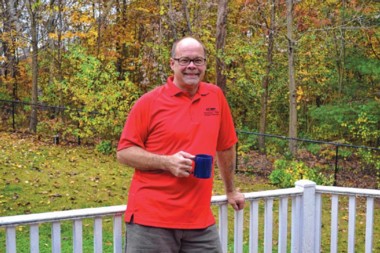
Clancy Kaye spent the past 32 years working as a mechanic at the Mt. Tom coal plant. On June 2, he and his 27 coworkers heard the news: the plant would close on Oct. 1.
Kaye, 53, lives on a quiet cul-de-sac in Holyoke. He’s the kind of guy who can strike up a conversation with anyone, and an affectionate brown mutt named Penny keeps him company at home. Still, he’s keenly aware of the pieces of his life that are missing now.
“When you work with people for a long time, you get to know them as well as your family,” he says, nursing an early-morning coffee on his living room couch. “The guys I worked with over the years were like family.” Kaye had suspected for several years that the closure was looming. “Some people at the plant didn’t see it coming, but you have to be realistic about this stuff. A lot of us were preparing for the future many years ago. We’d talk about it at work. Some people were in a state of denial. But I think we all knew deep down that a big company like GDF Suez wouldn’t take a big financial risk by doing major improvements on a plant that’s not well-liked.”
The signs were hard to miss. The Holyoke Water Power Company, which would later merge with Northeast Utilities, opened the station in 1960 with a staff of around 80 people, Kaye says. By the 1990s, the staff was cut to 50. By 2014, the station employed 28.
“The cuts didn’t have any rhyme or reason to me,” he says. “We were cut to two mechanics, which wasn’t impossible to deal with. But they made a lot of cuts in the fuel yard, and there’s no way a station can fuel and take care of itself with only three people working the yard. And you can’t just bring in someone new and expect they’ll know how to unload train cars. It’s a particular skill set.”
Kaye remembers the deregulation of Northeastern Utilities in the mid-1990s as the catalyst for numerous scale-backs at the station. “It changed the whole dynamic of the way energy was made. We lost interest in the longevity of stations. When it’s all about trying to distribute power at a lower cost, it’s easy to decide not to take care of capital improvements.”
Back in 1960, Kaye explains, the equipment that opened the station was designed to have a life expectancy of 25 to 30 years. “So, when they built the plant, somebody said, ‘Let’s call it quits in 1990.’ But nobody does that. We always expand the lives of plants, because the property is there and the infrastructure is in place. And on top of that, not a lot of people want to build new plants these days, because of all of the regulations. It’s a tough industry, no matter what you’re burning.”
Tough, but exciting. Kaye remembers his father, who worked in power engineering, leading a walk-through of the station in 1981—the year before Kaye took a job there. “I remember being so amazed. The plant was consuming a ton of coal per minute. By today’s standards, it’s a pretty small station. But to me at age 20, it was huge. I knew I wanted to work there. To see the size of the motors that turn the fans, and to feel the heat from 1.1 million pounds of steam per hour moving through the pipes all around you… it’s pretty unbelievable.”
Not everyone would be so charmed by a coal-burning plant’s complex network of belts, conveyors, heaters, pumps, and pulverizers.
Kaye smiles. “It’s definitely hot work. It’s dirty. It’s hard. Sweat’s pouring down from your hard hat into your eyes. Sometimes I’d be outside in the freezing cold lying on the icy grating to fix something, then running back into the heat wearing long sleeves, long pants, and welding leathers. It’s a unique breed of people who love doing it. Your body hurts, and it’s long, long hours. But you work through it, and you get it done.”
Much of the fun, he’s quick to add, was in working alongside strong, smart people. He laughs as he thinks of Stanley Skwira, his maintenance supervisor for 27 years.
“Even though I had a temper and I threw a wrench sometimes, he could tell that I wanted to learn. He really had faith in me, and I wanted to be there for him. He was one of those 40-year career guys. And one of the smartest people I’ve ever met. He’s still one of the most highly respected guys I know.”
Kaye describes Skwira, who lives in Southampton, as a practical genius. “He could make almost anything work. It might not look pretty, but it’ll work. In that way he was perfect for power plants. Because when you have a piece of equipment that’s down, you don’t have the time to make it pretty. You had to get it back up and running, then make it pretty on a different day.”
He also gets a kick thinking about Bernie Tobey, a fellow mechanic. “When Bernie left about three years ago, I really missed him. We always used to sit at the ends of parallel tables in the lunch room, and we’d just look over to each other and talk about people. Most people thought he didn’t talk much, but he did. He just wouldn’t talk to you if he didn’t like you. He would just sit there and smoke a cigar—this was back when you could smoke in the plant—and he’d just stare at people he didn’t like. It made them nervous. He’s one of the funniest guys I know.”
In some ways, Kaye’s job is the kind that a lot of people today would die for: good pay, good benefits, a pension plan. Kaye counts himself as fortunate, all things considered.
Still, he’ll be looking for work over the next few months.
“I don’t think of my job as a coal job,” he says. “When you’re taking equipment apart and putting it back together, the same fundamentals apply to a lot of different jobs across the industrial field.
“But the field isn’t what it used to be,” he adds. “When my dad was young, you could lose an industrial job on Tuesday, and you’d have a good shot at going to work somewhere on Wednesday.”
He’s thinking particularly of the handful of younger plant employees—those in their 30s and 40s. “They have much longer careers ahead of them. And they’re going to find, I think, that life’s not really fair. There’s a lot of competition out there. It’ll be tough to replace what they had.”•
Now that the dust is settling on a decades-long argument about the value of the Mt. Tom plant, how are its employees—and the activists who fought so hard to shut them down—taking stock and moving on?
“Those were good jobs, and they paid well. It’s unfortunate that they’re gone,” said Brian Kenney, business manager for the International Brotherhood of Electrical Workers, Local 455. “What was left up at Mt. Tom at the end were some really veteran guys. They grew up in this business, in what you’d call cradle-to-grave jobs.”
Back in June, GDF Suez encouraged the 28 remaining employees at Mt. Tom to apply for positions at other plants within the company.
“Six employees did apply for other positions,” said Carol Churchill, Manager of Communications for GDF Suez. “One of these employees was offered a position at another location.” Former Mt. Tom employees, she said, “will continue to receive preferential consideration for positions for one year after the October 1 closing.”
According to Kenney, no jobs are currently available at the two other GDF Suez-owned plants represented by Local 455: the Cabot station in Turners Falls and the Northfield Mountain hydro facility. “And if you’re a guy who’s 50 or 55 years old, you’re entrenched in this area. You’ve got a home. You’ve got a mortgage. You’re not just going to pack up and leave.”
For Claire B.W. Miller, the Massachusetts State Director of the Toxics Action Center, the closure of the plant is great news.
“This is certainly a milestone,” she said. “I think of this closure as one of the microcosms in which everyone needs to come to terms with the fact that it’s time to commit to renewable energy.”
“But there’s still a lot of work to do,” she added. “Particularly in making sure that the property is cleaned up.”
“We do remain concerned that the workers are cared for in this transition, but we are relieved that the plant is closing,” said Lena Entin, the local Holyoke organizer for the statewide organization Neighbor to Neighbor.
Entin has been working closely with the Toxics Action Center and with the Sierra Club over the past four years under the umbrella organization Action for a Healthy Holyoke. This past April, 14 members of the group met with local GDF Suez management.
Entin said she hopes that an in-depth site survey by the Massachusetts Clean Energy Center—which, thanks to a $100,000 state grant awarded to the city of Holyoke, is currently in progress—will provide more detailed information on the plant’s environmental impact over time. She said that she is eager to set up continued talks with GDF Suez about future uses of the property.
“The plant wasn’t good for the Holyoke people,” said Holyoke resident and activist Carlos Rodriguez. He added that he was surprised when GDF Suez announced the closure just one month after their April meeting. “If you asked me last year, I would have guessed that it would take another four years to close Mt. Tom.”
But to hear former plant mechanic Clancy Kaye tell it, Mt. Tom couldn’t have managed that long without extensive repairs.
“I’ve known this was coming since last December,” he said. “We were trying to run the station only from December to February, and we were having some major trouble with the boilers. We made some repairs, but it was clear the boiler had reached its life expectancy. And we just knew that the company wasn’t going to put the money into fixing it.”
The investments GDF Suez made in the plant over the years were mainly on back-end technology, Kaye added. These included several new machines designed to control toxic emissions.
“When I started working there in 1982, I had some photos of how dirty the stack was,” he said. “It was really bad. The smoke was chocolate brown. No question we were putting some bad stuff out that stack. But when you looked at it in 2014, it was a whole lot cleaner. That back-end technology went a long way to managing that.
“Unfortunately, putting money into getting compliant with new environmental regulations contributed to the demise of the station,” Kaye said. “Investing in cleaning up was the right thing to do. It’s always the right thing to do. But the consequences of doing the right thing aren’t always positive.”