
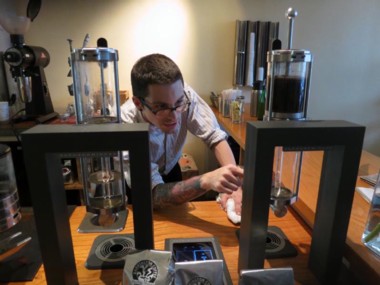
Walk into Northampton Coffee these days, and you’re greeted by a weird sight. Beside the expected contraptions—espresso machine, big grinder, vast coffee urns—something new and strange lurks. It’s a vision that could make Dr. Frankenstein take to coffeemaking instead of monster-making. Which might have worked out better for everybody. A pair of big glass cylinders vaults up from the counter, each one attached to a squared arch. The cylinders gleam with metal accoutrements in a clear case of Victorian-esque overbuild. Water bubbles in the cylinders, and in a chamber at the top of one, coffee steams. Completing the retro-futuristic aesthetic is a Google Nexus pad wired in between the two bubbling columns.
This madness is called the Steampunk by its Salt Lake City, Utah makers, Alpha Dominche. Barista Matthew Boyce is one of the resident mad scientists. He reaches a near-boil of enthusiasm when he talks about the machine. “It’s one of, I think, six on the whole East Coast,” he says, “and it’s the only one in New England.”
The machine is, in some respects, like a coffee siphon, an old-school brewer that sends near-boiling water, via air pressure, upward to brew coffee in a chamber atop a water reservoir, sucking the coffee back down when the heat’s turned off. All the same, Northampton Coffee manager and barista competitor Jenna Gotthelf says, the machine can replicate the flavor profile of many different brewing methods via its computer controls, which tweak the timing and temperature of brewing stages.
Boyce explains that the pad does far more than store the recipes Northampton baristas create. “It’s connected to all the other Steampunks in the world,” he says. Users can therefore easily employ their favorite recipe that’s au courant in the coffee joints of South Korea or Japan, where the machine is particularly popular.
When Boyce demonstrates the Steampunk, he’s putting into action all sorts of mechanisms. He points under the counter, where a covered set of fittings and tubes resides. He tells me there’s yet more below that, in the basement. This does, of course, call for a particularly important question. Does all this effort—not to mention expense of $12,000 or more—mean the coffee the Steampunk produces is that much better?
As the water moves through tubes and coffee starts brewing up top, it’s easy to dismiss the whole business as gimmickry. But when Boyce hands over a cup of the brew, it’s easy to become a believer. The coffee possesses a near-total lack of bitterness, more so, even, than a standard coffee siphon. Words like “fruity” and “bright” are apt. “It’s almost sweet,” Boyce adds. The Steampunk coffee’s taste lingers a long time, and it’s complex and deeply satisfying in a way that a standard cup of coffee can’t fully match. It’s enough to make you don brass goggles.•