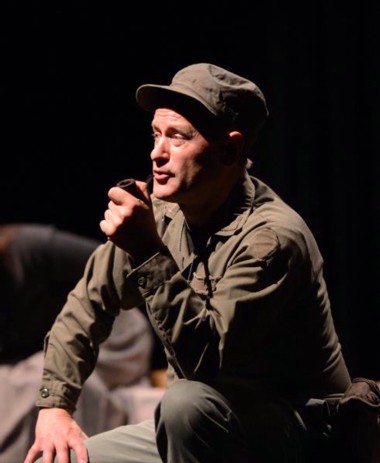
“My parents’ love for each other was forged, in part, by their separation during the Korean War,” writes Susan Thompson in her playwright’s note to Unforgettable: Letters from Korea. “So were essential elements of who they became. During 1953 and 1954 they grew up.”
That separation is documented in the letters they exchanged when Lt. Dwight Thompson was leading a platoon in the Korean battlefield and his bride-to-be, Cleora Barnes, was finishing her degree at UConn and beginning work as a city planner. Susan, their daughter, fashioned this multimedia play from that trove of correspondence, inspired by reading one of her father’s letters at a Veterans Day ceremony.
The piece was first performed in 2012 for a gathering of Korean War veterans at Arena Stage in Washington, D.C., and again last year on the National Mall as part of the Defense Department’s 60th-anniversary commemoration of the conflict. It’s neither a flag-waving glorification of wartime service nor a gritty war-is-hell memoir, but a rather quiet, often nostalgic but clear-eyed portrait of the time, observed from opposite sides of the globe.
Unforgettable is a production of Pilgrim Theatre, the Ashfield-based “research and performance collaborative” known for its stylistically adventurous stagecraft, of which Thomson is a member. So it’s not a standard docudrama, but a kaleidoscope of words, images and music, focusing on and growing out of the transpacific flight of lovers’ letters in a time of war. Jazz pianist Molly Flannery and sax man Stephen Elliott weave in songs of the era—including, of course, Nat King Cole’s “Unforgettable”—while period images illustrate and reflect on the letters’ substance.
Kermit Dunkelberg plays Dwight and and Susan Thompson herself portrays Cleora, both characters moving between their 20s and their 70s, when Susan’s mother was consumed by Alzheimer’s and her father gave up his law practice (after a 27-year military career) to care for her. Jeannine Haas plays their daughter, who finds the wartime letters as she’s clearing out their house after they’re both gone. The letters are spoken by all three, sometimes intermingling as a single missive read in turn by the writer, the recipient and the discoverer.
He writes, “Every day I wish I was coming home. I’d walk in, kiss you, and tell you how much I love you. Then I’d settle down to a quiet evening at home.”
She responds, “I wish I could write beautiful poetry, but simply put, I would be very proud to be your wife and take care of you. My cooking might even be good eventually.”
Lt. Thompson’s tour of duty in Korea included, at his own request, a lot of time on the front lines, but not many pitched battles. He reports being slightly wounded by a flare exploding in this face, and one firefight, in the battle for the redoubt known as Christmas Hill, where “one of my good friends here got both legs blown off and died before he got to the hospital.”
The letters primarily reflect the contrasts and convergences in the lives of the separated pair—he, bivouacked in alien countryside (“It’s all very picturesque here tonight. I’m writing by flickering candlelight”) and she, finishing her studies in peaceful Storrs (“The moon is out and your fraternity brothers are throwing someone in the lake!”). It is above all, as director Kim Mancuso says, “a simple love story, with music.”•
Nov. 8-9, $12-$20, veterans free, Memorial Hall, Shelburne Falls, (413) 628-3850, pilgrimtheatre.org.
Chris Rohmann is at StageStruck@crocker.com and his StageStruck blog is at valleyadvocate.com/blogs/stagestruck.