On September 2, Mike Samson, bass player for the band EasyBaby, was riding his motorcycle from Norwich to Middletown down Connecticut’s Route 66. It was a beautiful day—and possibly the last one Samson will spend on a bike.
As Samson drove through East Hampton, Conn., a woman driving in the opposite direction started to veer into his lane. Samson noticed she was looking down at her lap. With an on-coming car to his left and trees to his right, Samson watched with horror as the car drifted entirely into his lane. Just before she struck him, Samson says, her head popped up. She looked surprised.
Many drivers are aware of the dangers associated with distracted driving—but do it anyway.
For example, at the busy corner of King Street and Damon Road in Northampton last Tuesday, over the course of 30 minutes I counted 25 people talking, texting or otherwise using their phones. I saw one woman blow through the intersection without once glancing up from her cell.
Samson said when the car hit, he was thrown about 50 feet from his bike, shattering his pelvis and breaking his clavicle. Two months later, he is learning how to walk again, but grateful he survived.
“I feel like the miracle person of the year,” said Samson.
Samson, 64, lives in Shelton, Conn., but hasn’t been home since the accident as he still requires assistance—he just graduated from a walker to a cane after extensive rehabilitation. He hasn’t been able to meet his first-born grandchild, who arrived while he was healing in a managed care facility. EasyBaby was poised to record some new music just before the accident, he said, but now that’s been set back.
Samson has been an avid rider since he was 15, but says he’s not sure he will ever ride again.
“It kind of spoils my whole outlook on riding,” said Samson. “The fundamental rules of the road were broken. You can’t defend against that.”
If you think you can handle driving distracted better than most, don’t be so sure. Researchers and public safety officials have decades worth of data on what happens when drivers aren’t paying attention. And they know exactly—right down to a fraction of a second—how much goes unseen.
Northampton Police Department Highway Safety Officer Michael Allard told the Advocate a lot can happen in 1.5 seconds—about the time it takes to dial a phone number, read a short text, or look at a navigation system. In that time, he said, a car traveling 30 miles per hour will go 65.97 feet. Double that to include necessary reactionary distance—the time, and corresponding distance, it takes to process and respond to a roadway hazard—and that makes 131.94 feet of compromised roadway, he said.
“It can add up quickly and it can be a very dangerous situation,” said Allard. “It’s a problem—there are a lot of rear-end accidents.”
Allard said that compared to Massachusetts, the distracted driving laws in Connecticut, New York, Vermont, and New Hampshire are easier to enforce. Those states passed full bans on using handheld mobile devices while driving, but in Massachusetts, drivers can use their phones for calls and other purposes. It can be difficult to tell whether a driver is talking or texting.
Either way, the additional task reduces a driver’s ability to react to surprises on the road.
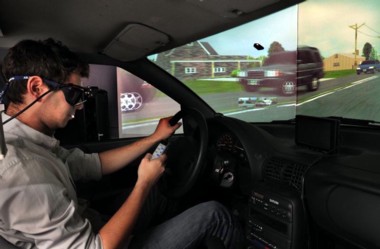
Siby Samuel, a research scientist in the Arbella Human Performance Laboratory at the University of Massachusetts Amherst, has been testing subjects in the lab’s driving simulator for more than five years to improve driver safety. The lab’s simulator is a stationary 95 Saturn in front of a three-screen projection system that may look like a video game, but is actually a sophisticated software program designed to mimic situations that appear in the roadway. Subjects driving the car wear glasses equipped with three cameras—one that records the scene as the driver sees it, one that records where the eye is moving in relation to that scene, and an infrared camera that melds the images from the other two cameras together.
Based on the resulting measurements, Samuel said that anytime a driver engages with their cell phone, their chances of perceiving threats on the road decrease by 20 percent to 40 percent.
“The results suggest when you’re driving and texting you’re compromising safety,” said Samuel. “Scanning is a critical component to driving safely. Research shows a correlation between poor hazard detection and increased risk of crashing.”
Samuel’s data demonstrates a focused driver detects about 80 percent of roadway hazards and every time a task is added onto driving, the ability to pick up on threats decreases significantly. A snacking driver, for example, notices about 75 percent of obstacles. A texting driver only sees 40 percent.
Samuel said internal distractions, like grabbing a hamburger from the back seat or searching for change for tolls, are much more dangerous than external ones—billboards, dynamic message signs, and wind turbines. This is because external distractions still mean the drivers’ eyes are focused outside of the vehicle and are therefore more likely to perceive potential hazards.
“It’s where you look and what you process that matters,” said Samuel. There are two types of processing: bottom-up and top-down, he said. Bottom-up processing involves the driver’s attention being grabbed by a stimulus—break lights on the car ahead signal a driver to stop, for instance. Top-down processing, like the way in which a driver takes in a four-way intersection and determines what to do, involves the driver having to use reasoning to determine the course of action. Samuel said that top-down processing is dramatically affected by distracted driving because it requires the driver to take in the scene and look for meaning. He explained that cell phone use and driving hits on all three points of distraction—manual, visual, and cognitive.
“You might be looking, but it doesn’t mean you’re seeing,” Samuel said.
Samuel explained that having experience enables drivers to pick up on common, potential hazards. An example of this would be when cars ahead switch lanes due to an obstacle not yet visible. A person who has been driving for years would know to follow suit, but a new driver may not.
Steve Brochu, AAA Driving School vice president, said distracted driving has become an increasingly important part of their educational program geared toward young drivers.
“As more distractions get introduced to the vehicle, you really have to touch on it,” said Brochu. “Within the last five to seven years it’s become a major issue.”
Brochu said he and the driving school hold one-day programs in local high schools to educate teens on the dangers of driving drunk and driving distracted. These workshops include real-life accounts of the impacts of distracted driving and a trip on a driving simulator. Brochu said the school is trying to get their message to resonate.
“A simple distraction can cost them their lives,” Brochu said, “and the lives of others.”