
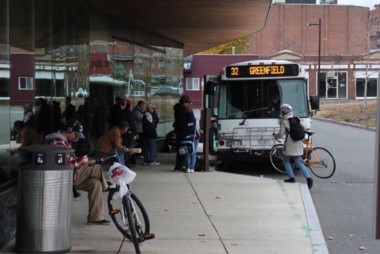
Outside the John W. Olver Transit Center in Greenfield, a bus has arrived and is emanating a sound like a jackhammer tearing up cement. The bus’ door is malfunctioning; it appears something is caught in its tracks. The woman driving the bus is able to pull on the lever and open the door enough to let passengers off, but wants to fix the problem before letting more people on.
Passengers with bags mill around the front of the bus, wincing at the terrible sound as the driver continuously deploys and retracts a yellow ramp beneath the doorway. This goes on for about 20 minutes. A teenaged couple appears delighted by their farewell’s delay and continue to hold each other as they wait. Unfazed by the commotion, Barney Cummings, Jr., of Orange, sits on a bench in front of the bus reading The Cat Who Walks Through Walls, by Robert Heinlein.
Funded through the American Recovery and Reinvestment Act, the center was built in 2012 to serve the community as a multi-modal transportation hub. When I approached the right turn from Main Street onto Olive Street, the building materialized like a spaceship from an alien planet. The upstairs offices comprise the mothership’s core. A panel of asymmetrically placed windows spans the building, overlaid by an almost transparent exterior metallic layer with circular cut-outs of various sizes (which likely acts as the authority’s force field).
The building, the first zero net-energy transit center in the country, will be Greenfield’s stop along the Knowledge Corridor rail line — slated for its first trip Dec. 29. A temporary platform is under construction for next month’s arrival and a permanent one will be in place by December 2015.
At the front of the center sits a large solar array, a traveler’s first sight as their train rolls into the station. A neighboring building adds to the extraterrestrial feel — looking at it from the center’s parking lot, you can see three solar panels slanted towards the tracks, as if the building is about to take flight.
Inside, a few travelers sit along the rows of seats, awaiting buses. They look up at large screens displaying weather, news and travel information.
Tina Cote, Franklin Regional Transit Authority Administrator, has an upstairs office in the center. Cote says that she and her colleagues have a lot of kinks to work out over the next month, such as how best to organize bus schedules around train schedules.
“There’s still a lot of things we’re trying to figure out,” Cote says.
Though the workload may be heavy for those bringing everything together, the train will not be stopped. M.J. Petterson, 26, of the Cayman Islands says he has been living in Greenfield for about three months and is excited for the coming rail service.
“I’ll go to the city more,” Petterson said with a smile.•