
A booming drumroll thunders off the walls. Six student drummers, seated in a row at one end of the dance studio, bang out powerful waves of sound. They watch as 10 more students rehearse a fast-paced dance together in the center of the room.
This is the Wofa African Drum and Dance Company, a student performance ensemble at Pioneer Valley Performing Arts Charter School in South Hadley. The group, founded in 2009 by Guinean faculty member Alpha “Kabisko” Kaba, performs a variety of West African dances. Its next public showing is on December 31 at 4 p.m. at the Academy of Music, a part of First Night Northampton’s festive lineup.
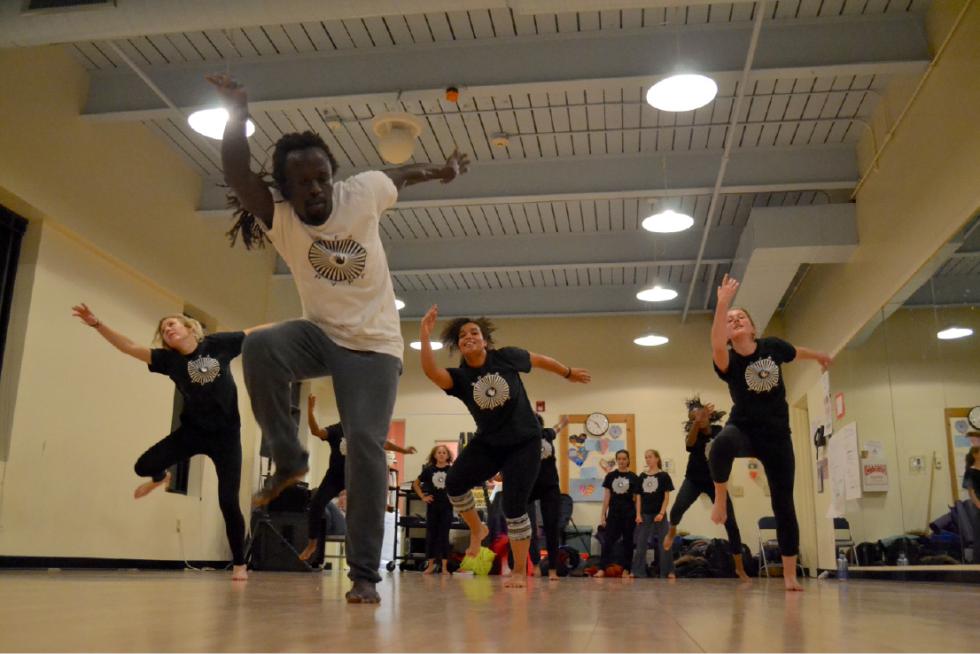
“Wofa” means “let’s get together” in Susu, one of the national languages of Guinea. For this tight-knit bunch of young people, the club is as much about community and friendship as it is about the moves.
This past January, Kaba chaperoned a group of PVPA students on a trip to Guinea for a three-week crash course in drum, dance, and local culture. Such an opportunity doesn’t pop up very often. But even on regular school days, student commitment to Wofa has its ongoing rewards.
Calvin Dolan, 16, says he drums with Wofa because he has a lot of friends in the group. “It’s like a family. If someone has a problem, the group makes it their problem to solve.”
It’s been unlike anything he’s done before, Dolan adds. “It’s a chance to have a new experience and learn something you wouldn’t typically learn.”
For First Night, the group is rehearsing a traditional dance called the makuru. Most of the performers have known this dance for a while, explains Maddie Silverman, 18. “I guess you could say it’s a standard of ours.”
Erin O’Connell, 16, remembers putting this routine together as a group about a year ago. “I find that it’s a happy, energetic dance,” she says. “The audience gives us energy, and we try to give it back to them and make them smile.”
Although the makuru offers moments for brief solo dances, every piece in the club’s repertoire is performed by the whole group. And because everyone is dancing in unison, much of the work lies in ensuring that dancers match and synchronize their movements.
“With a dance like makuru that we’ve known for a while, we want to put our best into it,” says Aisha Diallo, 16. “I think we’re performing it because it shows our best energy, and how much we appreciate the art that we do.”
“West African dance is very different from any other form that I’ve done,” says Kiki Badillo, 16. “It’s very interactive, and you get a positive energy from everyone. Everyone is really happy doing it.”
A handful of these high-schoolers have performed at First Night before. But for most, this New Year’s Eve show will lay a new stone in the foundation of a home that’s always expanding — the Wofa African Drum and Dance Company has trained about a hundred young dancers over the last six years.•
—Hunter Styles