

On Jan. 28, following a 10-day investigation, the Northampton Police Department decided not to bring hate crime charges against two local teenagers suspected of vandalizing city and private property along Sherman Avenue with spray paint, which was used to draw, among other things, two swastikas.
The girls, ages 14 and 15, will be charged with seven counts of vandalism and one count of larceny in juvenile court. But after conferring with the Northwestern District Attorney’s office, the Northampton PD concluded that it lacked evidence that the girls were targeting or threatening any specific persons on discriminatory grounds.
Forty-five states and the District of Columbia have passed some form of hate crime legislation — that is, statutes criminalizing a variety of violent or intimidating acts motivated by bias. In Massachusetts, the two statutes deemed most relevant by the Northampton PD and the DA’s office can be found in the General Laws under Chapter 265, which contains a “violation of constitutional rights” statute (Section 37) and an “assault or battery for purpose of intimidation” statute (Section 39).
The Northampton PD didn’t find probable cause for a violation of either statute in this case, explained Police Captain Jody Kasper. Ergo, no hate crime charges for the teens.
But that didn’t stop the flood of calls Kasper received. “Because a swastika was used, people really feel that this is a hate crime,” she said in an interview last week. “But the use of a swastika doesn’t constitute a hate crime in and of itself.”
Instead, according to state law, the teens would have had to attempt to injure, intimidate, interfere with, or threaten a specific person in order to violate Section 37, and they would have had to commit assault and battery in order to violate Chapter 39.
Even so, the PD’s conclusion left many in Northampton feeling unsatisfied.
Kasper fielded numerous phone calls from upset citizens.
“There was a lot of misunderstanding about the law — about what we can and can’t do as police officers,” Kasper said. “I did my best over the phone, but if the community feels we aren’t responding appropriately, that’s a problem.”
That’s why the Northampton PD and the DA’s Office put out a joint press release in January explaining the conclusion.
“There is no evidence in this case that the juveniles actually used, or threatened to use, physical force against one or more persons,” the statement reads. “There is no evidence the juveniles targeted any particular person or group of persons, or that they even knew who the owners of the involved property were.” The evidence instead suggests that “the juveniles acted with a general intent to shock and offend, but such conduct does not fall within the ambit of the ‘hate crime’ statute.”
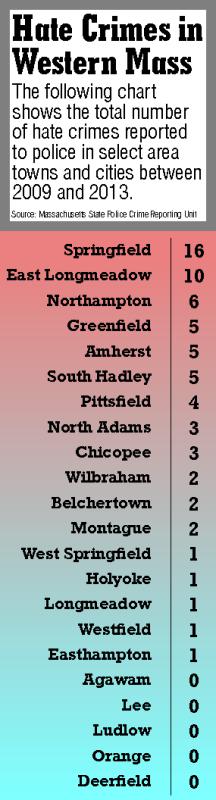
Still, differing legal interpretations are possible. For example, under state General Law 22C, which concerns the operations of the State Police, Section 32 defines a hate crime as including, but not limited to, violations of the above two statutes, and also defines a hate crime more broadly as “any criminal act coupled with overt actions motivated by bigotry and bias.” It is this definition that the State Police Crime Reporting Unit uses to tally annual hate crimes (see infographic).
Massachusetts uses hate crime legislation to criminalize violence on the grounds of race, religion, ethnicity, sexual orientation, disability, and trans/gender identity. The list does not currently include age, political affiliation, and homelessness, as it does in several other states.
District Attorney David E. Sullivan declined to comment for this article.
At Congregation B’Nai Israel on Prospect Street, Rabbi Justin David has been discussing the Sherman Avenue graffiti with meeting members. “When things like this happen, they touch a deep nerve in many people,” he said. “Even when you understand the context, it arouses feelings of real vulnerability.” For some, he explained, that shaken sense of security still feels fresh from back in August, when an unknown person set fire to the Israeli flag that flies in front of B’Nai Israel. In a letter to the congregation at the time, Rabbi David called the incident “disturbing.” No motive was determined.
Last October, Northampton City Council President Bill Dwight drafted and co-sponsored a resolution publicly condemning that act of vandalism at Congregation B’Nai Israel. “I’m proud that Northampton can have debates about the power of symbols,” he said. “Symbols can have horrific significance.” This most recent vandalism, he asserted, may not be a hate crime, but it does constitute hate speech, which is defined by the American Bar Association as “speech that offends, threatens, or insults groups based on race, color, religion, national origin, sexual orientation, disability, or other traits.”
Meredith Dragon hopes to stay optimistic about Northampton’s promotion of dialogue in the wake of events like this. Dragon is executive director of the Jewish Federation of Western Massachusetts, based in Springfield. But she pointed out that ignorance should not excuse actions, especially those that employ anti-Semitic imagery and symbols.
“I really want to know whether the larger Northampton community takes this as seriously as the Jewish community does,” she said. “I really wonder if people see what a difficult symbol [the swastika] is for us, and what a complicated thing it is for us to see it in the community. I don’t have a good sense of that yet.”
She will have a chance to find out, at least in some measure, on Saturday, Feb. 28 at 6:30 p.m., when numerous community sponsors — including Congregation B’Nai Israel — will gather in Pulaski Park in response to these recent events. A candle lighting will lead directly into a public chance to “Speak Out Against Hate and Bigotry & For Love and Peace,” according to the flyers posted around Northampton this week.
Easthampton resident Jennifer Levi is leading the organization of the event. Levi works as a law professor and civil rights activist, but she comes to this gathering in a volunteer capacity, through her involvement with the Reform synagogue Beit Ahavah on Pine Street.
Levi followed the Sherman Avenue case closely, as she did the burnt flag incident in August. “This is very much a response to those events,” she said. “I’m concerned that there hasn’t been enough attention paid to what look like increasing acts of bigotry in the community.”
Although the swastika-painting teens won’t face hate crime charges, Levi said she sees the very existence of hate crime legislation as a recognition that hateful conduct has an impact that goes beyond the individual target. “It’s incumbent on the entire community to stand up for each other,” she said.
“Any isolated incident can always be minimized,” she added. “That’s why it’s important not to ignore a single incident and pass it off as insignificant.”•
Hunter Styles can be reached at hstyles@valleyadvocate.com