I’ve often heard it said — mostly by people who don’t live here — that the Valley, and in particular the Northampton area, is something of a hot spot for restaurant life. And while I’m a far cry from a food writer (this column only covers popcorn and Milk Duds), I sometimes get the feeling that what many see as a rich restaurant row is in reality six to 10 sushi spots, coffee enough to drown in, and a whole lot of high-end flatbread.
Don’t get me wrong: as someone who works in downtown Northampton, I eat out a lot, and I’m glad every day that I’m not stuck with some terrible cold-case hoagie. But while there is a pretty wide variety of sit-down dinner cuisines, I would still love to see more of the quick, unusual, and inexpensive lunch options more common to bigger cities: carts and trucks and hole in the wall places that feature highly specific cuisines that their owners, often immigrants, grew up eating.
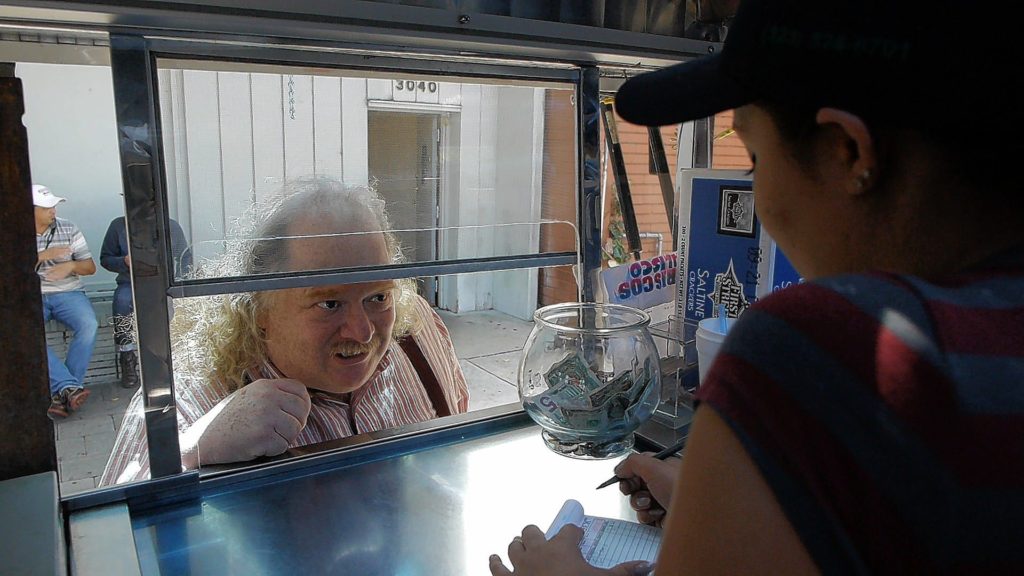
This sort of gastronomic melting pot is the bread and butter of Pulitzer Prize-winning food critic Jonathan Gold, who writes about food — and by extension, his city — for The Los Angeles Times. This week, you can still catch City of Gold, director Laura Gabbert’s documentary about the critic and his work, at Amherst Cinema, where it has been playing in the intimate Studio Theater.
An hour and a half portrait, Gabbert’s film follows Gold as he shuttles around Los Angeles in his green pickup truck, on the lookout for new cuisines and new takes on old standbys. He takes a particular joy in discovering the hidden gems that dot strip-malls and shopping plazas. These are the places where Gold — a wonderfully warm character with a wild mane of frizzy hair and bushy eyebrows and mustache — is welcomed in not just as a critic who could make or break a place’s reputation, but as a fellow food lover. As plates are brought out from the kitchen, the stories behind them — of immigrant journeys and secret family recipes that are the hope for a new American dream — follow like a waft of aromatic steam trailing behind a waiter’s tray.
In many ways, Gold’s type of criticism is an older, gentler, and arguably more useful sort. We have become used to using critics (and not just food critics) as our poison-tasters: they tell us if a restaurant, or TV show, or book is worth us slowing down for a moment. It is all too often a yes/no proposition that leaves little room for some of what Gold is interested in. For Gold, his job seems not to be simply telling us whether or not to order the taco. For Gold, his job is to get us to taste in that taco all the creativity of the person that made it, and all the many intersections (cultural, geographic, etc.) that helped make it possible.
“The thing that people find hard to understand is the huge number of cultures that live in this city, that come together in this beautiful and haphazard fashion … we are all citizens of the world, strangers, together.” If food helps bring us together, then Gold is a wonderful map maker.
Also this week: Pothole Pictures is bringing the Coen Brothers to Shelburne Falls this weekend with Friday and Saturday night showings of The Big Lebowski. Playing on the town’s Memorial Hall screen, the cult — can we still call a film with this big a following cultish? — comedy is a wonderfully absurd mash-up of film noir, stoner comedy, and caper movie. Jeff Bridges stars as The Dude, the bathrobe clad hero whose given name sets off a case of mistaken identity. Too complex and individual to summarize, Lebowski is simply something one needs to experience in person. Shows start at 7:30 p.m., with live music at 7 p.m. both nights, featuring covers of some of the songs in the film. And organizers will be awarding prizes to people who come dressed as their favorite characters from the film.
Jack Brown can be reached at cinemadope@gmail.com.