
By Monte Belmonte
For the Valley Advocate
Perhaps Christmastime still has enough magic in it that small gestures toward peace can make us believe that peace is possible. And if that small gesture is drinking wine, count me in. Max Hastings in his book Catastrophe 1914: Europe Goes To War, writes:
“On Christmas Day in Galicia, Austrian troops were ordered not to fire unless provoked, and the Russians displayed the same restraint. Some of the besiegers of Przemysl deposited three Christmas trees in no man’s land with a polite accompanying note addressed to the enemy: ‘We wish you, the heroes of Przemysl, a Merry Christmas and hope that we can come to a peaceful agreement as soon as possible.’ In no man’s land, soldiers met and exchanged Austrian tobacco and schnapps for Russian bread and meat.”
Food and drink and Christmas cheer was able to, for at least a day, bring pause to the violence. Fast forward more than a century and Russia is still on the frontlines of a war. This time, not with Austria but with Ukraine. And the Ukrainians, despite their recent corruption scandals, are continuing to resist. Being so far from these fronts, it’s easy to feel helpless when it comes to how to support those people most directly impacted by war. But there is one delicious way that I can think of. I found it in a bottle at State Street Fruit Store Deli Wines & Spirits in Northampton.
Shabo is a wine region of Ukraine that has been making wine for more than 2,000 years, not so long after that first Christmas. Wes Desantis, wine buyer at State Street said to me, “We talk a lot about ‘Old World Wine,’ meaning France, Italy, Spain … When those folks talk about ‘Old World Wine,’ this is what they are talking about.”
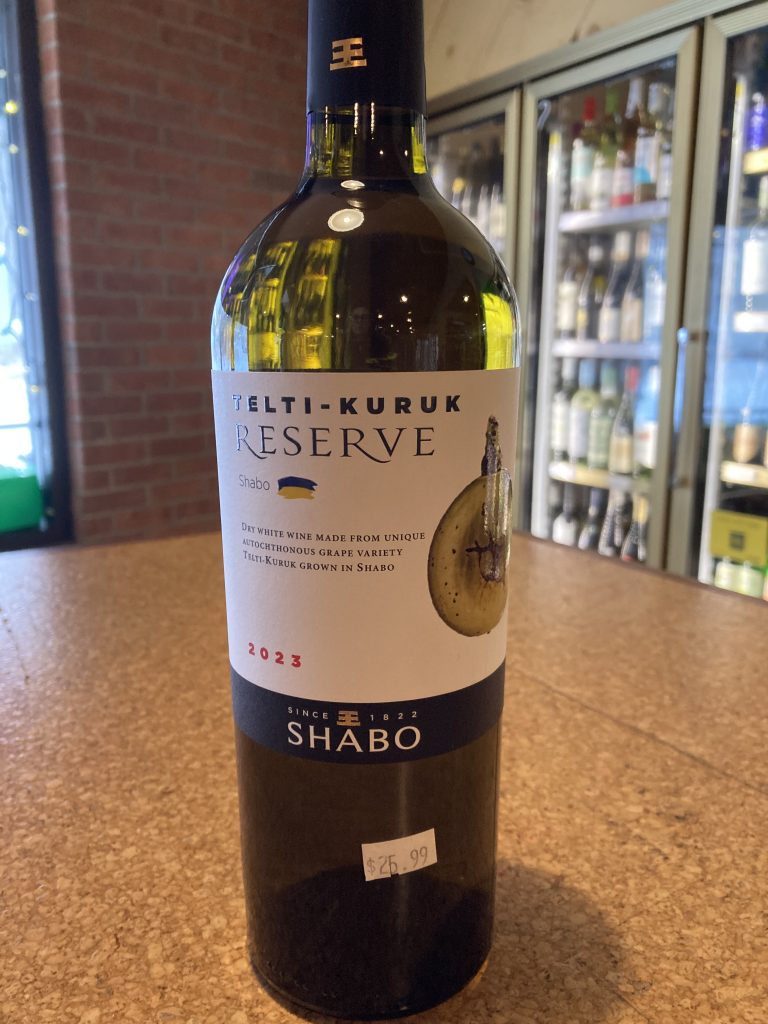
Shabo is near the Black Sea, which brings a unique terroir to this ancient winemaking region. More recently, Swiss colonists founded a winemaking settlement there in the early part of the early 19th century. And since 2003, Shabo Winery has been bringing Ukrainian wine to the world. Shabo Winery was founded by Vaja Lukuridze. He runs it with his family. Like so many former citizens of formerly Soviet states, their relationship with Mother Russia has been somewhat tempestuous since the fall of the Iron Curtain. For example, about 10 years ago, I tried my first Moldovan wines. After relationships between Moldova and Putin soured, that nation had to find new markets. Moscow’s loss was Massachusetts’ gain. Now the company Wines of Moldova has made Moldovan wine widely available to us here in the Valley. The same is becoming true for Ukrainian wine. And Shabo Winery is the first pioneer. State Street has at least two of their wines. I’m eager to try their Brut White Sparkling wine. But I was able to try the Teltí-Kuruk Reserve Shabo Dry White.
Teltí-Kuruk is an indigenous grape in Ukraine. Well, at least 500 years old indigenous. It arrived with the Ottoman Empire and survived the plague of louse, called Phylloxera, that decimated much of European viticulture. The Turkish name Teltí-Kuruk translates to “foxtail” in English, likely because of the long and clustered way these bunches of grapes grow. The wine tasted clean and crisp with great acidity. Three things I value in any great white wine. It had notes of nectarine, but it was bone dry. And austere like a Ukrainian winter. After the wine had a little while to breathe, I noticed hints of flint or Salpeter, maybe even gunpowder. I’m not sure if it was the power of suggestion knowing how much gunpowder has been expended in Ukraine over the last decade, but flint was certainly a tasting note. And a welcome one at that. I’m not Pollyannaish enough to think that if you buy Shabo wine you are actively fighting back against Putin’s act of military aggression. But I’m sure that these farmers in the World’s breadbasket are thankful. And it’s often everyday folks, like farmers, that suffer as much from the destruction of war as those fighting on the front lines.
State Street had also been carrying a Ukrainian beverage more typical of what you might expect from that region-vodka. But our Wines of Moldova friends, who had been representing the Ukrainian vodka in Massachusetts, let the folks at State Street know that the particular brand they had previously been purchasing was no longer available. The Russians had bombed the distillery. The rampant destruction of non-military targets has been going both ways. Ukraine has also bombed several Russian distilleries over the course of the war. Despite the Russian-sounding names of many of the more popular brands of vodka available in the states, almost none of the vodka sold here is owned by Russian companies. So, if you support Ukraine, you can drink your Stolichnaya or Smirnoff guilt-free.
But if you do want to actively support farmers and distillers in Ukraine, and Shabo wine is not up your alley, State Street was able to procure another Ukrainian vodka. It’s called Ghost of Kiev Ukrainian Freedom Vodka. If you think the name is a little too on-the-nose, wait until you read the label. The poor translation on the back of the bottle reads, “In the days of great battles for the freedom of Ukraine, during the glorious victories, heroic losses with great respect to our defenders and defenders, we are with Ukraine in our hearts.” Drinking this vodka brings respect to both the defenders, as well as the defenders. I do love a good bad translation. Almost as much as I love a good wine.
And Shabo Teltí-Kuruk Reserve is just that. It’s wine from a grape that I had never even heard of, let alone tried. It’s affordable, at about $20. And it’s a small way that you can support something non-violent in the face of an interminably long war. Donald Trump famously doesn’t drink. But maybe if he did, maybe he could have added a 29th point to his 28-point peace plan for the Russia-Ukraine War-“Make a Point to Try Each Other’s Alcoholic Beverages-Thank you for your attention to this matter.” Then perhaps the peace talks would be going better. Likely, they wouldn’t be. But I still find hope in the fact that on Christmas during “The War To End All Wars,” the Russians and those they were fighting paused, even for a day, to drink and eat together as human beings. I’ll do my part to support some human beings, some farmers and winemakers from Ukraine, and I’ll go back to State Street to pick up that Shabo sparkling that I’ve yet to try. And I’ll raise a hopeful toast “Vashe zdorov’ya (to your health).” “Happy Xmas. War is Over.” At least until that bottle is empty.