By Melissa Karen Sances
For the Valley Advocate
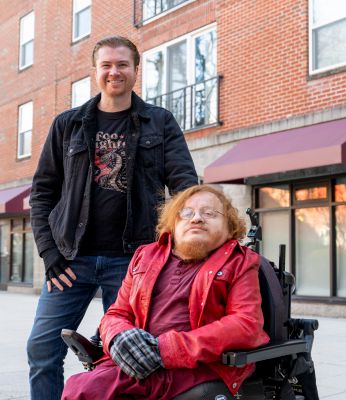
The black-and-white buddy comedy “Tallywacker” opens on Aleister, its star, a young man with brittle bone disease sitting in a wheelchair in downtown Northampton. Locals will recognize the actor as Jeremy Dubs, who is a city councilor representing Ward 4. As he waits for a ride from his bandmate, his guitar case hangs off his chair, upright.
While his halo of hair is tousled by the wind, a prim woman in pearl earrings strides past, then regards the musician with pity. She taps him on the shoulder.
“You’re just an angel,” she said. “You’re just like, God’s gift to Earth.”
“Thanks,” Aleister responded.
The woman tucks her hair behind her ear and says conspiratorially, “Can I pray with you?”
“I’m just waiting for my ride,” he said.
Giggling and kneeling down next to him, she begins to pray. “Lord, thank you for blessing this world with this wonderful gift to show us true strength and suffering. For even though he’s” — her voice fades to a whisper — “disabled, he’s still beautiful-”
“Actually, can you help me pray for something?” he interrupts.
She clasps her hands and closes her eyes.
“Dear Lord,” Aleister said. “Every time someone prays for me, I get a boner. Please help me … I mean, of course I like the fact that random strangers want to pray for me, but every time they do, it’s just boner, boner, boner.”
After the woman skitters away, his bandmate, Emmett, pulls up, and they harmonize for a moment — emitting histrionic cackles that rival a world-domination-obsessed villain like Dr. Evil’s.
Origin story
It’s a bold beginning to an edgy movie, one that grapples with how society responds to disability by ratcheting up the absurdity until the audience laughs — a release that makes room for reflection. By centering the story on Aleister, who identifies as disabled but also wants to be a rock star, “Tallywacker” incentivizes all of us to be better humans. Because when he does become mildly famous, he’s the one that ends up being kind of a dick, which he cops to while singing the aptly titled, “Aleister is a Dick.”
“Tallywacker” — which according to the Oxford English Dictionary, refers to slang word for male genitalia or “a stupid, annoying or otherwise objectionable person” — was digitally released on Nov. 18. Dubs, writer/director Brendan Boogie and actor Chris Goodwin, who plays Emmett, co-produced the film, which won the Special Jury Prize at the Independent Film Festival Boston in 2024. The trio also penned 12 original songs, some of which Dubs and Goodwin will perform in Easthampton on Saturday, Jan. 17 as part of a live band tour.
“With the first scene, you’re either with us, or against us,” said Boogie, who is Boston-bred but Los Angeles-based. “Humor is a great weapon to look at how ridiculous humans are.” As a mental health therapist, he has seen his share of well-meaning misfires. “People think there are these angels, but that’s their way of coping with something they’re uncomfortable with.”
Boogie was inspired to write “Tallywacker” after Dubs reached out on social media, daring any of his director friends to make a film starring a disabled character played by a disabled person. While Dubs had seen characters with disabilities, he noticed that often “people were feeling bad for them,” and he wanted a more nuanced portrayal.
“There’s a lot of joy in disabled people’s lives,” said Dubs, a lifelong musician who sang backup vocals for the Pixies in 2013.
When Boogie sat down with him in Northampton, Dubs was generous in sharing his lived experience of osteogenesis imperfecta (OI), also known as brittle bone disease, a connective tissue disorder characterized by a susceptibility to bone fractures. But the director was most interested in why Dubs originally wanted to be in a band. As a musician himself, Boogie admitted that as young men, “We all join to try to get laid.” When Boogie asked Dubs if he ever worried about being fetishized in the process, Dubs said honestly, “Yeah, but I decided I didn’t care.”
“That’s when the character was like — boom,” said Boogie.
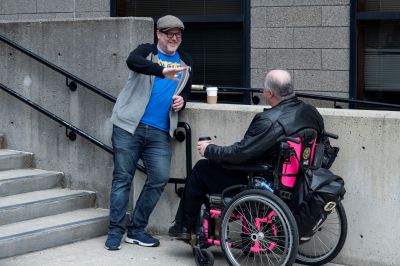
Writer/director Brendan Boogie was inspired to write “Tallywacker” after Jeremy Dubs reached out on social media, daring any of his director friends to make a film starring a disabled character played by a disabled person. CONTRIBUTED
Behind the scenes
While Boogie didn’t go to film school, he said that being a therapist has been an exercise in empathy that he’s applied to his craft.
“Understanding human behavior — that’s writing,” he said. “And trying to create a safe environment for people to be vulnerable — that’s directing.”
Within the movie, he wanted to create the “voices” for two bands: Tallywacker, featuring Aleister on guitar and vocals and Emmett on drums and back-up vocals; and Carly Major (Rivera Reese), a contentious singer who fires her guitar player and asks Aleister to fill in for the rest of her tour, reducing Emmett to the status of roadie. Because Dubs and Aleister share some similarities, Dubs was tasked with writing the songs for “Tallywacker,” while Boogie channeled his inner “narcissist monster” to write for Carly Major.
“Tallywacker” was filmed in Easthampton, Northampton and Greenfield over the course of 16 days. Some of the sites included 1o Forward, a now-closed live music venue in Greenfield; Marigold Theater and Rock Valley Studios, both in Easthampton; and Anchor House of Artists, as well as lots of outdoor streets in downtown Northampton.
While Dubs and Goodwin hadn’t met before “Tallywacker,” they quickly got in sync as a band, becoming a duo before stepping on set. Their camaraderie is evident from the moment Emmett pulls up in the van and they burst into laughter.
“The chemistry was there indeed,” said Dubs. “We hung out while having band practice and I guess we fell in (platonic) love.”
Goodwin, who has toured as a musician, as well as written and directed his own films, said he prefers being part of a band or cast because he is naturally shy. Boogie knew he had a knack for comedy, though, and in the movie, Goodwin’s Emmett offers well-timed comic relief. Boogie said that he and Goodwin “had a scale of how much ‘George Costanza’ Emmett was going to be,” referring to the neurotic character from the highly-acclaimed sitcom “Seinfeld.”
After one tense scene, when Aleister and Emmett are sitting in uncomfortable silence in their van, Emmett waits a beat, and says, “Think it’d be weird if I took a shit while driving?”
When Aleister ignores him, he digs in. “Alright, new business idea. Ready? Pooper. It’s like Uber, but your driver’s pooping.”
Subverting everything
Aleister’s hubris drives the story, because being idolized — and, ideally, getting laid — is more important to him than anyone’s intentions. When Aleister begins touring with Carly Major, a photographer named Scarlett (Adwoa Duncan-Williams) wants to chronicle Aleister’s rise to the top, and in posting videos of him playing, she draws more attention to him.
Throughout the movie, Emmett worries that Aleister is being exploited, particularly after Aleister writes a haunting song called “Brittle” that speaks to his disease.
It begins:
It was after midnight
And my bones were broken
We came to a red light
Beneath the stars
We didn’t need to travel far
My screams filled the car
Dubs said that for him and his character, writing something brutally honest was new. He described his earliest memory, when he was three years old and his dad had left him alone in the middle of a large bed, assuming he wouldn’t go anywhere. He rolled off the bed and broke both of his legs. The lyrics pick up there, when Dubs is rushed to the hospital, screaming in pain while looking up at the vast universe, the stars racing by.
Emmett refuses to play the song. “It’s too obvious,” he says. This isn’t a disabled band.”
“You wrote a bunch of mopey shit when Stephanie dumped you,” Aleister fires back. “Is this a pussy band?”
“What about integrity? Tallywacker is supposed to be about integrity.”
While Scarlett keeps posting videos, she gently but firmly says she can’t “envision ever having sex” with Aleister.
“That’s fine,” he says flippantly. “I can envision it enough for both of us.” It’s the first sign that he’s perfectly capable of objectifying someone else.
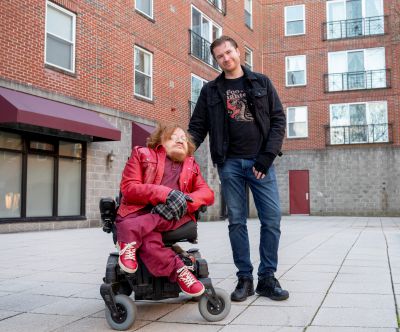
Actors Chris Goodwin, left, and Jeremy Dubs, right, at a filming location from the film “Tallywacker,” Saturday, Nov. 29, 2025, in Northampton. DANIEL JACOBI II / Staff Photo
Heavy heart
Two relationships anchor the movie: the brotherly bond between Aleister and Emmett, who have played in a band together for 15 years, and the mother-and-son dynamic between Aleister and Bonnie (Laurie Mahoney), who is also his caretaker.
As Aleister’s ego grows, Emmett is a voice of reason, while his mother, who struggles with addiction, isn’t sure how to cope.
Dubs said that Bonnie is his favorite character in the movie, because she reminds him so much of his late mother. In the film, the two are bosom buddies who clash wildly. In one scene, Bonnie reluctantly “lets” Aleister play a show in a bar after pointing out that he could get trapped in a fire. When a smoker sets off the fire alarm, Bonnie bursts in while Aleister is talking with Scarlett. “Mom, no!” he yells as she begins wheeling him away.
“Fuck that!” she yells back.
He and his mother “butted heads all the time,” said Dubs.
One part that she would have struggled with, he said, is a tender but surprising scene where Scarlett photographs Aleister privately. He decides to strip down to his boxers, and as she helps him remove his pants, the camera reveals a metal rod in his leg, there to hold his bones in place after multiple fractures.
This was a surprise to everyone involved, including Boogie, whom Dubs approached just before the scene to tell him about his “medical issue.” The interaction was supposed to conclude with Dubs getting bound in Christmas lights, so the director checked in to see if he wanted to proceed. “I said, ‘Honestly, it’s up to you. But to me, if we’re going to do this, we do it.’ And in very classic Jeremy fashion, he did,” Boogie said.
To him, going all-in allowed for the movie to be about more than what meets the eye. Boogie said not only does Aleister not care if he’s exploited, he wants to experience being sexualized.
“I think the balance we wanted is that we don’t pretend the disability doesn’t exist, but it’s not every minute of every day that that’s his [identity],” Boogie said.
Bondage of self
Ultimately, the movie is about empathy. Despite Scarlett’s honesty with Aleister about not wanting to hook up with him, he publicly dedicates a love song to her on the radio and she leaves, humiliated.
While Emmett advises him to leave her alone, Aleister tries to explain. “It was supposed to be romantic,” he says.
“You know what’s romantic?” she asks. “Listening to me when I tell you what I want.”
By the end of the movie, Aleister has alienated everyone who loves him and finally has an epiphany, singing:
I was an entitled dick
A toxic masculinity dick
I didn’t show you the respect
Because I am a dick
But the epiphany isn’t just for Aleister — it’s for the audience. Dubs said that, like Aleister, he’s experienced people wanting to pray over him or speak to him like he’s a child. “I’ve never done the boner joke, but once I was out with family and there was a waitress talking to me like a little kid and I just immediately started responding back to her like a little kid,” he said. “My family knew I was playing with her. But for the most part, I do have empathy because they don’t necessarily know any better.”
“People are trying, in their mind, to do the good thing,” said Boogie.
“I’ve learned over time to be very patient,” said Dubs. “But once I moved to Northampton, I realized that if I wasn’t more vocal about my experience, I wasn’t going to be a happy person. This led to being a city councilor and speaking up for disability rights … and posting on social media.”
“Tallywacker” is available to rent/own on major digital HD internet, DVD, cable and satellite platforms, including DISH Network, Sling TV, Apple TV, YouTube Movies and Amazon.
Melissa Karen Sances can be reached at melissaksances@gmail.com.