By CAROLYN BROWN
For the Valley Advocate
Fifteen years ago, Gabriel “Gabe” Levey’s life took a drastic turn when he had a seizure — his first of many. But rather than letting the diagnosis silence his career as a performer, the Northampton-based clowning instructor channeled his condition into practice onstage and off — not as fuel for jokes, but as a genuine source of guidance.
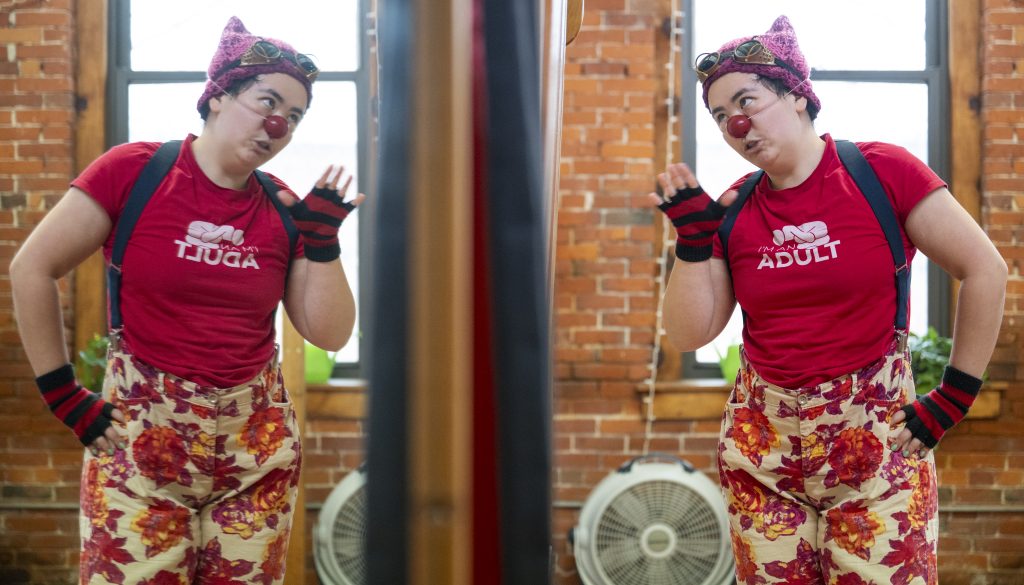
Levey teaches Clown I and Clown II classes at Northampton Karate. To him, clowning is a deeply philosophical endeavor, something far deeper than circus music and juggling pins. The red nose, he said, is “the tiniest mask in the world, which reveals far more than it covers.” To Levey, clowning is a wellness practice, and an exploration of all of the beautiful and hilarious things one might want to share with the world.
Levey grew up in Northampton and was part of one of the first graduating classes at Pioneer Valley Performing Arts Charter School (PVPA). As a kid, Levey was obsessed with comedic actors like Laurel and Hardy, Buster Keaton, Peter Sellers, John Cleese, Christopher Guest, among others.
“These were the idols of, ‘How are these people so serious about making such ridiculous things so funny?” he said. He wasn’t a fan of Charlie Chaplin — “there was something a little bit more performative” about Chaplin’s comedic style — but “I really liked watching Peter Sellers and John Cleese continue to walk into every wall as if they are the most genius people in the world.”
He made his way to Shakespeare & Company in Lenox as a 17-year-old, where he joined the Young Company, an actor training program for young people, and took nine weeks of clown classes.
“It was brutal and I was not good at it,” he said. “But I could see very quickly how it applied to all of the things I wanted to do.”
Levey had a breakthrough watching Shakespeare & Company instructors in rehearsal as the comedic acting troupe The Mechanicals for a production of “A Midsummer Night’s Dream.” One of his favorite sayings about clowning is, “The clown is not an idiot. The clown is an absolute genius doing an idiotic thing,” and he saw his teachers embody that notion as they rehearsed.
He attended Boston University, which he chose because it had a study abroad program at the renowned London Academy of Music and Dramatic Arts. After he graduated with a Bachelor of Fine Arts, he moved to New York City for four years, where he took a workshop with acclaimed clowning expert and theater teacher Chris Bayes.
“One of the things that was so striking to me was that in one of those moments where I was really struggling on stage, rather than [saying], ‘Okay, not funny, get out of here,’ he leaned in and was like, ‘Do you want to try the funny way?’” Levey recalled.
To Levey, it was “a smack in the face or a wake-up call,” he said, “but there was an implicit invitation.”
Levey was impressed at Bayes’ candor and insisted on continuing to study with him. He asked if he could assistant direct Bayes’ production of “The Servant of Two Masters” at Yale Repertory Theatre, to which Bayes replied that it was usually students who did that.
“I was like, ‘Well, should I apply to the acting program?’” Levey said. “And he was like, ‘Yeah, do that.’ And so I did.”
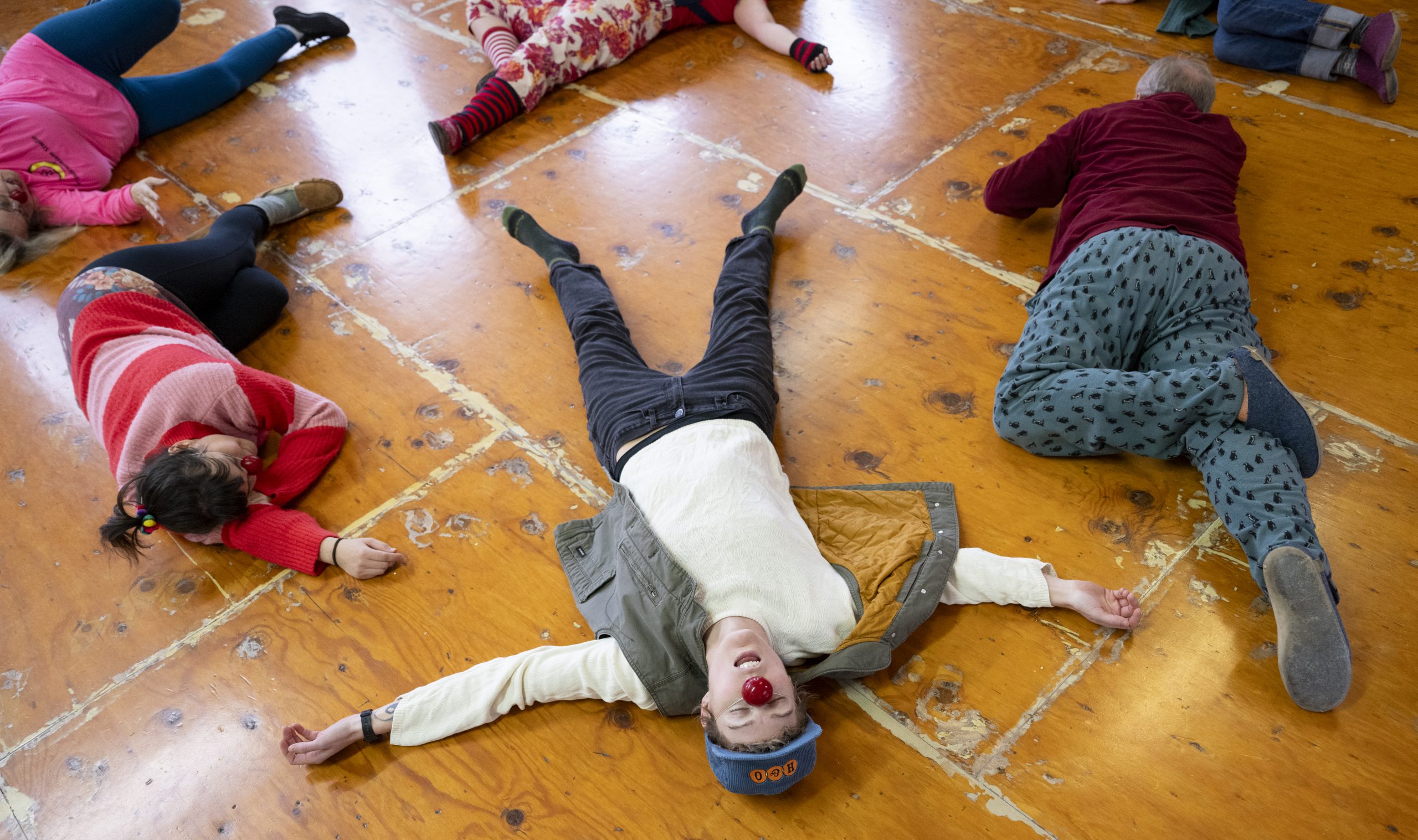
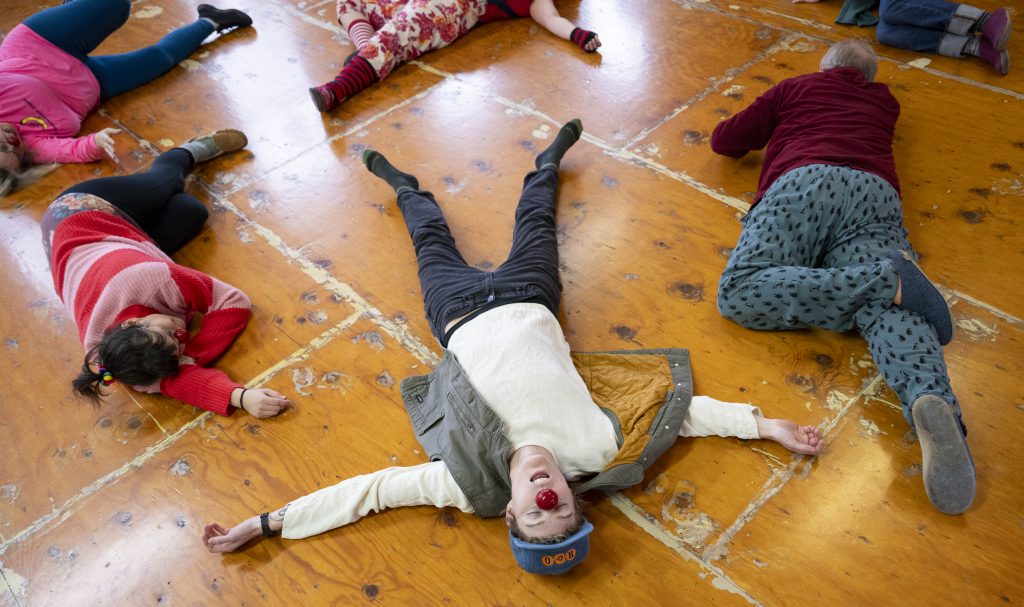
Ky Aldrich rests on the ground during an exercise in a clown class at Northampton Karate in Florence on Saturday, Dec. 20, 2025. DANIEL JACOBI II / Staff Photo
As a student under Bayes’ teaching, “I was just enamored,” Levey said. He thought, “This is everything — this level of vulnerability, this level of play, this level of presence. To me, I felt like I was witnessing people return to their humanity, return to who they actually were.”
Yet in 2010, only 10 weeks into his program, Levey was dealt an unexpected hand: he had a grand mal seizure, which he learned was because of a brain tumor.
Since then, he’s had daily focal seizures, also called simple partial seizures. They can be invisible to others — one may entail, for example, his arm going numb — but they’re now a regular part of his life.
Rather than perceiving a limitation, these moments of vulnerability have guided Levey toward a deeper understanding of his craft.
“For the last 15 years, my body has reminded me throughout the day, every day, that control is an illusion and that the only way forward — for me anyway — is to accept every moment just as it is,” he said. “The real-time presence that is asked of me with each seizure, not knowing what’s coming next, but still leading with hope and staying open to the infinite potential of each moment, is what clown is all about.”
As a student at Yale, he said his condition made him more mindful in his performance training.
“I was in scene classes and clown classes, having seizures, having these moments of, ‘Okay, do I start worrying about this passing sensation in my body, or do I get more curious about my scene partner?’” he added. “That was quite an amazing piece of my training, [the notion of] ‘Let’s just return to the moment. Let’s return to the present,’ because nothing outside of the present moment is going to help me having a seizure, is going to help me communicate with my scene partner, is going to help me, the character, move my life forward.”
Levey graduated with a Master of Fine Arts degree in acting from Yale in 2014 and moved back to New York City. In 2018, he had brain surgery and moved back to Northampton to recover. He made the move permanent in the fall of 2019, but he still commuted to his teaching job at New York University until the start of the COVID-19 pandemic.
Now, back in Northampton, he works as a clown instructor, coach and actor.
“I think Gabe is right when he says this is about being human,” said Ethan Wattley, one of Levey’s students, in a statement. “So much of the role of the clown that has come through the class is really looking at how to listen to the audience, respond to what is working, play into that, while also balancing what is present for you and being in the moment. I sometimes call clowning, from this class, learning how to be in ‘the wow of the now.’ Gabe talks a lot in class about the idea of life being full of possibilities and wonder, and clowning is about really leaning into that. Realizing the wonder of existence itself, that this present moment exists at all and here we are in it.”
“I think of the clown, to some degree, as shocking people back into the wonder and awe of the whole experiment of life,” Wattley added.
Levey will start his next round of Clown I classes on Saturday, Jan. 10, and he’s excited to continue his practice with a new group of students.
“I love this work, and I love sharing it with people, and I have found it to be so transformational for myself as a student and as a teacher,” he said. “There’s something also completely selfish about it, because I continue to learn so much about myself and the world and humanity, and it’s a beautiful thing, and I feel like I get to be in service of the growth of others in a transformational way.”
For more information about Gabriel Levey and his classes, visit gabriellevey.com.