
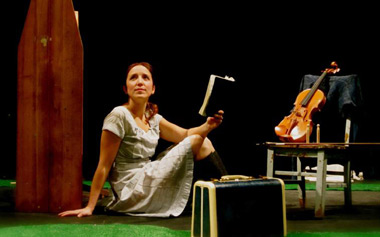
Monday. Kali Quinn is standing alone on a stage bathed in harsh work lights, surrounded by an intriguing assortment of props and fixtures: a pile of suitcases, an antique ironing board, a clothesline and, downstage left, a mini sound system and a violin.
We’re in the Holden Theatre, a black-box performance space on the Amherst College campus, beginning what’s called a “space-through.” It’s the first step in putting a theater piece onstage at the Ko Festival of Performance, an opportunity for the artist to get acquainted with the parameters and feel of the space she’ll be performing in. As Quinn runs through her one-woman piece, artistic director Sabrina Hamilton is taking notes on the show’s focal points for the lighting plot she’s designing.
It’s the beginning of the second week in the Ko Festival’s 20th anniversary season. Overture to a Thursday Morning, Quinn’s original play about three generations of women and the secrets that haunt their lives, is scheduled for the third weekend. But this week’s guest artist, Martha Kemper, doesn’t arrive till tomorrow, so the Ko crew are taking the opportunity to get a head start on this one.
In the perilous world of contemporary theater, the fact that Ko has not only survived for two decades, but has become nationally influential in the process, is cause enough for celebration. What’s downright astonishing is that this company doggedly avoids the mainstream in favor of the edge. In the I-Ching, “Ko” is the hexagram for revolution, renewal and rebirth. Its Valley namesake is devoted to revitalizing theatrical forms, primarily through explorations in what’s known as “devised theater”—theater created through experimentation and improvisation rather than readymade scripts.
*
Tuesday. Sarah Wolfe is sitting in the Holden lobby, taking a two-hour shift at the box office phone. She’s one of nine Ko interns who do a multitude of jobs throughout the festival. “I’m learning a huge amount,” she says between incoming calls. “Earlier today I was putting up posters, I’m the stage manager for this week’s show, and last week I was the light board operator.”
All the interns, unpaid and chosen from a nationwide applicant pool, are college students or recent graduates. All but one, that is. Bill Ross, a master juggler and longtime Valley resident, has been a professional entertainer and educator for as long as the other interns have been alive. He says he signed on because “I’ve been feeling very stagnant and need to shake things up. I’m already getting inspired again.” He and several other interns are also taking one or another of the festival’s week-long theater-skills workshops that are part of what Hamilton calls Ko’s “value-added” approach to summer theater.
In addition to her upcoming performance, Kali Quinn is teaching a workshop titled “Mask, Movement and Mayhem,” and Ross is in it. Today’s work introduces the students to the archetypal clown predicament: the “oh, shit” moment when hopeful endeavor stumbles into fiasco. One exercise involves walking blind toward a shoe placed on the floor and putting your hand down where you think it is—a recipe for almost certain failure that Quinn says isn’t really about the goal, but about making creative use of the journey.
*
Wednesday. “We had a great space-through for Martha’s show last night,” says Sabrina Hamilton, “but it’s so complex that we’ve hung twice as many lighting instruments as the last show.” A gang of interns swarm over the steel catwalks above the stage, focusing lights on the floor below while Hamilton and tech director Holly Gettings prowl the stage directing the beams. Evan Roby calls out each instrument in turn from a sheaf of charts detailing their purpose and position, and fellow intern Morgan Holmes punches them up on the computerized light board. She reveals, with a mixture of trepidation and pride, “I’ve never done lighting before.”
In a rare moment of stillness, Hamilton reflects on the fruits of 20 years doing this work. “From the beginning,” he says, ”we were so odd in the way we operated. We always try to start with the fantasy, to help people dream their dream. And whatever it is—as long as it’s safe, on time and doesn’t cost anything extra—it’s good. So I say to performers, ‘Don’t send me your reviews, tell me your ideas.’ We are often able to produce that spirit for them—the reason they go into this incredibly difficult life. And I think we get the best product to show our audience that way, too.”
*
Thursday. Ko also provides space for a couple of rehearsal residencies where guest artists can develop new work. This week, Ellen Di Giovanni (who is also Ko’s outreach coordinator) and New York theatermaker Katie Pearl are working with a group of young performers to fledge a piece based on the letters of Marie de Rabutin-Chantal, marquise de Sévigné, an aristocrat in the age of Louis XIV.
Today’s staging experiments enact a world where mail was delivered on horseback and weeks could pass between posting a letter and receiving a response. The actors sprawl on the floor in bored postures, then burst into action as a letter arrives, hastening to read it and scribble a reply before the rider departs. It’s inspiring, Pearl says, “to see how the material wakes up when it’s in the actors’ bodies and creative minds. This group has a great combination of intellectual curiosity, playfulness and we-don’t-care-about-looking-dumb-ness.”
*
Friday. In the Holden lobby, its walls lined with posters from the first 20 Ko seasons, Martha Kemper is running over her lines for tonight’s performance while intern Belen Ferrer holds the script. Other interns are folding the programs that have just arrived from the printer and stuffing them with colored inserts. Bronwyn Maloney reflects that her comfort zone has been challenged in ways she didn’t even expect. “At the Fourth of July parade in Amherst, we handed out postcards and tried to engage people in conversation about the festival,” she says. “People were really receptive, which I was totally shocked by, since I come from New York City, where people are horrible to anyone who stops them on the street.”
Me, Miss Krause and Joan is Kemper’s one-woman homage to her acting teacher, the semi-legendary Alvina Krause, in whom Kemper found the same fierce dedication to a mission as her childhood exemplar, Joan of Arc. She’s an incandescent performer and her piece is riveting and even uplifting, notwithstanding the horrifying description of an assault that’s seen in parallel to Joan’s torment. In a post-show talkback moderated by longtime Ko collaborator Kermit Dunkelberg, audience members inquire about Kemper’s creation process and delve into the relationship between the creative muse and the “voices” that inspired Joan. This is a feature of all Ko performances, aimed at fostering community dialogue around artistic and societal issues.
Then there’s a party in the Amherst dormitory that houses the artists and interns. Amid a buzz of animated conversation, the staff unwinds from another opening night, while already casting an eye toward next week’s new hubbub of activity.
The Ko Festival of Performance continues through Aug. 6. Call (413) 542-3750 or visit kofest.com for info on weekend performances and midweek workshops.