
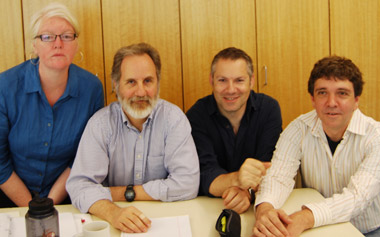
“I think this is the first time all four of a season’s directors have been together under one roof.” The speaker is Byam Stevens, artistic director of the Chester Theatre Company, and the roof sheltering this unprecedented gathering is that of the town’s elementary school. The company, which performs in the old town hall, is borrowing the schoolhouse, a mile down the road, to rehearse this summer’s four shows.
The concatenation of directors arises from the fact that on this late-June morning, the first two plays are in rehearsal at the same time—one heading for its opening night, the other in its very first day of rehearsal—and the director of the third production is also the author of the first show. Stevens himself is directing the fourth offering.
Since its debut two decades ago, the company (originally called the Miniature Theatre of Chester) has built its reputation on small-scale, high-quality productions of literate scripts. This season the “literate” becomes literal. All four productions are imaginative versions (and/or inversions) of literary works with intriguing twists on the original material. And none more so than the season opener, pride@prejudice.
That’s “@”, not “&”.
Daniel Elihu Kramer’s adaptation is not only a faithful rendering of Jane Austen’s classic dissection of manners and morals; it’s also inlaid with present-day comments, insights and study questions posted on Internet websites, as well as excerpts from Austen’s own letters.
“All these other voices that come into the script—the bloggers, the discussion boards, the students and teachers, the Austen enthusiasts and Jane herself—these are not a distraction from the book but a way into the story,” Kramer insists. “They actually become points of entry for us.”
As the five actors who perform all 21 roles in pride@prejudice begin a runthrough on a makeshift stage laid out on the floor of the school’s mini-cafeteria, it’s immediately apparent what he’s talking about. The script’s use of verbatim narrative from the book as well as dialogue, together with the ‘Net-based interjections, create shortcuts into the plot and characters. When one of the actors refers to “the five young ladies” whose fortunes are at the center of the plot, another one interrupts:
“Question: In the novel Pride and Prejudice by Jane Austen, how many sisters were there in the Bennet family?” And another responds:
“Best Answer, chosen by voters: There are five Bennet sisters in the novel. The eldest one is Jane Bennet, who is very pretty and always the center of attraction, though shy. The second sister is our very own Elizabeth Bennet, who gets married later to Mr. Darcy. …”
“My hope is that the play is, in fact, Pride and Prejudice,” Kramer says. “But it’s also about our love affair with the book. It enacts that incredibly pleasurable process of finding a book that pulls you into its world so fully. And the theatricality of the style lets us see sides of the characters we might not see in the film and TV adaptations.”
Classic Stories, Contemporary Voices
As it happens, three of this season’s directors are members of theater departments at nearby colleges. Kramer, who will direct The Turn of the Screw, based on Henry James’s vintage ghost story, teaches at Smith College. Ron Bashford, pride@prejudice‘s director, has just completed his first year on the Amherst College faculty. And Sheila Siragusa is an assistant professor at Central Connecticut State University.
Siragusa’s production is a bare-bones retelling of Dostoyevsky’s psychological thriller Crime and Punishment. Today she’s had the first read-through and discussion with her actors—in the school’s art room—and instead of quailing at the prospect of lifting such a heavyweight classic onto the stage, she’s brimming over with praise and pleasure.
She says this three-actor adaptation of the story of Raskolnikov, who commits a sordid murder which then haunts him, is “a beautiful play about redemption and the possibility of love. And of course,” she adds, “it’s also a crime drama, filled with suspense and dramatic irony.” The script by Marilyn Campbell and Curt Columbus, she says, “is really clean and has its own motor, but it doesn’t oversimplify.”
The season will close in August with Wittenberg, a kind of prequel to Hamlet in which the Prince of Denmark debates theology and morality with two of his university professors—the historical Martin Luther, instigator of the Protestant Reformation, and Christopher Marlowe’s fictional Doctor Faustus.
Byam Stevens acknowledges that this one isn’t an adaptation per se, but a literary spinoff. Set in the year 1517, David Davalos’ play imagines that Hamlet has learned of Copernicus’ heretical theory that the earth revolves around the sun, and wants to discuss its implications with these two great men, the philosopher and the theologian.
“It sounds really serious, and it does cover some really big ideas, but it’s quite Stoppardesque,” Stevens says of the play. “It’s very clever and funny.”
Later this month, after pride@prejudice opens, Daniel Kramer will begin rehearsals for The Turn of the Screw. He says he’s eager to get to grips with its multilayered spookiness, and excited about opportunity to work intensely with “two terrific actors,” Allison McLemore and Justin Campbell.
Kramer says he’s constantly amazed at the quality of the actors who agree to work in this little theater up in the hills, many of whom return for successive seasons. McLemore and Joel Ripka, who plays Hamlet in Wittenberg, co-starred in last season’s Nibroc Trilogy, and pride@prejudice‘s inscrutable Mr. Darcy, Jay Stratton, is a familiar face on the Chester stage.
Stevens accounts for the company’s appeal to actors in one word: “scripts.”
“It’s hard to overestimate the amount of time the average actor spends with really inferior material in order to make a living,” he explains. “If you pick good scripts… you’re going to get good actors. And if you stay true to that over the years, your company develops a reputation.”
Circling back to the meta-theme of pride@prejudice, he credits the Internet with expanding the universe of actors who are attracted to Chester. “One of the things about the Net is that it allows actors to look at what you’ve done over the years, and our list of plays is very, very actor-friendly. It’s filled with big, meaty roles for actors.”
This season’s page-to-stage plays promise to give actors, and audiences, the chance to get their teeth into some meaty material that’s food for thought.
Chester Theatre Company’s season runs July 6-Aug. 28 at Chester Town Hall, 15 Middlefield Rd., Chester. (413) 354-7771, chestertheatre.org.