
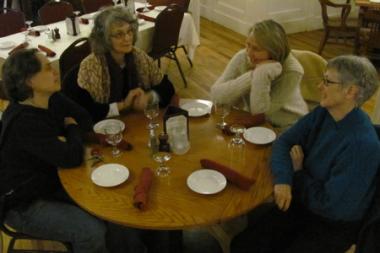
The other night I had the pleasure of dining out with three accomplished women of the Valley’s theater community: Jeannine Haas, artistic director of Pauline Productions, Linda McInerney, artistic director of Old Deerfield Productions, and Linda Putnam, a widely respected acting teacher—all three of them also experienced professional actors.
Haas had recently played the demanding title role in The House of Bernarda Alba, and was experiencing the letdown of what actors call “coming off the role”—the visceral “crash” that happens to many performers after a show closes. The dinner table conversation began with a discussion of the life of a woman actor juggling her many real-life roles as well.
Putnam: It’s the nature of being a woman—you do the dishes and the laundry and the kids. I get to go off and do theater, but when the show’s over, you’re exhausted, you haven’t kept up with the ironing, you have all those bills to pay and all those people to call back.
Haas: I studied with Linda [Putnam] and I remember you saying, Linda, that acting is no different from canning peas—it’s your job, that’s what you do. That has been really valuable for me. And yet, when I finish these plays, I’m like, Okay, so why do I have these post-show crashes? It should just be my job.
McInerney: All of a sudden the play’s over, but it’s not gone. That role will be in you for the rest of your life.
Putnam: I think the crash is really, really important. It’s a necessary transition. We have to be able to come back to being the person who can stand at the kitchen sink, who can be satisfied with all of the things our loved ones bring to us that aren’t about those elevated passions on the stage. If we didn’t crash we would go insane.
McInerney: It feels like suffering, and in a way it is.
Haas: It feels like a kind of grief. I feel lonely. I don’t want to get off the couch, so it feels like depression. But it doesn’t feel the same every time.
Putnam: It’s particular to the characters you’re playing.
McInerney: It’s very specifically wrapped around who you just played. You’re never the same after you play a role.
Haas: This is interesting. The idea that a role changes you never actually occurred to me!
Putnam: Every character you play opens up a part of you that becomes dominant. Your job afterward is to take that part and put it back into the whole range of your personality.
McInerney: You have to put yourself together in a new way. There’s a processing and an integrating. You can say, What kind of ritual can I wrap around what I’ve gained from this character? I say that to my actors.
Putnam: My old teacher, Peter Kass, used to say that after every show you have to make your character buy you a shirt. I do that. I make every character I play go out and buy a new shirt. It blows my mind what I come home with. And at the same time, you have to throw a shirt out.