
Bright Star
Written and directed by Jane Campion. With Abbie Cornish, Ben Whishaw, Paul Schneider, Thomas Sangster, Kerry Fox, Samuel Barnett, and Edie Martin. (PG)
It can't ever be easy to make a film about a poet. The act itself is most often a solitary affair on both ends: a writer alone at a desk; a reader in a chair. Once in a while, the particular circumstances of the poet's life add a dramatic frisson missing from the art itself—the recently deceased poet Jim Carroll had his compelling addiction memoir The Basketball Diaries turned into a so-so film; author Charles Bukowski was immortalized by Mickey Rourke's turn as the alcoholic writer in Barfly. John Keats' claim to fame, at least according to the new film Bright Star, is that he was very polite.
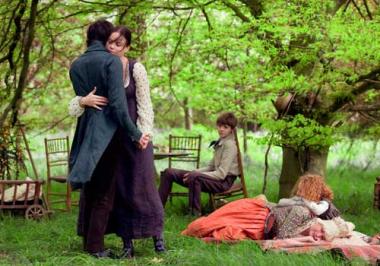
The great Romantic poet Keats, played here by Ben Whishaw (Perfume; Brideshead Revisited), died at 25 of tuberculosis. His one deep love—never consummated—was for Fanny Brawne, the daughter of a neighbor. A talented seamstress and flirt, Fanny (Abbie Cornish) at first has little interest in Keats' work, but quickly falls under its sensual spell, a situation intensified by meeting the author. It's one of the welcome changes of pace in what could have been a revisionist bodice-ripper that Keats is far more beautiful than Fanny; with his glinting eyes and blooded lips, Whishaw makes Cornish's Fanny seem plain, sturdy but unremarkable.
But if writer/director Jane Campion (The Piano) makes the poet (and poetry) an object of seduction, the ensuing relationship doesn't live up to the movie's hype. Lacking the financial security to propose marriage, Keats is an eternal suitor—the closest thing to a bedroom scene is when he and Fanny push their single beds against opposite sides of the same wall. Many walks are undertaken, and many poems are read. It's all meant to be tragic—true love held apart by an unjust caste system—but feels repetitive and inert; one longs for the lovers to do anything besides meekly accept their fate, but it's a longing unrequited.
Still, the actors turn in good work; Cornish is especially able, giving her character a touch of modernity—she challenges Keats' boorish and chauvinistic housemate Brown when he tries to bully her out of his study—without turning her into a 19th-century Gloria Steinem. And Paul Schneider, who plays Brown, is simply great as the blustering billy goat who might have designs on Fanny. It's one of the hallmarks of a good performance in villainy that we forget the actor—except to curl our lips when he appears—and Schneider gets that, not caring if we like him.
Campion, too, has crafted a visually marvelous work, substituting the vibrant explosions of wildflowers, an abundant heath, and the coarse needle and thread of Fanny's seamstress work for the sensual pleasures the characters can't provide for themselves. Even in Bright Star's quietest moments, she makes the screen dance. In the end, it's not her fault if the poet's life could never live up to the romance of the work it inspired.
*
Also this week: If you're a fan of the many special film events that crop up in the Valley, Thursday offers a bit of a conundrum, as three separate venues offer up screenings that range from scholarly to schlock. (As ever in the great tradition of cinema, opinions may differ on which is which.) The truly dedicated—if you ask yourself why anyone would pay to see a film from a man once voted the Worst Director of All Time, this is not you—can manage, with a bit of speed, to catch at least two of the batch.
Screening first is Der Tunnel (The Tunnel), which unreels at 4 and 7:30 p.m. at Amherst College's Stirn Auditorium. A suspense thriller that seems to borrow from all the great escape dramas, the 2001 award-winner is actually the true account of one desperate group's plan to escape fro East Berlin. Starring Sebastian Koch (The Lives of Others) as Matthis Hiller, it recounts the efforts of Hiller—an engineer by training—and a group of associates to dig a tunnel under the border in hopes of spiriting away family and friends. Along the way, the band recruit visiting Americans (including an NBC film crew) to their cause, but also attract the attention of the secret police.
Just after The Tunnel wraps up, Amherst Cinema begins a one-night-only screening of the T-shirt industry favorite Rebel Without a Cause. Nicholas Ray's 1955 classic Technicolor tale is an occasionally dated teen drama but one that still feels like a bracing refresher next to the maudlin Happy Days fare of later years. James Dean stars as the angry young man in his most famous role, with Natalie Wood and Sal Mineo as the classmates that become his surrogate family over the course of one long, terrible day.
The film screens as part of The 1950s: Cold War Culture and Birth of The Cool, a new experimental course at Hampshire College; the school has partnered with the theater to bring a selection of the film series to the wider public, and Rebel will be introduced by Hampshire's Karen Koehler, who will also lead a question and answer session following the film. The aim of the series, according to Assistant Professor of U.S. Literature Michele Hardesty, is to "study the culture of the 1950s from multiple disciplinary perspectives and in multiple media—the lecturers are from art history, music, literature/American studies and philosophy"; other film entries coming to Amherst this month include West Side Story and the Elvis Presley picture Jailhouse Rock.
If you plan to make it a multiple-film night, here is where you have to make your choice. Because at 7:30 p.m., Hadley's Cinemark Theatre begins screening the delightfully awful Plan 9 From Outer Space, by Z-movie director Ed Wood (he won that award mentioned earlier). The 1959 film is said to star fright-film icon Bela Lugosi, but Wood was simply recycling footage left over from a film the pair was shooting when Lugosi died. To fill out Plan 9, the director hired his wife's chiropodist, Tom Mason, as a stand-in for Lugosi; to disguise the fact that the men looked nothing alike, Wood simply had Mason hold a cape in front of his face for all his scenes.
That's small potatoes compared to the film's other bits of numbskullery: "flying saucers" that are simply hubcaps held aloft by string; actors reading from the script while on camera. It's the kind of inspired nonsense that was always raw meat to the crew of Mystery Science Theater 3000—a group of wisecracking comics who became a cult hit when they filmed themselves riffing on the cut-rate idiocy of B-movies. Their commentary was hilarious enough that, for once, you didn't mind someone talking during the movie.
Admission to the one-night screening, presented in collaboration with RiffTrax and Fathom Events, includes access to a smorgasbord of digital freebies including songs, photos, and animated shorts depicting the plans for the aborted plans one through eight.
Finally, Pleasant Street Theater's horror series Shocktober continues this Saturday at midnight with Haxan, a rarely seen silent film from 1922. A departure from our expected ideas of big screen silent movies—this is no slapstick, but a dark look at black magic—the film's imagery was disturbing and haunting enough to inspire a DVD commentary by Naked Lunch author William S. Burroughs.
Jack Brown can be reached at cinemadope@gmail.com.