At nearly a mile in length, the Hadley Common is the longest in New England. It’s a magnificent swath of clipped grass, manicured trees, tucked-away fountains and well-positioned benches.
It’s idyllic and sublime—but for the four lanes of heavy automobile traffic that bisect it.
The immensely popular Esselon Cafe and Coffee Roasting Company stands on the southern side of Route 9, just off the Common. If you want to enjoy all the cafe has to offer, most patrons appear to agree you need four wheels to get there: its parking lot is often full beyond capacity, with the overflow spilling out into the streets. Standing on the northern side of Route 9, looking across to the cafe, it feels like you simply can’t get there from here. The torrent of traffic is relentless. There isn’t a crosswalk—not even a traffic light to occasionally stem the flow.
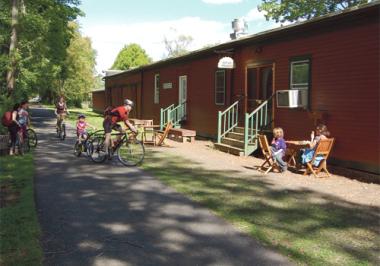
But if you turn your back on the road and walk up the Common, you’ll find a narrow paved path running along an old rail bed. Following it a few hundred yards to the east, you find a one-story red building that houses a dance school and Sofia’s Praises, another cafe serving homemade Polish delicacies, sandwiches and ice cream. Outside, lining the bike path, are benches and a couple of tables. You can get there by car along Railroad Street, but most patrons arrive on two wheels or by foot, and on a warm day you’ll see them sitting outside, licking at a cone or partaking of a pierogi, listening to the birds rather than the traffic.
The two cafes and their proximity to the Hadley Common offer a clear illustration of the forces that have been at work shaping American public space for the last 400 years, and they offer hope that finally public interests, rather than private ones, may be getting the upper hand.
*
When the Hadley Common was designated in the 1600s, like others across the region, its purpose was more practical than recreational. In addition to militias using the commons for practice (in 1676 the Common and most of the houses that bordered it were surrounded by an eight-foot high stockade to guard against attacks from the Native Americans), the long stretch of green acted as a market and meeting place. It served as connective tissue and social sustenance for the community whose front doors opened out onto it.
As America and its urban centers grew in the 1800s, the vital resource provided by the town green was found to be lacking in the rapidly spreading cities, and the notion of building public parks in heavily settled areas was introduced as a way to offer city dwellers a taste of rural. It was a revolutionary notion. Up until then, parks were considered private, guarded domains for European nobility to hunt at their own pleasure; early residents of Hadley would not have conceived of their Common as a park.
Before it was implemented, many thought Frederick Law Olmsted’s and Calvert Vaux’s plan for Central Park in New York City was a social disaster waiting to happen. Known as the Greensward Plan, instead of stately, symmetrical gardens of flowers, the plan tried to provide a simulation of the lush, bucolic Connecticut River landscape Olmsted had known in his youth growing up in Hartford. Within its confines, the park had walking paths and carriage roads intermingling with one another.
How, skeptics asked, could anyone expect the merchant and working classes to share the same winding trails, wooded glens and great lawns? Couldn’t any fool see such a park would ignite class tensions and turn the meadows into battlefields for class warfare?
As we now know, Olmsted’s experiment in realizing democratic ideals through landscape design succeeded. He spent the rest of his life with his services in great demand, designing parks for urban areas across the country. But as his career flourished, cities and populations exploded, and his vision expanded to accommodate them. He argued against the tendencies of city planners to design streets in grids, saying that such a plan would put the needs of industry over those of the people living and working along those roads. What it would do to expedite commerce would also suffocate the city populace, cutting off their connection to the earth and the environment.
As the northern part of Manhattan was first being developed, he proposed a street layout that worked with the topography of the area, and instead of a rigid grid, he suggested more meandering routes divided by tree-lined lanes. While his vision for Harlem was never realized, he developed the idea of connecting parks throughout a city by a network of landscaped routes, or what he dubbed greenways. Buffalo, N.Y. had one such system built, but the most famous is the park system Olmsted designed for Boston, which became known as the Emerald Necklace. When the network of parks was first constructed, a pedestrian could walk beneath a lush canopy and often along a waterfront all the way from the Boston Commons through the Fens, over to Jamaica Park and across the Arnold Arboretum, and end up in Franklin Park.
In the last 100 years, though, like the Hadley Common, the Necklace’s once-uninterrupted path has become dissected by heavy road traffic. It is no longer equal to the sum of its parts, and an uninterrupted walk along its route is impossible.
*
While the advent of the automobile has isolated pedestrians, leaving them stranded on islands that often require some kind of motor to travel between, since the late 1960s there has been an effort afoot to take Olmsted’s ideas and apply them to another 19th century relic—the abandoned rail lines that crisscross the continent. By preserving these rail corridors as paths for non-motorized travel, the Pioneer Valley is now beginning to enjoy the fruits of rail trail advocates’ work and Olmsted’s greenway vision.
It’s been an uphill fight, though. Just as when Central Park was first proposed, many who lived near abandoned rail lines had ill-founded fears of what the routes would bring if opened to public use. While Northampton is currently seeing federal stimulus money being used for two out of the four Massachusetts projects that got funding for pedestrian and bicycle improvements (the rail trail connection between the city and Easthampton, and sidewalks in the Jackson Street area), other towns have resisted preserving their rail corridor.
Craig Della Penna, a local realtor who specializes in selling properties in close proximity to rail trails, formerly worked for the Rails to Trails Conservancy as the legislative agent and political organizer for the New England region. He explained recently that despite several grassroots efforts in Springfield to build rail trails there, the city had the distinction a decade ago of being the only municipality in Massachusetts to have sold portions of the abandoned track to private businesses, making completion of a public trail network all the more difficult. Della Penna’s own advocacy for rail preservation began in 1996 when, to his amazement, Southampton voted not to preserve the rail corridor in its town, citing the aforementioned fears.
Increasingly, though, rail trail advocates have been persuading voters and lawmakers to see things differently, and the state is getting connected. More and more pedestrian islands are becoming liberated. Della Penna estimates Massachusetts is still about eight years away from finishing connections between Western Massachusetts and Boston, and he also points to progress connecting the Valley with New Haven. Along with several trail connections being made over the state line, Southampton recently wavered in its resistance and voted to investigate the possibilities of building a trail.
And though Route 9 still tears through the middle of the Hadley Common like an open wound, making walking the green’s length a peril-laden adventure, the northern part is now connected by a network of paths to places like Northampton’s Look Park, the UMass and Amherst College campuses, and much of the Pioneer Valley.
But the connection is more than merely a physical link between two places; it’s an opportunity to close the distance the combustion engine has created between us and our food.
These new greenways offer Valley residents and visitors a way to relate to their sustenance that is closer to what the early Hadley settlers enjoyed than at any time between now and then. Just as our ancestors could look out their windows to see where their meals came from—the livestock grazing on the green out front or the plants growing in the pastures behind their homes—modern-day travelers can journey through these farmlands, enjoying the seasons and scenic vistas, and rather than hunting for a gas station to refuel, they can step inside a cafe or restaurant and eat their fill of what the Valley has to offer.