
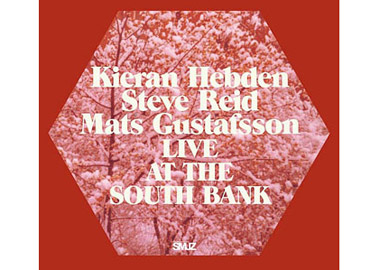
Kieran Hebden, Steve Reid, Mats Gustafsson
Live at the South Bank
(Smalltown Superjazz)
Recorded at 2009’s Meltdown Festival in London, this double CD set is more than a live document. It’s a testament to the collaborative powers of electronic artist Hebden and drummer Reid, who worked together on four earlier albums. Sadly, Reid passed away in 2010, but his playing here could prove a fitting epitaph. Equal parts restrained cool and extended-beat mastery, it consistently matches the flourishes and soundscapes created by Hebden. The trio (which also includes saxophonist Gustafsson) segues from the bubbling excursion of “Lyman Place” to “People Be Happy” with almost no let-down amidst Reid’s persistent bass-kick and Gustafsson’s solo squawks. Though a nearly 90-minute runtime breeds redundancy, the tense opening number “Morning Prayer” is reason enough to mourn a partnership gone too soon. —Michael Cimaomo
*
Uncomfortables
Across the Shield Vol. 1 & 2
(75 or Less)
It would be inaccurate to say that The Uncomfortables have been quietly rocking away in the Valley under the radar—they typically don’t do anything quietly, or slowly, for that matter. This ambitious two-CD release continues the Dead Kennedys-esque hardcore/punk mission from Zod begun by the band’s core members’ former musical assault unit the Pajama Slave Dancers, though it’s definitely gotten more metal. The disc was co-produced with and engineered by Matt Bachand (Shadows Fall, Kobra Kai)—the basics have a great live sound, and the seriously spastic guitars have been tweaked in all sorts of delicious ways with some wah-wah tones and Hendrixian delays, but not too much to lose the basic DIY feel. —Tom Sturm
*
Gideon Freudmann
Rain Monsters
(Octagon)
Former Valley resident Gideon Freudmann has long specialized in what he calls “cello bop,” a looping, adventurous and electrified form of cello music. He’s unafraid to cross any genre line he feels like, and guitar effects like distortion or wah sometimes add a layer of modernity and rock abandon—on “Cello Shots,” he plays with monstrous fuzz, alternating those passages with pleasant, sitar-fueled folk/psychedelia. Here Freudmann’s introspective explorations are fleshed out by a full band, and the additional players offer him a wider palette by far, allowing him a broad landscape through which to gallop (and loop and bow). Freudmann’s sound is one of a kind, somewhere between Baroque, minimalism and organic electronica. It’s a pleasure to trip through the unexpected turns, always sophisticated in their musicianship and poignant in their contours. —James Heflin