
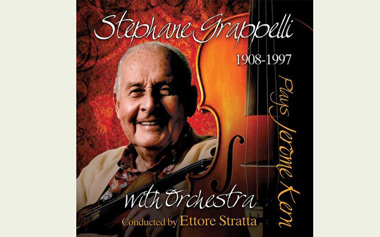
Stephane Grappelli
Stephane Grappelli with Orchestra Plays Jerome Kern
(Just A Memory)
Jazz violinist Stephane Grappelli is largely known as Django Reinhardt’s colleague in the Hot Club of France, where he played the equally talented foil to Reinhardt, but Grappelli had a decades-long career that included much beyond that era. In this re-release of a 1987 album, Grappelli is the anchor of a large orchestra. Strangely, much of the music here, undeniably well played, sounds more retro than Grappelli’s music of 50 years earlier. It’s not his fault: Grappelli’s violin is as sweet, lyrical, and lovely as ever. It’s simply that the soft, almost loungy production, sometimes capped by strange, breathy scatting, feels limp and unadventurous next to Grappelli’s gorgeous playing. That said, moments of great interplay, especially between acoustic guitar and violin, often blow this one out of its occasional doldrums. Grappelli, then around 80 years old, is never less than masterful. —James Heflin
*
PJ Harvey
Let England Shake
(Vagrant)
“Goddamn, Europeans. Take me back to beautiful England, and the grey, damp filthiness of ages and battered books and fog rolling down behind the mountains, on the graveyards of dead sea captains. Let me walk through the stinking alleys to the music of drunken beatings, past the Thames River, glistening like gold hastily sold for nothing.” So sings PJ Harvey on “The Last Living Rose.” Her new album is starkly critical of the musician’s homeland, yet also fiercely patriotic and reverential to her island kingdom’s traditions. It’s partly a deeply mournful lament, sung in her banshee punk style, for what has been lost in our modern, violent world, but she also works a magic closer to something druidical, calling up older ghosts. Flood, John Parish, and Mick Harvey are key members of her band, and while the arrangements are simple, they are eloquent and often achieve true majesty. —Mark Roessler
*
Benjamin Carr
Oakleaf
(independent)
Southern Vermont’s Benjamin Carr plays instrumental acoustic music that leans heavily toward jamming, and borrows from bluegrass and a bright, happy brand of rock and jazz. Whimsy is the order of the day on opener “Apple Dance,” which trips, sometimes handily, sometimes a touch awkwardly from rhythm to rhythm, slathering lots of mandolin and guitar on top. Often the whimsy on Oakleaf manifests itself in the combo of jazzed-up chords and plainly stated melody, the latter usually delivered on ukulele. The fairly dry recording and relaxed playing at times lend a sketch-like feel to these compositions. The album’s most interesting tracks are its uptempo efforts in which things stray from a purely melody-centered approach to emphasize playful rhythm. It all adds up to a distinctive blend of ukulele and a wide range of rhythmic and percussive concerns. —James Heflin