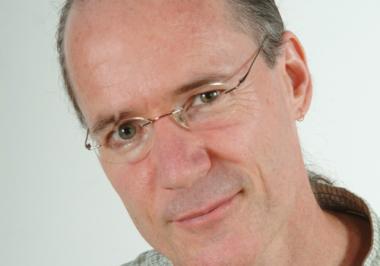
Andrew Lawrence used to be primarily a singer/songwriter, one of that hardy lot armed with only a guitar and a voice. And he's an exceptionally tasteful guitarist with a sure hand and a melodious solo always at the ready. Still, Lawrence decided to put down the solo ax and pursue an unusual musical path that has taken him from being alone on the stage to being the maestro of musical gatherings.
Lawrence leads an instruction group called Community Guitar, and he's a passionate spokesman for the idea of guitar as a connector and a creator of community. He also organizes the yearly Django in June gypsy jazz festival, a highly successful endeavor to tap into a fast-growing guitar-based subculture strongly emphasizing jamming. Community Guitar is a for-profit undertaking, but it's also largely alone in providing for a specific need—lots of people are stuck in basements working away at picking patterns and solo renditions of tunes, but, absent the commitment of joining a band, don't have a ready way to develop interactive playing skills. That's an important thing for the ever-present "jam session" in many a genre, and it's necessary for being a well-rounded and able musician. Lawrence is such a believer in the power of groups of guitarists that he no longer seems to feel a need to pursue his singer/songwriter muse—his compositions these days, he says, are for communal enjoyment, not passive listening. He even penned a birthday song that, he says, has shown up as far afield as New Zealand.
Lawrence first taught guitar at a shop called Appalachian Bluegrass in Baltimore. But he noticed a disconnect. "Here I am teaching one on one, and I'm assuming you're going to be going home and playing by yourself, so I teach you something that's going to sound good by yourself. That's, for the most part, what I had always done too, which is partly why I ended up doing the singer/songwriter thing. I'm at home. I'm working on these elaborate fingerstyle pieces, I'm working up these wordy songs with really rich imagery and yadda yadda yadda—and then I'm contrasting that with what's happening out there. Well, out in the lobby they're not playing those tunes. You can't jam on these tunes. This is not jam music," Lawrence said in a recent Advocate interview.
"Right there I saw what I might not have otherwise been able to see, that one of the critical choices that we have to make—and we have to make it now much more consciously than we ever did before—is, what do I want to do? Do I want to be a solo artist, and do I want to learn material that's basically designed for performance, or do I want to learn community music? Do I want to be a community musician playing with other people and playing primarily music that works well on the fly for participation, not for performance? You can't do everything."
He set out to change how he taught. "If you want to help people learn how to play with other people, you don't do that one-on-one with your teacher. You get together with somebody else at your level and you really start to hear where you're at."
That process reveals different things than an isolated, one-on-one session. "What happens if the person who's backing you up isn't the most solid rhythm player in the world? You're playing rhythm, and what do you do when the person who's playing the lead screws up? You never get a chance to practice that."
That territory required that Lawrence retool his own playing, too. "I started rethinking—what's good jam music, and can I do it?"
He rethought some old solo standbys in the process. "Like 'Deep River Blues'—Doc Watson owns that tune, you know? But the version that we all love is an elaborate, fingerstyle song that is a jam killer," says Lawrence. "What's everybody else supposed to do? If you're playing it well, you've got everything covered. It happens to me fairly regularly—you get together with these guys who are fairly good guitar players, but they've been playing fingerstyle forever, and they've got these Leo Kottke pieces worked up, or they've got their Doc Watson pieces covered up. It's great, but it's also solo guitar work.
"What if we wanted to play 'Deep River Blues' together? What would be a nice simple rhythm that would leave space for other people? What would another rhythm part be that would go with that? And now I'm not doing a fingerstyle solo, so how would I play a single-line solo over this chord progression?"
That way of thinking has taken Lawrence far—Community Guitar (formerly the Acoustic Guitar Network) has become a yet bigger idea. Lawrence has written material for his students that's divided into easily-read parts at different playing levels. The first two levels get students up to speed, and the highest level invites improvisation. He hopes that his way of teaching and his material will spread to other teachers, too.
Lawrence seems to be having a good time fostering the joys of musical interaction rather than solo performance. "If I had to choose, I think right now I personally find I'm more interested in music that gets me playing with other people rather than for other people."
The world of singer/songwriters hasn't ever been particularly easy. "As a performer, basically, you're dealing with booking agents who are completely swamped with performers. They don't need another singer/songwriter," says Lawrence. "Unless you get the winning lottery number this year and you're the guy who gets discovered, or you're just so far above everybody else or whatever, then basically you're dealing with a swamped market. Whereas it's just the opposite with trying to facilitate people getting together to make music.
"You've got tons of people who've taken up guitar at some point in their lives and maybe in high school, maybe in college, they had their buddies to play with, and 10 or 15 or 20 years later they look around and they're like, 'Where's my crew? How do I get plugged in again?' Look at the Advocate—where's the participatory music section? There's a participatory dance section. If you did find the little bit of participatory music that's in your town—there's the occasional jazz jam, which, for your average acoustic guitar player is just way too hard. And only one guitarist at a time is welcomed anyway.
"Celtic jams—how welcoming are they to guitar players? It's a total non-starter for guitar players. [At a blues jam] you get up on stage, you play with a band, play electric, you get one solo—it's more a performance than a jam. Most things are either open mics or they're focused on some kind of genre that's really not all that guitar-friendly. Maybe they want one guitar player banging out chords, and that's it. That's a remarkable thing! Here it is, the most popular instrument on the planet, and try to find a casual way to just go out of an evening and make music with some folks."
It's a readily observed premise, and one that Lawrence has found a particularly entertaining way to address, a sort of "guitar for everybody" approach that goes a long way toward creating the kind of back-porch musical interactions that used to be common.
To find out more about Community Guitar, visit www.communityguitar.com.