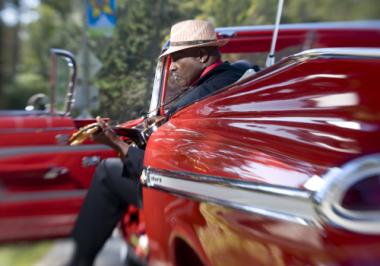
Taj Mahal is surely one of Springfield's finest and best-known exports. His version of blues, with its farflung mix of influences and sounds, is like little else. So is his swampy thunder of baritone. And though she is not as well known here, Taj's sister, Carole Fredericks, who died in 2001, was a much-loved singer in France. Through Nov. 9, the Springfield Museums offer a glimpse of the pair's family, their early years as Springfield residents and their later adventures as big-name musicians. This Thursday, the exhibit comes to life as Taj Mahal throws a shindig on the Quadrangle at the Springfield Museums.
Taj isn't just another musician made good in the usual sense, nor is he just "a blues guy," although his music is often labelled blues. To get a sense of what his restless musical mind is constructing, you have to think globally. It's clear that his starting point is the largely acoustic style dubbed "country blues," but Taj's travels, both literal and musical, add to that basis a pleasing blend of influences so varied it's only vaguely possible to think of it all as blues. He's added everything from African kora to Hawaiian and Caribbean sounds. The result is not merely blues with weird instrumentation, but an endlessly variable style whose common thread is Taj's easy way with melodies wrapped around pleasantly grooving rhythm.
"Blues is a huge American platform for music," said Taj in a recent Advocate interview. "It came from a lot of African ingredients, but the interesting part is that it morphed to be something because of the influences of the English and Irish and Scottish. The syntax is still the frame of the original language, of European poetry, but the subject matter, the pathos and ethos, comes from the experiences of Africans. There's nowhere you can go in the world and not hear it."
Despite years of exploring all kinds of instrumentation (Taj plays a long list of things), these days he's touring with the Taj Mahal Trio, in which he plays guitar and sings and is joined by Kester Smith on drums and Bill Rich on bass. Taj seems perfectly comfortable playing in that sparse setting, in which a guitarist often receives intensified scrutiny and must either switch between rhythm and lead playing or find a more expansive way of employing the instrument.
When asked if it's tougher to play as the only guitarist, Taj said, "It's not tough at all. It's just an older style of playing. & When we had one guitar, when the singer was singing, with rhythm and horns and piano, you changed the figure in the rhythm to support the space where the vocals come out. When there was a sax solo, everybody switched to comping to maintain the soloist who was playing. The singer would pick up a woodblock, or maracas or whatever, and add another kind of support behind the solo. & There was no need for a second guitar.
"Most of the lead men aren't chord men. For instance, in B. B. King's case, he has the band [to play chords]. If I play a [lead] line, something changes in the rhythmic figure so it doesn't leave a hole. We used to talk about that all the time. Somebody would come in and say, 'I'm a lead player.' We'd try to play, and we'd find out the guy didn't know any chords! I've kind of learned my own chords. If you just play standard chords, your music tends to sound standard. I'm not saying I'm against it, if that's the sound you want. But the instrument is always open for development, and the music is too."
Taj has always been an innovator in search of the new, and these days, he's hoping to adjust his travel schedule to allow for some producing of newer bands through his record label. He says that kind of looking forward is possible in part because of his current group. "We're doing really well with the trio," he said. "We're in a position where the recording industry is pushing their weight around and taking what they want. But we own this whole thing outright. We want to make a real deal, not this stuff they drop on you because you're coming to them [for what to listen to]—that's why the music gets choked up.
"It used to be exciting. Hair would stand up on the back of your neck. Now it's business as usual. That's what drove me deeper. People came along like Howlin' Wolf… next thing you know, there was a whole lot of copying," says Taj. "Years later, they go back to the sounds. Everybody was leaving that great music behind. Why? In an effort to be modern? I wasn't going to do that."
Decades later, Taj's dedication to the innovators of American blues has led him to discoveries of his own, and to a musical style that seems at once rooted and global. There's really nothing else quite like it in American music.
Taj sums it up this way: "It's quite an outcome for a kid who used to lie in bed and dream about putting together a band with musicians from all over the diaspora."
If you visit the Springfield exhibit, you can discover more about Taj's sister, Carole Fredericks, and her own remarkable musical journey.
Taj didn't realize at first that his sister also had big aspirations. "If you look at her Classical High School yearbook, she said, 'I'm going to have the best blues band in the world.' I knew my sister had a good voice, but the first time I got an idea of what was going on was when I came back after going to California. She was off doing something. I stayed in her room—it was completely pasted up with the Beatles!" Taj says.
"She came on out to California and stayed with me. She was singing somewhere in wine country. These two guys heard her. They said, 'This place will not give you the credit you deserve as a singer. You should go to France.' They got her a ticket to go and she went, knowing nobody. That's the same kind of experience my grandfathers had—one in the South and one in the Caribbean."
When Taj visited his sister in France later, he was surprised at just how big a name she was. "It was like I was with Madonna and I was her bodyguard. & I was thrilled for her. She shared her love with a lot of people. She carried it well," says Taj.
"You know, Jim Morrison got buried in Montmartre, and later they moved him. My sister is buried in Montmartre, but she will never be moved."
The Taj Mahal Trio play Aug. 1 at 7 p.m. at the Springfield Museums Quadrangle. Tickets can be purchased by calling the Northampton Box Office at (413) 586-8686.