
By Carolyn Brown
For the Valley Advocate
On a recent Saturday morning in Florence, two friends were arguing over who would be the first to hug the other.
“I’m gonna hug you, bro!” said Aaron Cantor.
“I’m gonna hug you, bro!” said Joseph Goldin.
The friends were gathered at the Hidden Temple — an event space on the third floor of the Brushworks Arts & Industry building in Florence — with a group of about two dozen adults and children as part of Cantor’s Playfighting class. Rather than engendering competition or the high-impact contact of boxing, Cantor uses games rooted in movement and resistance. His goal is to help students be active, build strength and shed inhibitions while tapping into their primal instincts.
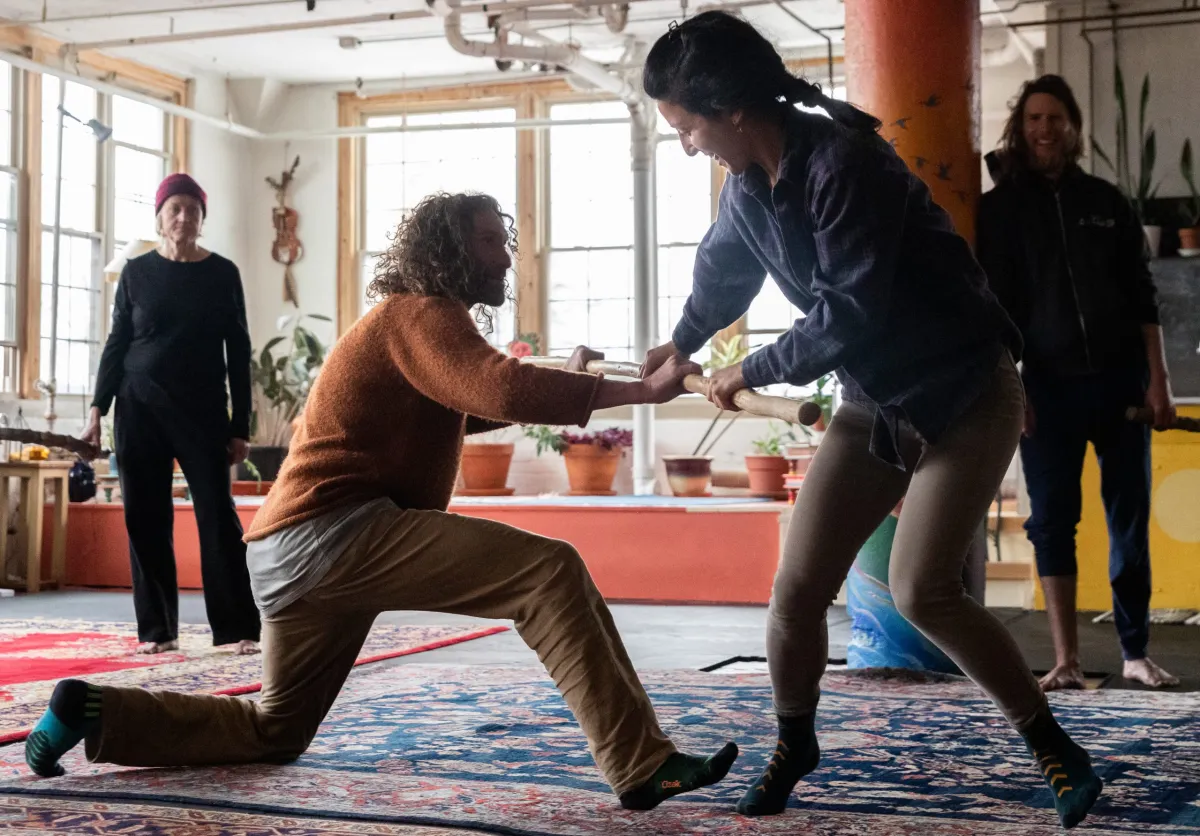
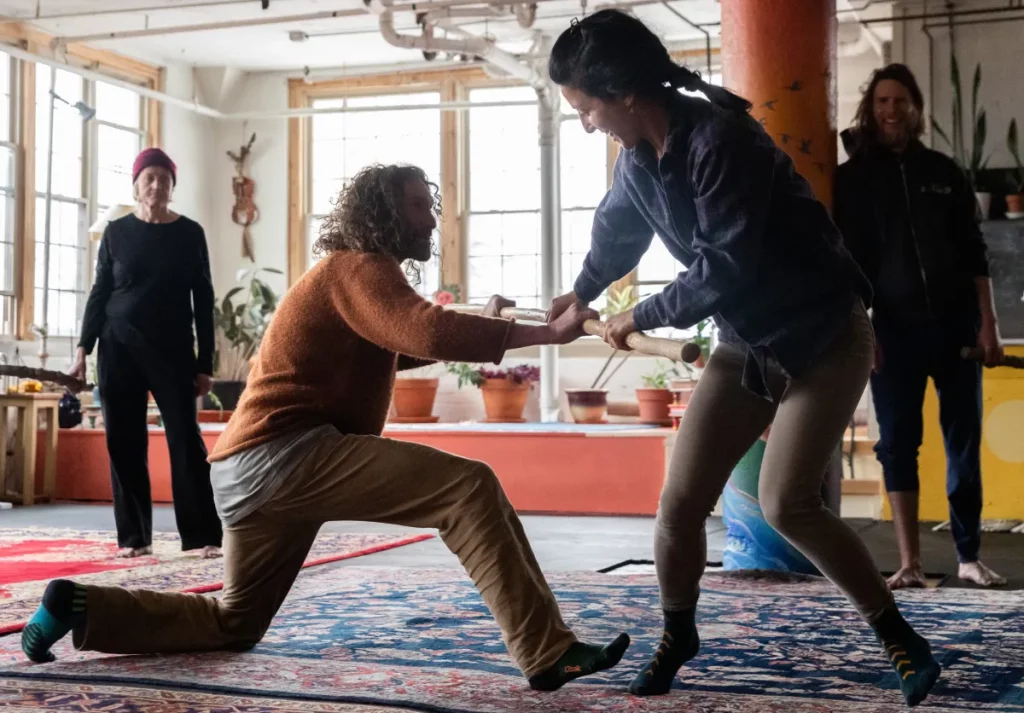
Aaron Cantor, left, takes part in an exercise with Funda Gul in which each participant has to try to move the other person’s feet. “This is not a strength game; it’s a subtlety game,” Cantor said. “It’s also not a speed game. I’m not trying to yank the stick away from my partner. You want to stay connected and figure out how to move each other.” / CAROLYN BROWN / Staff Photo
“I think there’s a craving in our modern life for physical engagement,” Cantor said. “Not necessarily touch, but being more physically engaged in a way that isn’t mechanical [and] job-oriented,” like a repetitive workout in a gym.
He explained that playfighting is “a holistic way to learn a lot of very practical things about how to handle yourself and how to relax and how to stay calm and how to use your strength and your structure.”
The morning began with some warmups, which included crawling, rolling around and a full-body shake. Afterward, Cantor asked everyone to grab a partner for a simple game: one person pushed their partner’s shoulders while the other resisted. They moved together like a playful tango to the opposite side of the room, then switched.
Paul Vidich, left, and Flynn Bryan take part in a game at a playfighting class on Saturday, March 14, 2026 at the Hidden Temple in Florence. / CAROLYN BROWN / Staff Photo
The next game added an animalistic twist: while one partner resisted, the other crawled on hands and knees, pushing against them with their head.
“We’re animals, and I think [day-to-day] most people are holding back all of their physicality,” Goldin said. “[With Playfighting,] I can just push into someone and connect with them on a different level than if I were to just have a conversation at a coffee shop, which I think is boring.”
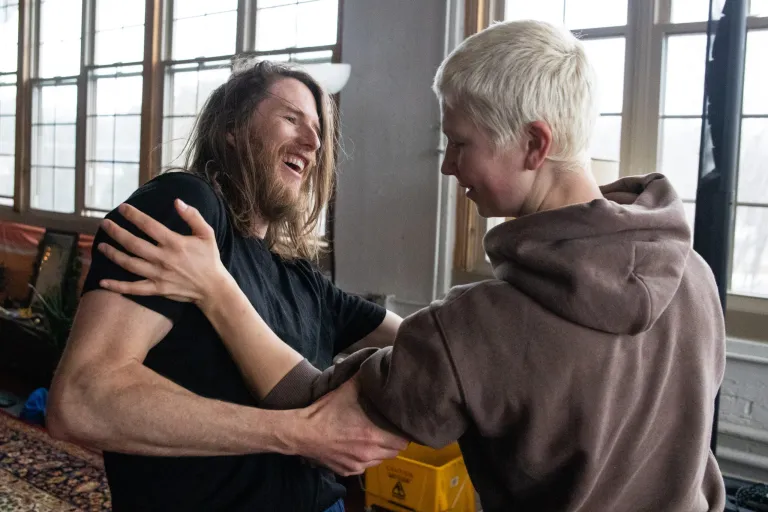
Other games focused on resistance and agility. In one, partners tried to tag each other’s shoulders or knees while avoiding being touched themselves. In another, each partner would try to hug the other from behind, first while wrestling, then while standing up. They also took turns trying to stand up against a partner’s weight. And both partners also used a large stick in a game of balance, attempting to shift their opponent’s feet without moving their own.
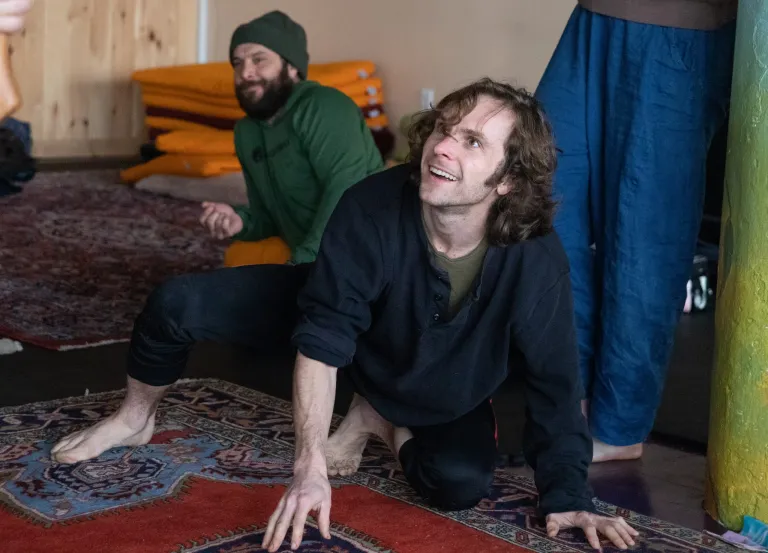
Brett Roche, center, prepares to head into the center of a circle as part of a game in which participants have to sneak up on those in the middle. / CAROLYN BROWN / Staff Photo
“This is not a strength game; it’s a subtlety game,” Cantor told the group. “It’s also not a speed game. I’m not trying to yank the stick away from my partner. You want to stay connected and figure out how to move each other.”
“Is it cheating to change my grip?” one person asked.
“No, you can move your hands around,” he said. “Try not to let go of the stick, because then there’s no game. There’s no connection.”
Participant Brett Roche, whose background includes wrestling and dance, said that for him, fighting “has always been a way of connecting with folks. It’s my way of playing.”
Before he met Cantor, “I hadn’t found anyone that was able to communicate and teach and open people to a way of adversarial play. Very early on, Aaron was the first person to tell me that the word ‘competition’ or ‘competitor’ meant ‘those with whom you strive,’ which always felt like my relationship to competition, which was, I don’t actually want to hurt you. But I kind of want to [expletive]-talk a little bit, because I want to be like, ‘You’re stronger,’ and then we get to meet each other and get stronger together,” Roche said.
As Roche sees it, a game in a context like this class is an entertaining and useful cover for its real purpose.
“It’s like a magician’s trick — ‘Look over here!’” he said, gesturing. “But actually, what you’re doing is, you’re engaging with each other. You’re meeting your own body again. You’re meeting each other.”
Cantor makes a living as “a body person,” as he calls it. Cantor grew up abroad — first in Japan, for five years, then in Brazil for 10. “I would wrestle all the time [as a kid],” he said. “I would just go to playgrounds and wrestle and dance and play.”
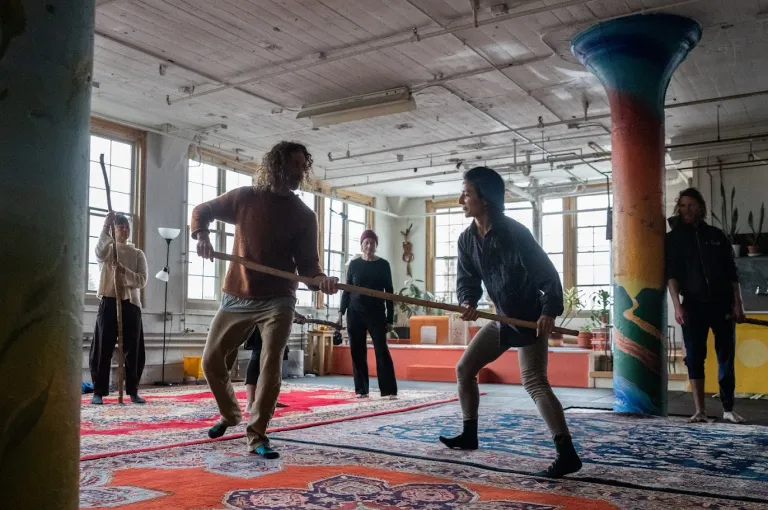
At the Hidden Temple, an event space on the third floor of the Brushworks Arts & Industry building, Aaron Cantor, second from left, teaches a class on “playfighting” on Saturdays from 9:30 to 11 a.m. His goal with the class isn’t to engender competition or to use types of hardcore physical contact (like boxing, for example) that could cause injury – rather, he uses games that involve movement, contact, and resistance to help people build strength, be active, release inhibitions, and tap into their primal instincts. / CAROLYN BROWN / Staff Photo
Cantor went on to train as a physical therapist and worked as a yoga teacher for a while, which was “awesome, and calmed me down when I was doing it, and calmed me down for a few hours afterwards,” he said. “But the stress of traffic and interactions and life would rile me up, and I was like, ‘Okay, I need to find a way to train to be calmer in situations that stress me out, so I can practice that.’”
He began introducing games into his yoga classes — having students push each other with rolled-up mats or hop between yoga blocks. Though the Playfighting classes at the Hidden Temple only launched a few months ago, Cantor developed the game-playing methodology over about 15 years. “I found that games were such a good, engaging way to get people to do things that they would feel inhibited about doing if you explained it to them,” he said.
“I’ve done this in corporate events with buttoned-up people who [only] handshake,” he said. “And by the end of the session, they’re rolling around on each other, lifting each other up, laughing, bear-hugging.”
To Cantor, playfighting isn’t just good for personal development — it’s hardwired in everyone.
“Evolutionarily, all mammals wrestle. That’s how they learn not only how to protect themselves and how to hunt, but it’s also pro-social — you learn to take care of your brother by not killing him while you’re practicing,” he said. “And male animals do that. Female animals do it. It’s just something that all animals do, so I think it’s such a natural way to get strong, get flexible.”
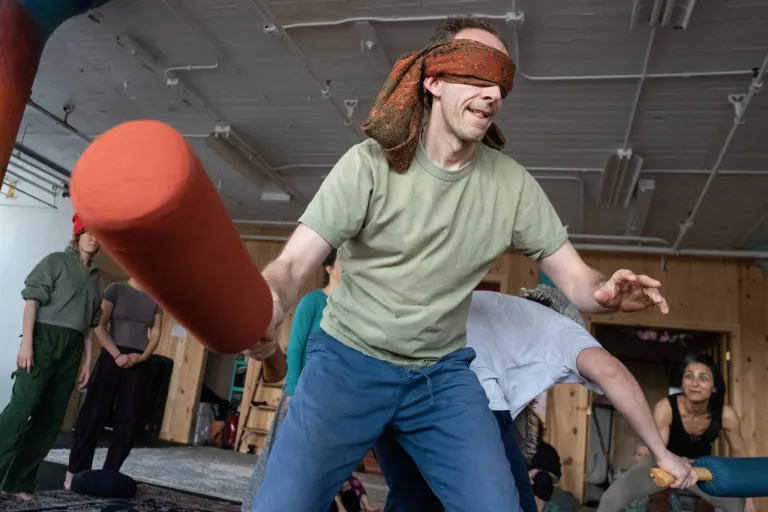
In the last game, the whole group gathered into a circle. One person — then two, in later rounds, standing back to back — would stand in the middle, blindfolded with a scarf and armed with a cushioned baton that resembled a large corn dog. The goal was for the other participants to try to touch them and get back into the circle without getting hit, silently.
Participants snuck on tiptoe, bolted across the circle and army-crawled through the center person’s legs. Every so often, the baton would find its mark, like a game of piñata in reverse. It wasn’t long before the pace quickened and the intensity rose — all in the spirit of lighthearted fun.
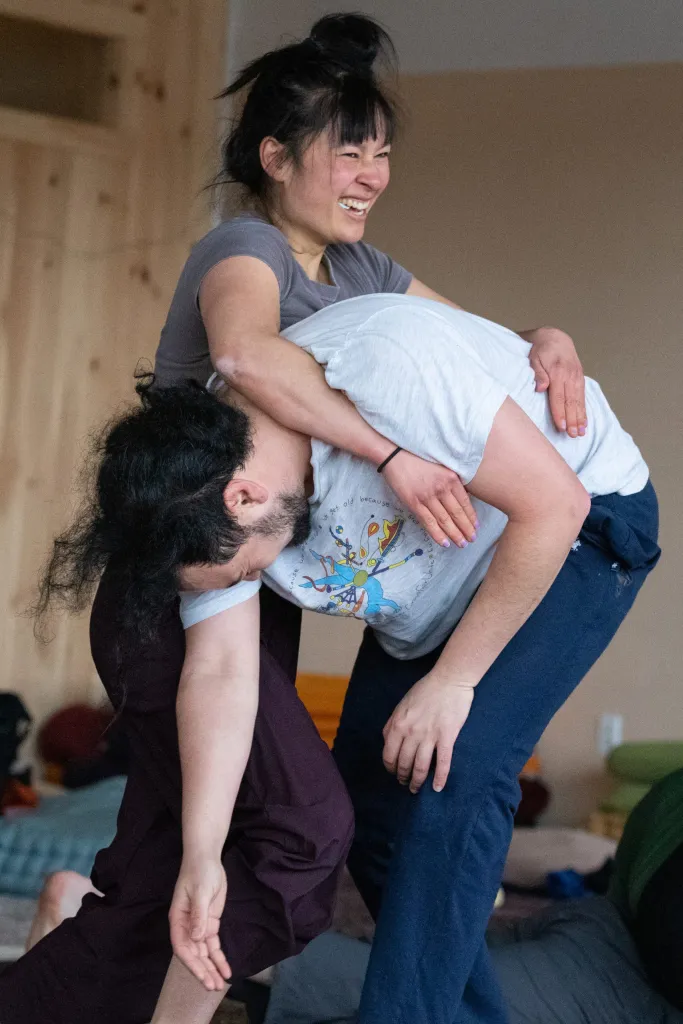
Zoe Weizenbaum, above, plays a game with Joseph Goldin. / CAROLYN BROWN / Staff Photo
Cantor’s ultimate goal with the playfighting classes, he said, is to “create a space where people can develop really healthy, strong, resilient, springy body-minds. To put all the gyms out of business. And really to create a more playful, healthy world.”
“I’d love to see this in schools. I’d love to see this in companies,” he added. “It’d be amazing if Congress just took a break and they all wrestled.”
Each playfighting class is $20 to $30 per person or free for Hidden Temple members. For more information about the Hidden Temple, visit hiddentemple.org.